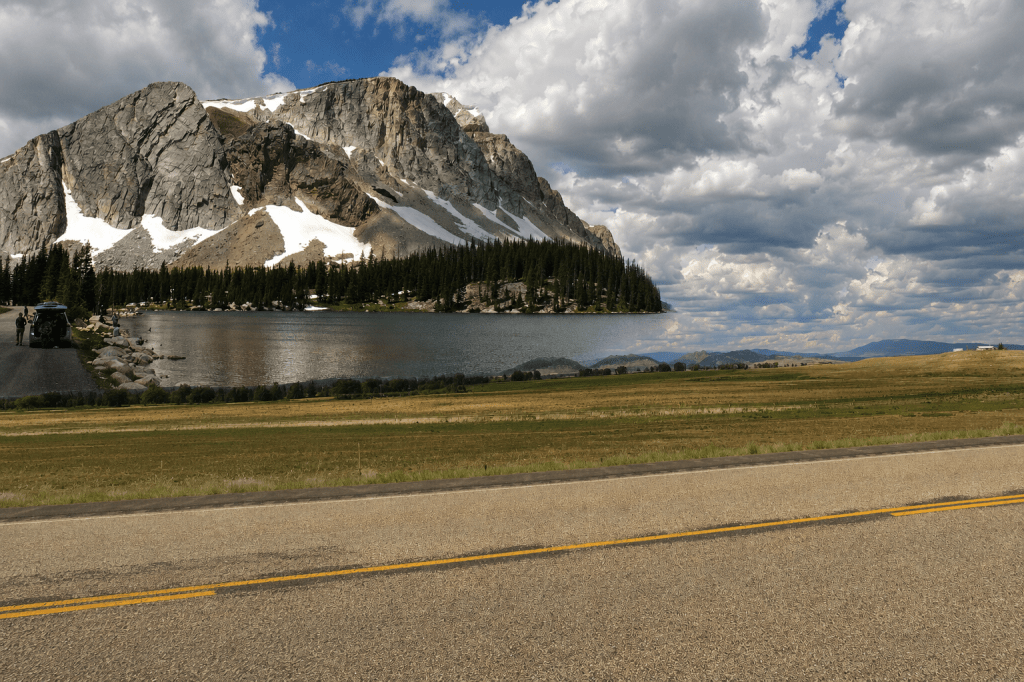
Last summer, while driving through Wyoming and Colorado, I noticed something that challenged an assumption I’d carried for years.
The valleys weren’t the difficult part of the journey.
They were broad. Open. In many places, I could see for miles. The roads were relatively gentle, and obstacles could often be spotted long before I reached them.
It was the mountains that demanded my full attention.
The road narrowed.
The next curve disappeared from view.
The drop-offs became steeper.
The weather changed without warning.
Every mile required a little more caution than the last.
As I drove, a question quietly settled into my mind.
Have we, as Christians, oversimplified the Bible’s language about mountains and valleys?
For years, I’ve heard people describe difficult seasons as “walking through the valley” and victorious seasons as “standing on the mountaintop.” There is certainly biblical truth behind those expressions. After all, David wrote of walking through “the valley of the shadow of death,” and mountains are often places where God revealed Himself in extraordinary ways.
But Scripture paints a richer picture than our clichés sometimes allow.
Not every valley in the Bible is a place of despair.
Some valleys are fertile.
Some are filled with rivers.
Some become places where battles are fought and won.
Some are where people build homes, raise families, and experience God’s daily provision.
Likewise, not every mountain represents ease or triumph.
Abraham climbed Mount Moriah carrying the wood for Isaac’s sacrifice.
Moses climbed Mount Sinai into God’s presence.
Elijah climbed Mount Carmel to confront hundreds of false prophets.
Each ascent required obedience before it brought revelation.
Then I thought about Lot.
When Abraham gave him first choice, Lot looked toward the well-watered plain of the Jordan. It seemed like the obvious decision. Fertile land. Prosperity. Opportunity. Yet that same plain led him toward Sodom. The problem wasn’t that Lot chose a valley. The problem was that he chose by sight instead of by faith.
The geography wasn’t the lesson.
His heart was.
Perhaps that’s where we sometimes miss the point.
We become so focused on whether we’re living in a “valley” or standing on a “mountain” that we forget the Bible never asks us to put our confidence in the terrain.
It asks us to trust the One who leads us through it.
Sometimes God meets us on the mountain.
Sometimes He restores us beside still waters in the valley.
Sometimes He calls us to climb.
Sometimes He calls us to descend.
Peter wanted to remain on the mountain after witnessing Christ’s glory, but Jesus led him back down because ministry was waiting below.
Mountaintops are often places of revelation.
Valleys are often places where that revelation is lived out.
Looking back, I realized the most dangerous part of my drive wasn’t the open valley stretching before me.
It was the climb where I couldn’t see what lay around the next bend.
Yet that’s also where I became most attentive.
I slowed down.
I watched more carefully.
I depended less on myself.
Maybe that’s exactly why God sometimes leads us into seasons where we can’t see very far ahead.
Not because He has abandoned us…
But because faith grows best when we learn to trust the Guide more than the map.
The older I get, the less interested I am in labeling every season of life as either a mountain or a valley.
Instead, I’m learning to ask a different question.
Where is God leading me today?
Because whether the road winds through fertile plains, shadowed ravines, or steep mountain passes, His presence has always mattered far more than the landscape.
⸻
Final Word
We spend a lot of time asking whether we’re on the mountaintop or in the valley.
Scripture asks a different question.
Are you following the Shepherd?
The terrain will change.
Some days will be wide, open valleys filled with quiet provision.
Others will be steep climbs where every step requires faith.
Neither place defines your relationship with God.
His presence does.
So don’t place your hope in reaching easier ground.
Place it in the One who never leaves the path.


