Scripture Focus: Jonah 1–4
“Now the word of the LORD came unto Jonah the son of Amittai, saying, Arise, go to Nineveh, that great city, and cry against it…”
— Jonah 1:1–2
Jonah knew exactly what God had said.
There was no confusion about the calling. No uncertainty about the destination. No need to pray about it for another week and ask God for confirmation.
God had spoken.
“Arise, go to Nineveh.”
Jonah arose.
And went the other direction.
“But Jonah rose up to flee unto Tarshish from the presence of the LORD…”
Those two verses establish the conflict of the entire book. God said Nineveh. Jonah chose Tarshish.
It would be easy to reduce Jonah’s story to a simple lesson about obedience: God told Jonah to do something, Jonah refused, God sent a fish, Jonah changed his mind, and eventually Jonah obeyed.
But Jonah is far more complicated than that.
So are we.
Jonah knew God. He was a prophet. He had heard the voice of God and had been used by God before. His problem wasn’t that he didn’t know what God wanted.
His problem was that he didn’t want what God wanted.
And there is a world of difference between the two.
The Fare to Tarshish
Jonah went down to Joppa and found exactly what he was looking for—a ship headed toward Tarshish.
That must have seemed convenient.
Think about that for a moment.
Jonah was running from God, arrived at the port, and there happened to be a ship going exactly where he wanted to go.
We sometimes make the mistake of believing that an open door must mean God approves of the direction we are taking.
Not necessarily.
Sometimes there is a ship to Tarshish.
Jonah found one.
Then Scripture includes a small detail that is easy to overlook:
“He paid the fare thereof.”
Jonah had to pay for passage in the wrong direction.
Running from God cost Jonah something before the storm ever arrived.
Disobedience always has a fare.
Sometimes we pay it in time.
Sometimes in peace.
Sometimes in relationships.
Sometimes in opportunities.
Sometimes in years we can never recover.
We spend enormous amounts of energy trying to maintain a journey God never told us to take.
Jonah bought passage to Tarshish, but he could not purchase distance from God.
He could leave Israel.
He could sail across the Mediterranean.
He could surround himself with people who knew nothing about his calling.
But there was nowhere Jonah could go where God ceased to be God.
Jonah discovered something David had written about long before:
“Whither shall I go from thy spirit? or whither shall I flee from thy presence?”
The answer is nowhere.
Jonah could run.
God could follow.
But the LORD
Jonah found his ship.
“But the LORD sent out a great wind into the sea.”
There is that word:
But.
Jonah had made his plans.
But the LORD.
Jonah had purchased his ticket.
But the LORD.
Jonah had boarded the ship.
But the LORD.
Jonah was headed toward Tarshish.
But the LORD.
The storm was not evidence that God had abandoned Jonah.
It was evidence that God had not.
That distinction matters.
Not every storm in life is caused by disobedience. Scripture gives us far too many examples of righteous people suffering to make such a careless claim. Job suffered without Jonah’s rebellion. Paul encountered storms while obeying God. Jesus Himself sent His disciples across the Sea of Galilee, where they encountered a storm while doing exactly what He had told them to do.
We should never look at someone struggling and automatically assume, “They must have disobeyed God.”
But Jonah knew why this storm had come.
He was running.
And God loved him too much to simply wave goodbye from the shoreline.
Sleeping Through the Storm
The storm became so violent that experienced sailors became afraid.
These were not men unfamiliar with the sea. Storms were part of their lives.
Yet this one frightened them.
They began throwing cargo overboard to lighten the ship.
Then they began praying.
“Every man unto his god.”
Everybody aboard that ship seemed to understand that something serious was happening.
Everybody except Jonah.
Jonah was below deck.
Asleep.
The prophet of God was sleeping while pagan sailors were praying.
There is an uncomfortable picture there.
Jonah had become so settled into his disobedience that he could sleep while the consequences raged around him.
Isn’t that sometimes how we become?
At first, running from God bothers us.
Our conscience speaks.
The Spirit convicts.
Something inside us knows we are moving in the wrong direction.
But if we continue long enough, we can become comfortable somewhere we never should have been comfortable.
We can sleep on the way to Tarshish.
We can become spiritually numb while storms rage around us.
I know.
I’ve been there.
There have been times when I knew what God had said and still thought I knew better. Times when I stepped away, pulled back, resisted, or tried to convince myself that another direction would be easier.
The frightening part isn’t always the running.
Sometimes it is how comfortable we can eventually become while running.
Everyone on the Ship Paid
The sailors eventually cast lots to determine who was responsible for the calamity.
The lot fell on Jonah.
Suddenly the questions came.
Who are you?
Where are you from?
What do you do?
What people do you belong to?
Jonah answered:
“I am an Hebrew; and I fear the LORD, the God of heaven, which hath made the sea and the dry land.”
His theology was correct.
His life was contradicting it.
Jonah claimed to fear the God who made the sea while using that very sea to run from Him.
The sailors recognized the contradiction.
Verse 10 tells us Jonah had explained that he was fleeing from the presence of the LORD.
Their response was essentially:
Why would you do this?
And by this point, Jonah was no longer the only one suffering because of his decision.
That deserves our attention.
Our disobedience rarely affects only us.
The sailors didn’t choose Jonah’s rebellion.
They didn’t hear God’s command and reject it.
They were simply on the same boat with the man who did.
Yet their lives were endangered.
Their cargo was lost.
Their journey was interrupted.
They experienced fear they never would have experienced had Jonah obeyed God.
That is a serious warning for anyone who says:
“My decisions are between me and God.”
Not always.
Sometimes our families ride on the ship with us.
Our children.
Our spouses.
Our churches.
Our friends.
The people we are supposed to be ministering to.
The people who depend on us.
The people who simply happen to be close enough to experience the consequences of our decisions.
Jonah bought one ticket, but an entire ship entered the storm.
Sin loves to tell us that our choices are private.
They rarely remain that way.
Throw Me Overboard
Eventually Jonah admitted what had to happen.
“Take me up, and cast me forth into the sea; so shall the sea be calm unto you.”
Interestingly, the sailors initially refused.
They rowed harder.
They tried desperately to reach land.
These men, who had every reason to be angry with Jonah, still attempted to save him.
But they couldn’t.
Finally, after crying out to the LORD, they threw Jonah overboard.
Immediately the sea became calm.
And something remarkable happened.
The sailors who began the chapter crying out to their own gods ended the episode fearing the LORD.
“They feared the LORD exceedingly, and offered a sacrifice unto the LORD, and made vows.”
Even in Jonah’s rebellion, God revealed Himself to people who had not known Him.
That does not excuse Jonah’s disobedience.
But it does reveal something extraordinary about God.
God is capable of working redemptively even in situations created by our failures.
He does not need our mistakes.
He does not approve of our rebellion.
But neither is He defeated by them.
God can take the wreckage of human disobedience and still reveal Himself in the middle of it.
Then Jonah disappeared beneath the waves.
And for the first time in the story, there was nothing Jonah could do.
No ship.
No fare.
No destination.
No plan.
No escape.
He could not sail himself out.
He could not bargain his way out.
He could not swim his way out.
Jonah had finally reached a place where he could not save himself.
And God was already there.
God Had Prepared a Fish
“Now the LORD had prepared a great fish to swallow up Jonah.”
Most of us grew up thinking the fish was Jonah’s punishment.
Look again.
Jonah was drowning.
The fish kept him alive.
The storm confronted Jonah.
The sea broke Jonah’s illusion of control.
But the fish preserved him.
The fish was not God saying:
“Now I’ve got you.”
It was God saying:
“I’m not finished with you.”
What looked like the worst possible thing that could happen to Jonah was actually God’s provision for him.
Imagine Jonah sinking beneath the surface.
The ship growing distant above him.
The light disappearing.
His strength failing.
There was no human possibility of rescue.
And then came the fish.
Not how Jonah would have designed salvation.
Certainly not comfortable.
Definitely not pleasant.
But effective.
Sometimes God’s rescue does not look like rescue when it first arrives.
Sometimes it looks like an interruption.
A closed door.
A consequence.
A season we never would have chosen.
Something gets removed.
Something collapses.
Something we depended upon disappears.
And in the moment, all we can see is the fish.
Only later do we understand:
That wasn’t God destroying me.
That was God refusing to let me drown.
From the Belly of the Fish
Jonah finally prayed.
Not from a temple.
Not from Jerusalem.
Not standing confidently before a congregation.
From the belly of a fish.
There are prayers we pray when we still believe we can fix everything ourselves.
Then there are prayers we pray when every other option is gone.
Jonah remembered God.
He acknowledged his helplessness.
He recognized that salvation belonged to the LORD.
And God spoke to the fish.
Jonah was deposited onto dry land.
Wet.
Humbled.
Probably smelling worse than any prophet in Israel.
But alive.
Then Jonah 3 begins with one of the most beautiful statements in the book:
“And the word of the LORD came unto Jonah the second time.”
The second time.
God could have found another prophet.
He could have replaced Jonah.
Jonah had openly rebelled against a direct command from God.
He ran.
He endangered others.
He resisted.
He failed.
Yet after the storm, after the sea, after the fish, God spoke to Jonah again.
The calling survived the failure.
“Arise, go unto Nineveh.”
Almost exactly what God had said the first time.
God had not changed the assignment.
He had been working on the messenger.
And this time Jonah went.
The Runaway Preaches to Runaways
Jonah entered Nineveh and proclaimed the warning God had given him.
And Nineveh responded.
The people believed God.
They fasted.
They repented.
Even the king humbled himself.
And God saw their response and withheld the destruction He had warned them about.
That should have been the triumphant ending.
The runaway prophet had been restored.
The wicked city had repented.
Thousands had been spared.
Everyone should have been celebrating.
Except Jonah.
Jonah was angry.
And now we finally learn why he ran.
It wasn’t because he was afraid to preach.
It wasn’t because he doubted God’s power.
Jonah ran because he knew God’s character.
He told God:
“I knew that thou art a gracious God, and merciful, slow to anger, and of great kindness…”
There is the great irony of Jonah.
Jonah wanted mercy for Jonah but judgment for Nineveh.
He was grateful for the fish when he was drowning.
He was angry about grace when Nineveh needed it.
He celebrated the mercy that saved the prophet but resented the mercy that saved the city.
And suddenly the story turns the mirror toward us again.
How easily we receive grace while deciding who else deserves it.
We thank God for forgiving our failures while remembering someone else’s.
We rejoice that God pursued us while secretly wishing He would punish those who hurt us.
We sing about amazing grace until grace becomes amazing for someone we don’t think deserves it.
Jonah had learned that God would pursue a runaway prophet.
Now he had to learn that God would also pursue a wicked city.
The God Who Pursues
That may be the deepest message of Jonah.
Everyone is running from something.
Jonah ran from Nineveh.
Nineveh had run far from righteousness.
Even after obeying, Jonah still struggled with his own heart.
Yet God kept pursuing.
He pursued Jonah with a storm.
He pursued the sailors through Jonah’s failure.
He pursued Jonah beneath the waves.
He pursued Nineveh through preaching.
And in chapter 4, He was still pursuing Jonah through a plant, a worm, a hot east wind, and a conversation.
The book ends without telling us how Jonah responded.
God asks:
“Should not I spare Nineveh…?”
And then the story stops.
No recorded answer from Jonah.
Perhaps that is intentional.
Because eventually the question stops being about Jonah.
It becomes a question for us.
Do we believe God has the right to show mercy to people we would rather condemn?
Can we celebrate redemption when the person being redeemed is someone we believe deserves judgment?
Can we trust God enough to go where He sends us, even when we do not understand—or even like—what He intends to do there?
And when we are the ones running, can we believe His pursuit is not always anger?
Sometimes the storm is mercy.
Sometimes the interruption is mercy.
Sometimes the fish is mercy.
Sometimes the second chance is mercy.
Jonah ran.
God followed.
Into Joppa.
Onto the sea.
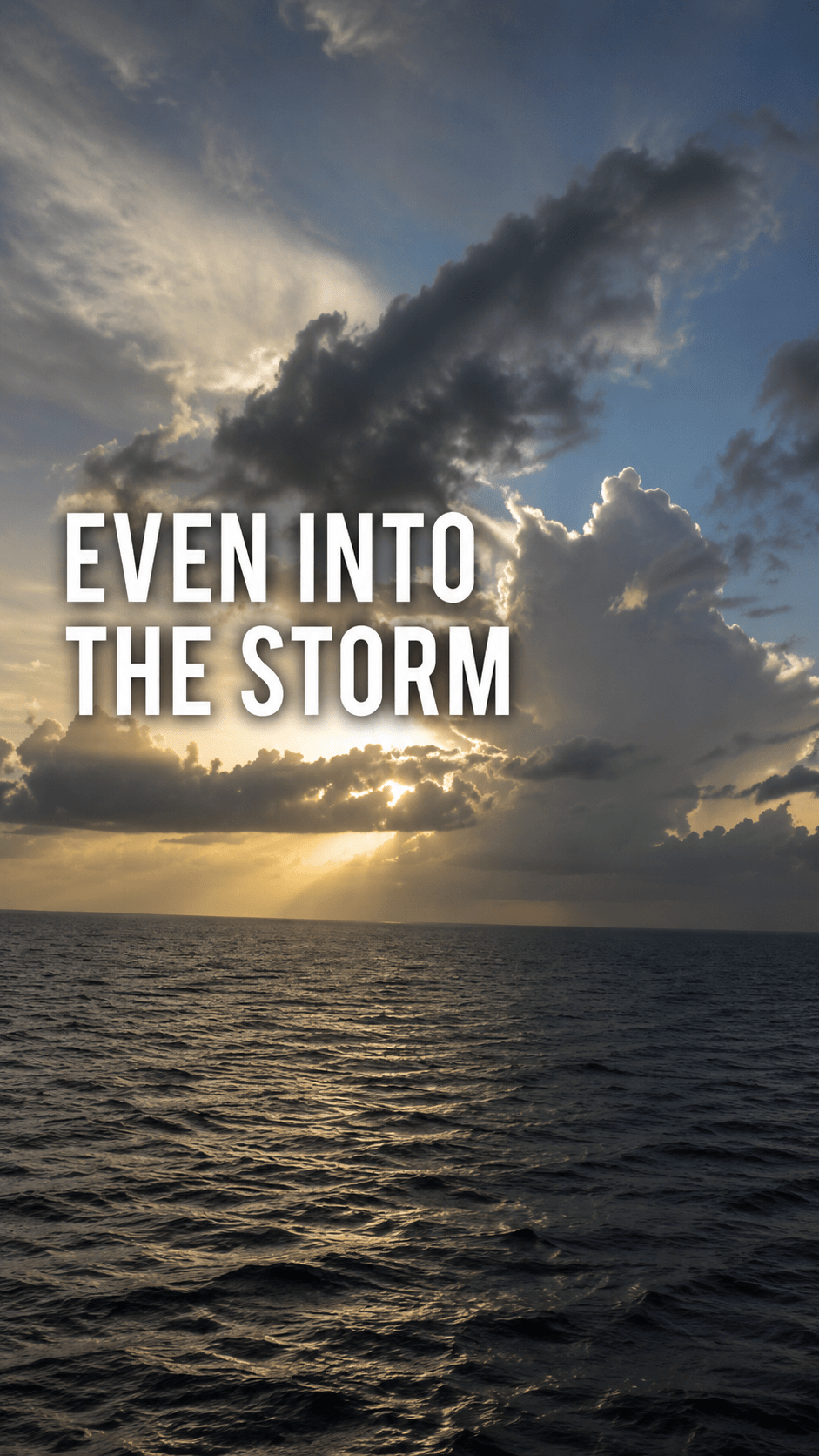
Into the storm.
Beneath the waves.
All the way to Nineveh.
Jonah discovered that there is no distance far enough, no sea wide enough, no failure deep enough to place a person beyond the reach of God.
His disobedience had consequences.
His rebellion affected innocent people.
His failure was real.
But his failure did not get the final word.
God did.
And when Jonah finally reached the place where he could no longer save himself, God had already prepared what he needed.
The fish wasn’t revenge.
It was rescue.
The storm wasn’t the end.
It became the road back.
And the God Jonah was desperately trying to escape turned out to be the only One who could save him.
Jonah ran.
God pursued.
Jonah sank.
God provided.
Jonah failed.
God spoke a second time.
That is more than the story of a runaway prophet.
That is redemption.