Tag: David

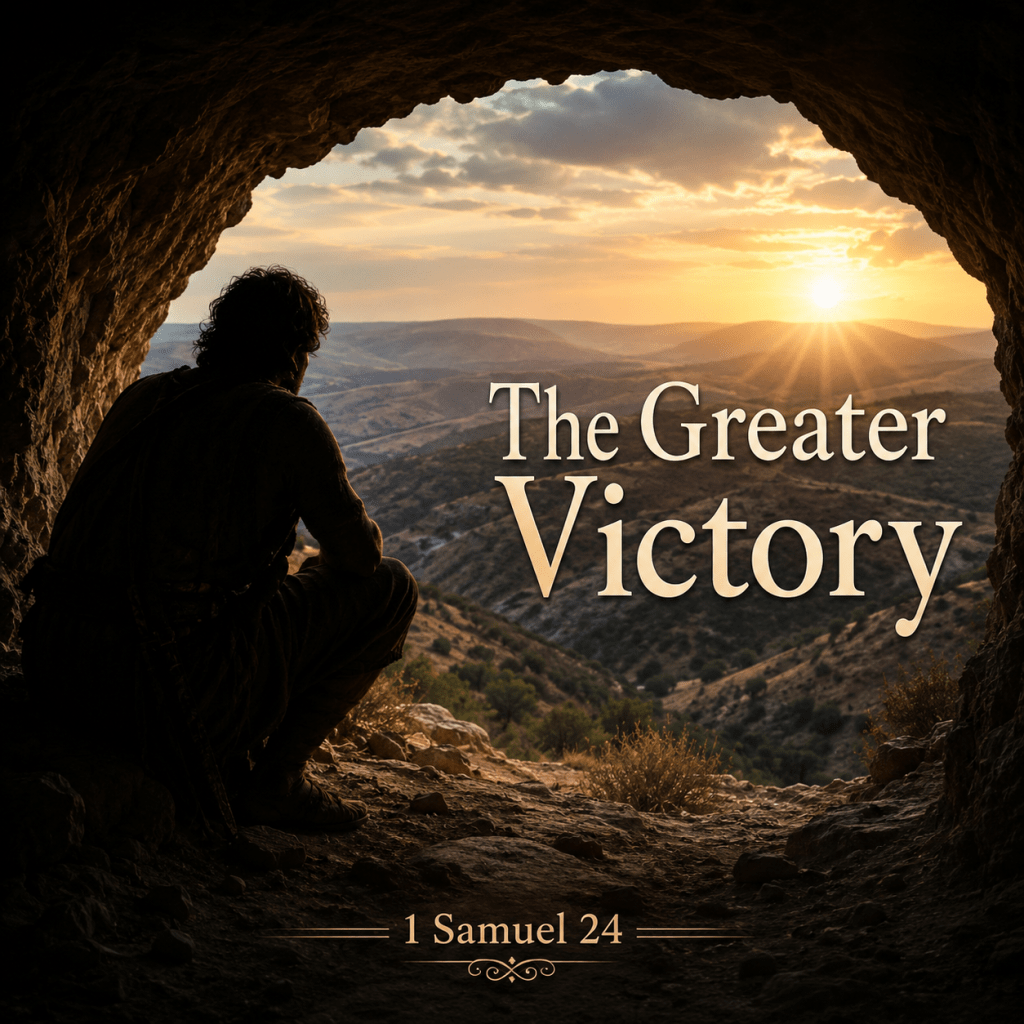
  • The Greater Victory

    The Greater Victory

    Scripture: 1 Samuel 24:1–12

    When most people think about David’s greatest victory, they immediately think of Goliath.

    It’s understandable.

    A shepherd boy walks onto a battlefield with nothing but a sling and five smooth stones. One giant falls, an army flees, and a nation celebrates.

    It is one of the greatest stories in all of Scripture.

    But I’m no longer convinced that was David’s greatest victory.

    This week has been filled with thoughts about David.

    First, Nathan confronting him.

    Then Psalm 51.

    Then, on the drive home Tuesday, Lisa read me something she had found on Facebook.

    It simply said that David’s greatest victory wasn’t defeating Goliath.

    It was sparing Saul.

    I asked her to read it again.

    Then I asked her to send it to me.

    The more I’ve reflected on it…

    The more I think there is profound truth in that statement.

    Not because Saul deserved mercy.

    But because David had become the kind of man who trusted God enough to show it.

    At first glance, it almost feels like we’re going backward in David’s story.

    After all, the cave came long before Bathsheba.

    Long before Nathan.

    Long before Psalm 51.

    But perhaps that’s exactly why this passage matters.

    Earlier this week we saw what a heart after God’s own heart looks like when it fails.

    Today we see what that same heart looked like before it failed.

    The setting couldn’t have been more dramatic.

    Saul had spent years hunting David.
    David had done nothing to deserve it.

    He had served Saul faithfully.
    He had fought Israel’s enemies.
    He had married Saul’s daughter.

    Yet now he was living as a fugitive.

    Then the opportunity came.

    Saul unknowingly entered the very cave where David and his men were hiding.

    David’s companions could hardly believe it.

    “This is the day the LORD spoke about!”

    To them, this wasn’t merely an opportunity.

    It was providence.

    David could finally take the throne God had already promised him.

    No more running.
    No more hiding.
    No more caves.

    He quietly crept toward Saul.

    Sword in hand.

    Then…

    He stopped.

    Instead of taking Saul’s life, he cut off a corner of Saul’s robe.

    Even then, Scripture says something remarkable.

    “David’s heart smote him…” (1 Samuel 24:5)

    That verse has always fascinated me.

    David wasn’t convicted after killing Saul.

    He was convicted after cutting a piece of cloth.

    Why?

    Because David understood something his men did not.

    The robe represented the office God had established.

    Saul may have failed as king.
    God had already rejected him.
    Samuel had already confronted him.

    But David understood that judgment belonged to God.

    Not to him.

    So David declared:

    “The LORD forbid that I should do this thing unto my master, the LORD’S anointed…”

    Those words have often been misunderstood.

    Some have used them to suggest that spiritual leaders should never be questioned or held accountable.

    But that’s not what David was saying.

    Saul had already been confronted.
    He had already been rebuked.
    He had already been judged by God.

    David simply refused to seize for himself what only God had the right to give.

    He would wait.
    Even when waiting hurt.
    Even when the opportunity seemed perfect.
    Even when everyone around him insisted this must be God’s will.

    God’s promises will never require us to abandon His principles.

    All too often we see an opportunity and immediately assume God has opened the door.

    But when we dig beneath the surface, we sometimes discover that walking through that door would require us to compromise the very principles God has already made clear in His Word.

    David refused to do that.

    He understood that God’s promise of the throne did not give him permission to violate God’s character in order to obtain it.

    Sometimes the greatest act of faith is walking away from something you have every human reason to take, because you trust that God’s way is always better than your own shortcut.

    As I’ve reflected on David’s life these past several weeks, one thought continues to surface.

    God wasn’t merely preparing David to wear a crown.
    He was preparing him to carry one.

    Anyone can display courage when facing a giant.

    It takes a very different kind of strength to lay down your sword when facing an enemy.

    Goliath tested David’s courage.
    Saul tested David’s character.

    One victory won Israel’s applause.
    The other revealed the heart God had been forming all along.

    Final Word

    David eventually became king.

    Not because he took the throne when he had the chance…

    But because he trusted God enough to wait until God placed him there.

    There are moments in life when we could force the outcome.

    We defend ourselves.

    We get even.

    We take what we believe is rightfully ours.

    The cave reminds us that the greatest victories are not always the ones everyone celebrates.

    Sometimes the greatest victory is trusting God enough to leave justice in His hands.

    Because a heart after God’s own heart doesn’t simply ask,

    “What can I do?”

    It first asks,

    “What would honor God?”

    And perhaps that’s one of the clearest marks of spiritual maturity.

    Not that we seize every opportunity placed before us…

    But that we trust God enough to refuse the ones that require us to abandon His principles.

  • Two Kings. Two Prophets. Two Hearts.

    Two Kings. Two Prophets. Two Hearts.

    Last weekend, Lisa and I had the opportunity to see David at Sight & Sound in Branson.

    The production was outstanding.

    Like most people, I expected to leave thinking about Goliath.

    Instead, I couldn’t stop thinking about Nathan.

    As I watched the prophet confront David over his sin with Bathsheba and Uriah, I found myself comparing that scene with another confrontation recorded in Scripture.

    Two kings.

    Two prophets.

    Two sins.

    Two completely different responses.

    King Saul was confronted by Samuel after sparing King Agag and keeping the best of the Amalekite livestock, despite God’s clear command to destroy everything.

    King David was confronted by Nathan after committing adultery with Bathsheba and arranging for Uriah to be killed in battle.

    Neither man sought out correction.

    God sent a prophet to them.

    Both men had sinned.

    Both men were confronted.

    But that’s where the similarities end.

    When Samuel confronted Saul, his first response wasn’t confession.

    It was self-defense.

    “I have obeyed…”

    “The people took of the spoil…”

    “It was to sacrifice unto the Lord…”

    Excuse followed excuse.

    Responsibility was shifted.

    Blame was shared.

    Even after finally saying, “I have sinned,” Saul immediately added another request:

    “Honor me now, I pray thee, before the elders of my people.”

    Even in repentance, he was still concerned about preserving his image.

    Then Nathan stood before David.

    He didn’t begin with an accusation.

    He told a story.

    A rich man stole the only lamb a poor man possessed.

    David was furious.

    “The man that hath done this thing shall surely die!”

    Then Nathan spoke four words that have echoed through history.

    “Thou art the man.”

    At that moment, David could have done exactly what Saul had done.

    He could have blamed Bathsheba.

    He could have blamed loneliness.

    He could have blamed the pressures of leadership.

    He could have blamed anyone but himself.

    Instead, David uttered one of the shortest—and most powerful—confessions in all of Scripture.

    “I have sinned against the LORD.”

    No excuses.

    No blame shifting.

    No attempts to justify himself.

    Just honest repentance.

    David’s sin was enormous.

    Adultery.

    Deception.

    Murder.

    None of it was minimized.

    The consequences were real, painful, and far-reaching.

    His family suffered.

    His kingdom suffered.

    David himself suffered.

    Repentance does not erase earthly consequences.

    But it does restore fellowship with God.

    I’ve often wondered why preachers spend far more time talking about David and Goliath than David and Nathan.

    Perhaps it’s because Goliath is easier.

    We all like sermons that ask,

    “What giant are you facing?”

    Nathan asks a far more uncomfortable question.

    “Where are you refusing God’s correction?”

    One sermon inspires us.

    The other examines us.

    One points to battles around us.

    The other exposes battles within us.

    As I reflected on the production afterward, another thought settled into my heart.

    The greatest difference between Saul and David wasn’t that one sinned and the other didn’t.

    Both failed.

    Both needed mercy.

    The difference was what happened after God confronted them.

    Saul defended himself.

    David humbled himself.

    One protected his reputation.

    The other surrendered his heart.

    I don’t believe God is looking for people who never fail.

    If He were, none of us would qualify.

    I believe He’s looking for people who remain teachable.

    People who are willing to hear hard truth.

    People who care more about holiness than appearance.

    People who, when confronted by the Spirit of God, are willing to say,

    “Lord… You’re right.”

    Because every one of us will eventually have a “Thou art the man” moment.

    The question isn’t whether correction will come.

    The question is what kind of heart it will find.

    Final Word

    David wasn’t called “a man after God’s own heart” because he never sinned.

    He was called that because when God exposed his sin, he didn’t harden his heart.

    He humbled it.

    The difference between Saul and David wasn’t the seriousness of their failures.

    It was the condition of their hearts after they were confronted.

    May we never become so concerned with protecting our reputation that we stop listening to God’s correction.

    Because the path to restoration doesn’t begin with defending ourselves.

    It begins with four simple words…

    “I have sinned, Lord.”

  • Finding Strength When Life Gets Heavy

    1 Samuel 30:6 (NKJV) – “Now David was greatly distressed, for the people spoke of stoning him, because the soul of all the people was grieved, every man for his sons and his daughters. But David strengthened himself in the LORD his God.”

    You ever have one of those days where it feels like life’s throwing everything it’s got at you? Bills piling up, work stress mounting, maybe a family squabble or two—everything just feels heavy, like a thick fog you can’t seem to shake off. We’ve all been there, feeling as if fate itself is just out to get us. But here’s the thing—you’re not alone in that struggle.

    Take King David, for example. He knew a something about life’s curveballs. Between facing battles, betrayers, and heartbreak, David had his fair share of tough days. Yet amidst the chaos, he found a way to rise. In 1 Samuel 30:6, we see David in a real tight spot…his own people were ready to take him down. But rather than wallow in despair, David took a moment to regroup; he chose to encourage himself “in the LORD his God.”

    Even when God’s hand didn’t seem to be readily visible, David was vocal about His greatness. He was lifting his own spirit, reminding himself that no matter how dire the situation seemed, God is still mighty, faithful, and always with us.

    That’s a lesson that hits home. How often do we let negativity seep in, flooding out our faith? Just like David, we might need to take a step back and remind ourselves of the blessings and strength God has given us in the past. We all have our “God stories,” moments that we’ve seen him work miracles or simply help us through the rough patches.

    So, what should we do when life tries to pin us down? Let’s dive into the word of God and declare those over 7,000 truths and promises over our situations. When you start reminiscing about all the times God came through for you, it’s like lighting a spark in your spirit. It helps bring clarity when everything seems heavy and dark.

    Today, lean into David’s tenacity. Speak those promises of God like an old friend whispering in your ear. Remember, you are not alone in this; you have the strength of a loving God behind you. That makes you more than a conqueror (Romans 8:37). So, let that faith reshape those gloomy feelings and push you forward with hope and grace.

  • Faithful Still

    There’s a song that’s been rolling around in my head since my feet hit the floor this morning. The first verse and chorus go like this:

    When my heart is racing deep within my chest
    When I’m underneath the weight of anxiousness
    When my fear is raging and I can’t catch my breath
    I will remember

    You are faithful still
    You have carried me through the deeper waters
    Walked beside me through the fire
    Faithful still
    You have closed the mouth of bigger lions
    Conquered even greater giants
    Gone before me, and You always will
    You are faithful still

    And it’s true. Even when we struggle with our own faithfulness to Him—fighting giants, facing lions, overwhelmed in deep waters, struggling to keep our heads above the waves as the tempest rages—He’s there. Faithful Still.

    Time after time, God promises in His Word that He will be faithful in so many ways, and I’d like to explore some of them here.

    He is Faithful in Our Trials

    Though life’s circumstances often rock our boat and the winds of uncertainty blow, Scripture repeatedly reminds us that God is faithful to His promises. Even as Jeremiah suffered under the horrific conditions of Babylon’s siege and occupation, he wrote:

    “This I recall to mind, therefore I have hope… His compassions never fail. They are new every morning; great is Thy faithfulness.” (Lamentations 3:21-23)

    The psalmist tells us in Psalm 46:1, “God is our refuge and strength, an ever-present help in time of trouble.” And Paul, who endured immense suffering for the sake of Christ, said in 2 Corinthians 12:9, “My grace is sufficient for you, for My power is made perfect in weakness.”

    No matter the size of the storm, God is there. Faithful Still.

    He is Faithful to Keep His Promises

    By all accounts, God made no fewer than 7,000 promises in His Word—and He is faithful to keep them all. People, even those closest to us, will make promises and break them, often breaking our hearts in the process. I know… I’ve been guilty of it myself.

    But Moses reminds us in Numbers 23:19, “God is not a man, that He should lie… Does He promise and not fulfill?” Paul, in Romans 4:21, declares that he was “fully persuaded that what He had promised, He was also able to perform.” And Peter affirms in 2 Peter 3:9, “The Lord is not slack concerning His promises.”

    Whatever the circumstance, the evidence is undeniable—He is Faithful Still.

    He is Faithful Even in Our Doubt

    We all have those moments—not doubting God’s existence, but His willingness to come through in time… to meet our needs… to save our loved ones… to heal… Hits home, doesn’t it? Or is it just me?

    No matter how many times He proves Himself, we still doubt. Yet Isaiah reminds us in Isaiah 59:1, “Behold, the Lord’s hand is not shortened, that it cannot save; nor His ear heavy, that it cannot hear.”

    Paul urges us in Hebrews 10:23, “Let us hold fast the confession of our hope without wavering, for He who promised is faithful.” And David, in Psalm 94:19, writes, “In the multitude of my anxieties within me, Your comforts delight my soul.”

    Even Peter, called by Jesus to step out of the boat in the middle of the storm, took his eyes off the Master and began to sink beneath the waves. But when he cried out for help, Jesus responded—not with condemnation, but with a question:

    “Why did you doubt?”

    Even when we doubt, even when we wonder if He’s even listening—He is Faithful Still.

    He is Faithful When We Stumble

    It’s happened to all of us. We’re walking along on our spiritual journey, and out of nowhere, something trips us up—a temptation, a mistake, our own stubborn pride.

    David, who had his own share of failures, writes in Psalm 37:23-24, “The steps of a good man are ordered by the Lord… though he fall, he shall not be utterly cast down.” Micah declares in Micah 7:8, “Rejoice not against me, O my enemy; when I fall, I shall arise.” And Paul reminds the church at Philippi in Philippians 1:6, “He who began a good work in you will complete it.”

    So even when we stumble and fall flat on our faces, God is there. Faithful Still.

    Regardless of where you are in life—your circumstances, your doubts, your struggles—God is always there, His hand reaching out just as it did for Peter. Because He always has been, still is, and always will be…

    Faithful Still.