“Then Jesus spoke to them again, saying, ‘I am the light of the world. He who follows Me shall not walk in darkness, but have the light of life.’”
—John 8:12, NKJV
A statement appeared in my Facebook feed on Sunday, and I was immediately convicted:
The sin you refuse to depart from is your thirty pieces of silver. The more you entertain that sin, the more you are trading Jesus for it.
The wording is severe.
Perhaps it is supposed to be.
We have become accustomed to softening difficult truths. We cushion the warning, qualify the consequences, and reassure people that everyone struggles. All of that may be true, but sometimes truth is supposed to hurt. Sometimes the sharpness of conviction is what awakens us from spiritual slumber.
Jesus could be gentle with the broken, patient with the confused, and compassionate toward those trapped in sin. But He also called religious hypocrites “whitewashed tombs,” “blind guides,” and a “brood of vipers.” He spoke of cutting off a hand and plucking out an eye—not as instructions for physical mutilation, but as deliberately severe language about the danger of tolerated sin.
Jesus was not cruel, but neither did He make truth comfortable for people who had become comfortable in their compromise.
The statement about thirty pieces of silver is not directed toward someone who hates their sin, falls, repents, and continues fighting. It confronts the person who has stopped fighting—the professing follower of Jesus who has decided there is something they will not surrender.
There is a difference between struggling against sin and protecting it.
There is a difference between falling and arranging to return.
There is a difference between being tempted and pulling out a chair, setting the table, and inviting temptation to stay.
The danger is not merely the sin that catches us off guard. It is the sin we entertain, accommodate, excuse, and eventually defend.
Before the Thirty Pieces
Judas did not suddenly become a betrayer when the chief priests placed silver in his hand. The betrayal had begun long before that moment.
John tells us that Judas was already stealing from the disciples’ money box. When Mary poured expensive oil on the feet of Jesus, Judas objected:
“Why was this fragrant oil not sold for three hundred denarii and given to the poor?”
—John 12:5, NKJV
His protest sounded compassionate, but Scripture exposes what was hiding underneath it:
“This he said, not that he cared for the poor, but because he was a thief, and had the money box; and he used to take what was put in it.”
—John 12:6, NKJV
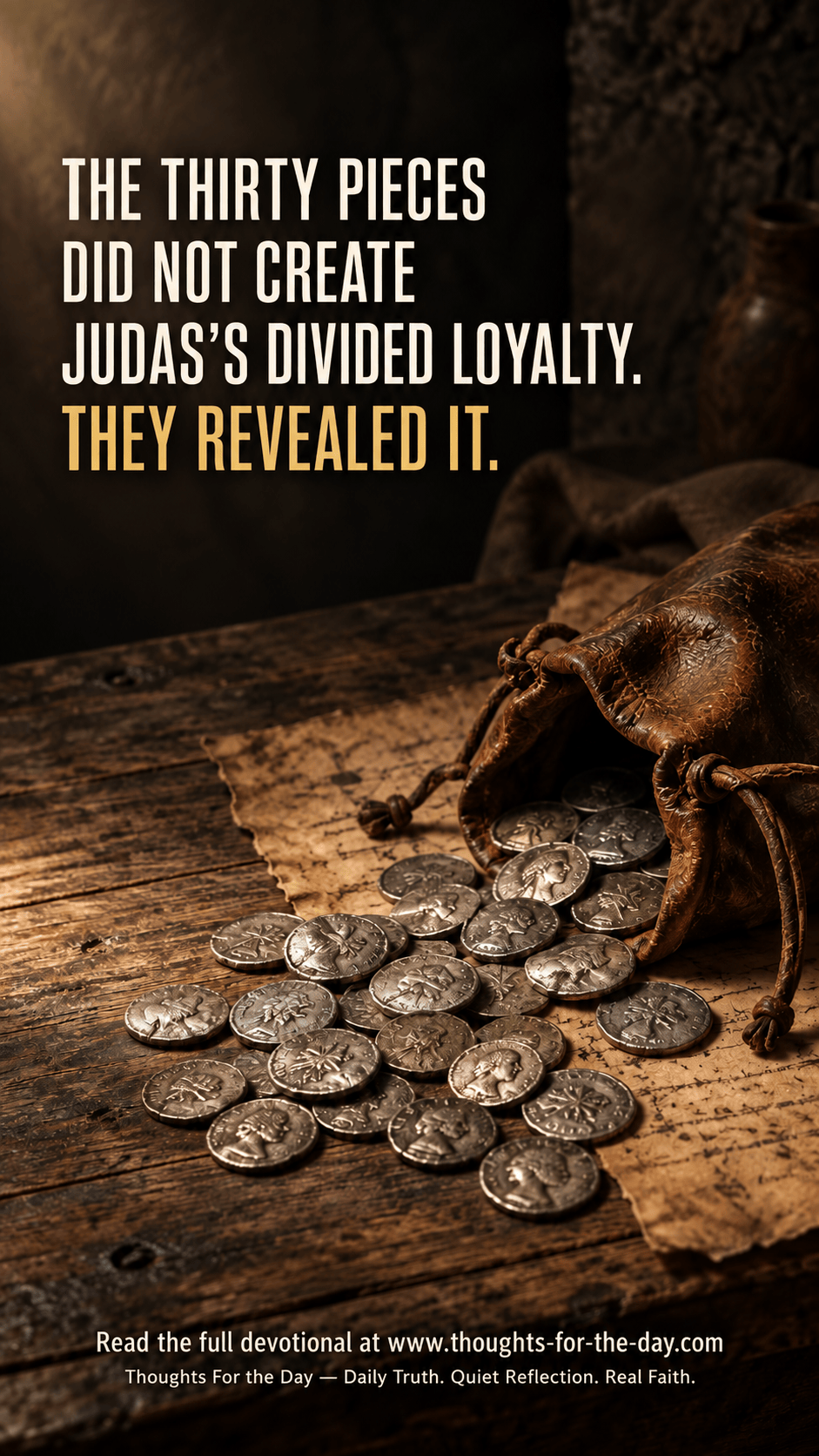
The thirty pieces did not create Judas’s divided loyalty. They revealed it.
In an earlier reflection, “Divided Loyalties,” we considered the impossibility of following Christ while preserving something within us that refuses His authority. Judas shows us where that division can eventually lead.
Before there was open betrayal, there had been private theft. Before Judas sold Jesus publicly, he had repeatedly chosen greed privately. One concealed compromise prepared him for another until something that may once have been unthinkable became negotiable.
That is how tolerated sin works.
What was once unthinkable becomes negotiable.
What becomes negotiable eventually becomes permissible.
What becomes permissible eventually becomes normal.
And what becomes normal eventually stops producing conviction.
Public betrayal is often the final expression of a private compromise.
The Doorway in the Alley
Yesterday, in “The Same Dark Alley”, I wrote about an image Lisa sent me of a dark alley with light visible at the far end. We saw the same image from two different perspectives.
Lisa immediately saw the light.
She saw the destination. No matter how dark the alley became, if we kept our eyes fixed on the light and continued walking toward it, we would eventually make it through.
I noticed the dangers along the way—the twists, shadows, dark corners, hidden passages, and doorways.
Both perspectives were true.
The alley itself is life. Christ is the light at its end. As we travel through life, we encounter temptations, disappointments, wounds, complications, and countless opportunities to become distracted. If we keep our eyes on the Light, He will guide us through.
But it is easy to take a detour into one of the alley’s dark doorways.
Most people do not step through such a doorway intending to abandon Christ. It may begin with curiosity. Loneliness. Anger. Wounded pride. The desire for pleasure, relief, approval, or control.
We tell ourselves we are only stepping aside for a moment. We still intend to follow Jesus. We simply want to investigate something beside the path.
But once inside, it is easy to become disoriented.
The deeper we wander, the harder it becomes to remember where the opening was. Our eyes adjust to the darkness. Things that once appeared dangerous begin to look ordinary. Things we would once have immediately rejected begin to appear harmless.
The enemy does not need us to renounce Jesus at the entrance. He only needs us to step through one doorway and remain there long enough for our eyes to adjust.
Paul warned:
“Nor give place to the devil.”
—Ephesians 4:27, NKJV
A foothold is not the complete surrender of territory. It is one small place yielded to the enemy.
But the enemy never intends to remain confined to the small space we initially surrender. He uses that position to press farther inward.
What begins as a foothold becomes a stronghold.
What begins as a detour becomes a new direction.
What begins as something we control eventually takes control of us.
Judas Walked With the Light
Judas did not merely walk toward the Light. He walked beside Him.
He heard Jesus teach. He witnessed miracles. He watched blinded eyes open and the dead raised to life. He traveled, ministered, and prayed alongside the other disciples. Jesus washed his feet and gave him a place at the table.
Yet proximity to Jesus never became complete surrender to Jesus.
Somewhere along the alley, money caught Judas’s attention. Perhaps the first theft seemed insignificant. He could take a little from the money box and continue following Jesus. For a while, he may have believed he could accommodate both discipleship and greed.
But greed became a doorway.
Once Judas entered it, his spiritual vision began adjusting to the darkness. Stealing became normal. Mary’s worship began to look wasteful. The chief priests began to look like potential business partners. Eventually, betraying Jesus—something he may never have imagined at the beginning—became worth considering for the right price.
Thirty pieces of silver echoed the value assigned to a slave. Judas did not simply sell Jesus; he valued Him cheaply.
Every protected sin makes a similar statement about value:
This pleasure is worth disobeying Him for.
This resentment is worth withholding forgiveness for.
This pride is worth resisting correction for.
This secret is worth weakening my relationship with Him for.
We would never stand in church and say those words aloud. But deliberate disobedience says them through our choices.
Sin Changes What We Can See
Judas may have considered greed his private weakness, but protected sin never remains confined to one compartment of life.
His greed affected how he viewed Mary’s worship. Because he wanted access to the value of the oil, her sacrifice looked irresponsible. The sin he protected began interpreting what he saw.
That still happens.
Pride makes correction look like persecution.
Bitterness makes mercy look unjust.
Lust makes boundaries look unreasonable.
Greed makes generosity look wasteful.
Resentment makes reconciliation look like weakness.
The darkness does not always hide what is in front of us. Sometimes it changes the way we see it.
James described the progression:
“But each one is tempted when he is drawn away by his own desires and enticed. Then, when desire has conceived, it gives birth to sin; and sin, when it is full-grown, brings forth death.”
—James 1:14–15, NKJV
The destination visible from the entrance is never the destination sin ultimately has in mind.
The Light Has Not Moved
There is mercy even in this severe warning.
Jesus knew what Judas had done and what he was preparing to do. Yet He still washed Judas’s feet, seated him at the table, and gave him opportunities to turn back.
Conviction is evidence that the Light is still reaching into the darkness.
When God puts His finger on something we have been protecting, He is not merely exposing us. He is warning us about what is attempting to destroy us while there is still time to turn around.
Exposure is not rejection.
Conviction is an invitation to return.
Judas eventually returned the silver and admitted that he had betrayed innocent blood. But he carried his remorse back to the religious leaders rather than carrying his sin to Jesus. He discarded the payment, but he did not return to the Savior.
Peter also became disoriented in the alley. Fear drew him into a dark corner where denying Jesus suddenly appeared safer than confessing Him. But when Jesus looked at Peter, he remembered. He wept, turned, and remained within reach of restoration.
Both men failed Jesus.
One turned back toward the Light.
The other surrendered to the darkness.
What Are We Choosing?
Every day, our choices assign value. They reveal what we believe Jesus is worth.
The question is not merely, “Would I sell Jesus for thirty pieces of silver?” Almost every professing Christian would immediately answer no.
The harder question is:
What have I already begun choosing over Him in smaller amounts?
Because what begins in smaller amounts does not remain small.
One compromise becomes another. What we entertain, we eventually accommodate. What we accommodate, we begin to protect. What we continually protect begins to claim territory within us.
And what we repeatedly choose over Jesus will eventually displace Him entirely.
Judas did not trade Jesus all at once.
He entered a doorway in the alley and continued walking, one decision at a time.
Keep your eyes on the Light. Be careful which doors you enter. And if you realize that you have lost your bearings, do not continue deeper simply because you are ashamed that you wandered.
Turn around.
The Light is still there.

