Primary Text: Jeremiah 18:1–6
“Arise, and go down to the potter’s house, and there I will cause thee to hear my words.” — Jeremiah 18:2
When I was a kid, I had the opportunity to spend time at Philbrook Art Museum in Tulsa participating in art programs that introduced us to Native American crafts and traditions. One of the projects was pottery.
I wasn’t very good at it.
My attempts usually looked more like lopsided bowls than useful vessels.
But while my own efforts left much to be desired, I never forgot watching an experienced potter at work.
Years later, when I read Jeremiah 18, those memories came rushing back.
God didn’t send Jeremiah to a palace or a battlefield to teach him one of Scripture’s greatest lessons. He sent him to a workshop.
“Go to the potter’s house.”
The lesson wouldn’t come through a sermon.
It would come through observation.
Sometimes God teaches us the same way.
Instead of immediately answering our questions, He simply says, “Watch.”
Watch how I work.
Watch what I do.
Watch the Potter.
The first thing I remember about the process was how important it was to center the clay.
Nothing else happened until that was right.
If the clay wasn’t perfectly centered on the wheel, everything that followed would be uneven. The faster the wheel turned, the more obvious the wobble became. No amount of skill could compensate for clay that wasn’t centered.
Life works much the same way.
When life speeds up, whatever sits at the center of our hearts is revealed.
Responsibilities increase.
Schedules become full.
Unexpected trials appear.
Pressure mounts.
Those seasons don’t usually create our instability. They expose it.
Before God shapes our lives, He centers our hearts.
Jesus said, “Seek first the kingdom of God.”
The writer of Hebrews tells us to keep our eyes fixed on Jesus.
Only when Christ occupies the center can everything else begin taking its proper place.
Then came the pressure.
Watching the potter’s hands was fascinating.
To someone unfamiliar with pottery, the process almost looks harsh.
The hands press firmly.
They squeeze.
They pull.
They stretch.
Yet every movement has purpose.
Nothing is random.
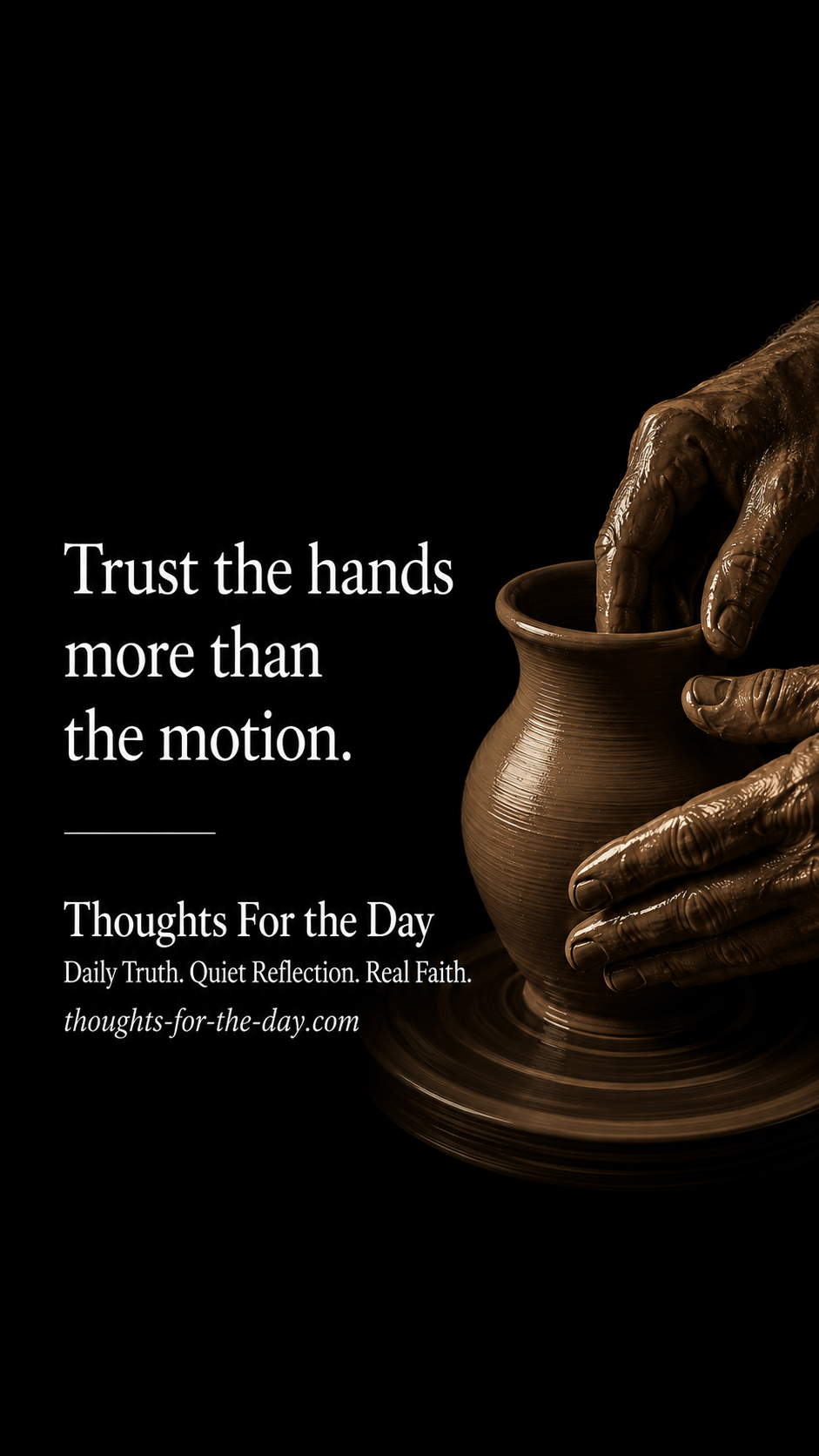
One hand supports the outside while the other shapes from within.
Remove either hand, and the vessel collapses.
How often is that exactly how God works in our lives?
We notice the pressures around us—the disappointments, the delays, the hardships, the uncertainties.
What we often fail to recognize is the quieter work taking place within us.
While circumstances shape our character externally, the Holy Spirit is transforming our hearts internally.
God is working from both sides at once.
The pressure isn’t punishment.
It’s preparation.
I also remember the water.
Clay without water quickly becomes stiff and brittle.
Push too hard, and it cracks.
Add too much water, and it loses its strength altogether.
The potter constantly adds just enough to keep the clay workable.
What a beautiful picture of God’s grace.
He knows exactly when our hearts need softening.
He comforts us without making us complacent.
He strengthens us without making us hard.
His grace is never excessive.
It is always sufficient.
Perhaps the greatest lesson, however, is this:
The clay never shaped itself.
Its responsibility was not to decide what kind of vessel it wanted to become.
Its responsibility was simply to remain in the potter’s hands.
That runs completely contrary to our culture.
We want control.
We want to choose the timing.
We want to determine the outcome.
We even try to tell God what our lives should become.
But clay has never instructed the potter.
It simply yields.
Jeremiah watched as something unexpected happened.
The vessel became marred in the potter’s hand.
The clay resisted.
The shape was spoiled.
Yet the potter didn’t throw it away.
He didn’t become frustrated.
He didn’t walk away from the wheel.
Scripture says, “So he made it again another vessel, as seemed good to the potter to make it.”
Those words have always moved me.
He made it again.
Not repaired.
Not patched.
Remade.
That is the story of redemption.
Every one of us has been marred by sin.
Every one of us has failed to become what we were created to be.
Yet our failures do not surprise the Potter.
He is able to begin again.
He reshapes what has been broken.
He restores what has been damaged.
He creates something beautiful where we expected only disappointment.
Sometimes people say they feel like life is going in circles.
Perhaps you’ve felt that way.
The same struggles.
The same prayers.
The same waiting.
The same unanswered questions.
May I offer another perspective?
Perhaps you’re not going in circles.
Perhaps you’re still on the wheel.
The wheel keeps turning because the vessel isn’t finished.
Every rotation places another part of our lives beneath the Potter’s hands.
Every season brings another opportunity for Him to remove what doesn’t belong and strengthen what does.
The clay never sees what the Potter sees.
The clay feels the pressure.
The Potter sees the finished vessel.
The clay experiences the spinning.
The Potter sees the purpose.
The clay only knows today.
The Potter already sees what tomorrow will require.
That is why faith is ultimately trust.
Not trust in the wheel.
Not trust in the process.
Trust in the One whose hands never leave the clay.
If your life feels uncertain today…
if the pressure seems greater than you expected…
if the wheel seems to keep turning without end…
don’t mistake movement for abandonment.
The Potter is still at work.
And the fact that His hands are still shaping you is evidence that He is not finished yet.