Tag: Faith

  • Before and After

    Before and After

    📖 “Behold, I go forward, but He is not there; and backward, but I cannot perceive Him… But He knoweth the way that I take…” — Job 23:8-10

    It started as an ordinary Thursday.

    You weren’t looking for your life to change.

    You were just going to work.

    Going to the doctor.

    Going home.

    Then one conversation.

    One phone call.

    One sentence.

    …and suddenly your life had a before and an after.

    At first, it didn’t seem real.

    Surely there had been a misunderstanding.

    Maybe the tests were wrong.

    Maybe they meant someone else.

    Maybe tomorrow would somehow put everything back the way it was.

    But tomorrow came.

    And so did the questions.

    “What happens now?”

    “How am I going to get through this?”

    “What if everything changes?”

    The future that once seemed so certain suddenly became filled with uncertainty.

    The plans you had carefully made no longer seemed guaranteed.

    You found yourself lying awake at night, replaying conversations, imagining outcomes, searching for answers that refused to come.

    So you did what believers have always done.

    You prayed.
    You searched the Scriptures.
    You waited.
    You listened.

    And if you’re honest…

    heaven seemed painfully quiet.

    Not because you stopped believing.

    Not because you walked away.

    But because you couldn’t understand how God could feel so silent when your world had become so loud.

    Job understood that feeling.

    He searched in every direction.

    Forward.
    Backward.
    To the left.
    To the right.

    Everywhere he expected to find God…

    he found silence instead.

    Yet in the middle of his searching, Job spoke words that have comforted weary hearts for thousands of years.

    He didn’t say, “Now I understand.”

    He didn’t say, “Everything is going to be all right.”

    He didn’t even say, “I know where God is.”

    He simply declared what he knew to be true.

    “But He knoweth the way that I take.”

    What a remarkable statement.

    Job couldn’t see God.

    But he believed God could still see him.

    He couldn’t trace God’s hand.

    But he trusted God’s heart.

    Maybe that’s exactly where you are today.

    You’ve looked in every direction you know to look.

    You’re still waiting.
    Still praying.
    Still hoping.
    Still wondering.

    If that’s your story…

    hold on to Job’s.

    Your ability to see God has never determined His ability to see you.

    He knows where you are.

    He knows what you’re carrying.

    He knows every question you haven’t spoken aloud.

    He knows every tear that no one else has seen.

    He knows every burden you’ve tried to carry by yourself.

    And even if today you cannot say, “I know the way He is taking…”

    you can still rest in this unchanging truth:

    But He knows the way I take.

  • Learning To Lean

    Learning To Lean

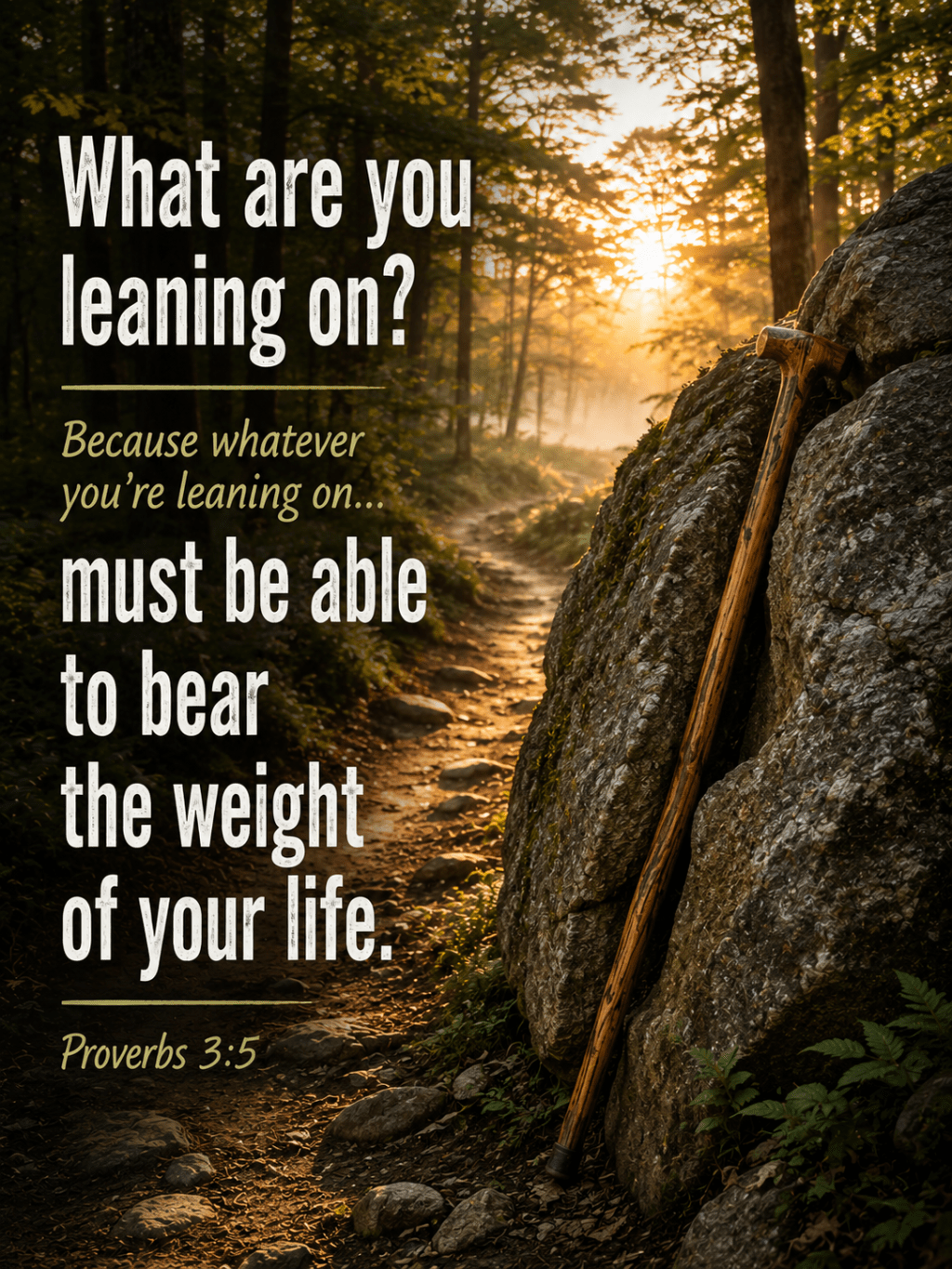
    “Trust in the LORD with all thine heart; and lean not unto thine own understanding.” — Proverbs 3:5

    I woke before sunrise with an old hymn running through my mind.

    Learning to lean…
    Learning to lean…
    I’m learning to lean on Jesus…

    At first, I thought it was simply an encouraging song.

    But as I spent time in Scripture, I realized it was asking me a deeper question.

    What am I leaning on?

    We all lean on something.

    Some lean on their own abilities.
    Some lean on financial security.
    Some lean on relationships, reputation, influence, or strength.
    Some lean on determination, believing that if they just try harder, they can make it through.

    Others lean on things that promise relief but never truly heal—addictions, distractions, habits, or anything else that numbs the weight they are carrying.

    But there is a second question we must ask.

    Why am I leaning on it?

    Because we do not lean on these things for no reason.

    We lean on money because we want security.
    We lean on people because we want acceptance.
    We lean on control because we want peace.
    We lean on success because we want significance.
    We lean on escape because we want relief.

    Every false support is promising something to the soul that only God can truly give.

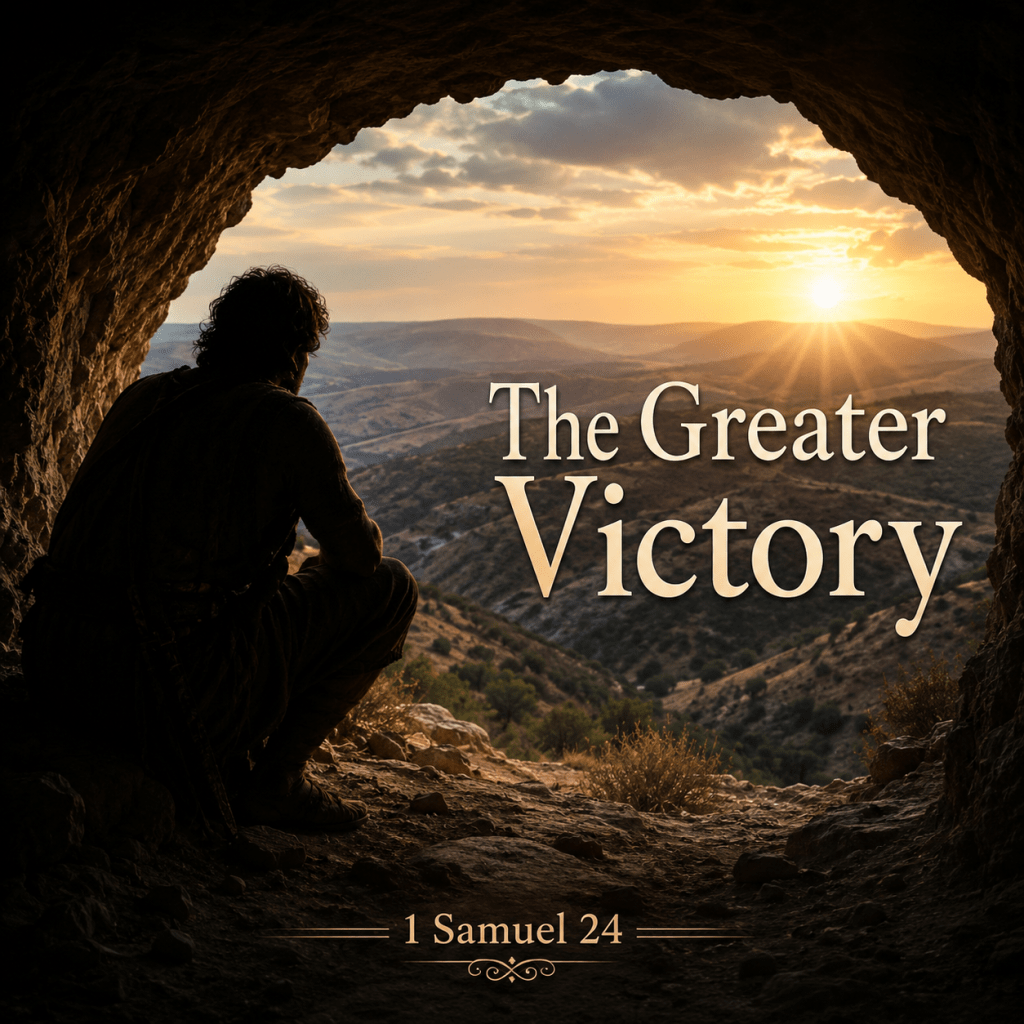
    David faced that very test in a cave.

    King Saul, who had hunted him relentlessly, unknowingly walked in alone. David’s men saw the opportunity of a lifetime. One swing of the sword, and years of fear could be over.

    But David saw something else.

    He saw a promise that did not need his manipulation.

    He refused to take by force what God had promised by grace.

    David did not lean on his sword.
    He leaned on God.

    And because David was leaning on God, he did not need the throne to satisfy his soul.

    That is the difference.

    David still desired what God had promised.
    But he did not need to sin in order to obtain it.

    Perhaps that is why Solomon wrote,

    “Trust in the LORD with all thine heart; and lean not unto thine own understanding.”

    Those are not two separate commands.

    They are one.

    The first half tells us what God is calling us to do.

    The second half tells us how.

    We trust Him by refusing to lean on ourselves.

    Faith is not simply believing that God exists.

    Faith is transferring the weight of our confidence from our own understanding to His wisdom, and from our own strength to His faithfulness.

    And that brings us to the other hymn that came to mind today:

    Only Jesus can satisfy your soul…

    That is the full equation.

    What am I leaning on?

    And…

    What am I expecting it to give me?

    Because whatever we lean on must be able to bear the weight of our lives.

    And whatever we look to for satisfaction must be able to reach the deepest place in our souls.

    Only Christ can do both.

    He alone can carry the weight.
    He alone can satisfy the longing.

    So maybe the question today is not just whether we believe in Jesus.

    Maybe the question is more personal than that.

    Am I leaning on Him?

    And am I trusting Him to be enough?

  • The Greater Victory

    The Greater Victory

    Scripture: 1 Samuel 24:1–12

    When most people think about David’s greatest victory, they immediately think of Goliath.

    It’s understandable.

    A shepherd boy walks onto a battlefield with nothing but a sling and five smooth stones. One giant falls, an army flees, and a nation celebrates.

    It is one of the greatest stories in all of Scripture.

    But I’m no longer convinced that was David’s greatest victory.

    This week has been filled with thoughts about David.

    First, Nathan confronting him.

    Then Psalm 51.

    Then, on the drive home Tuesday, Lisa read me something she had found on Facebook.

    It simply said that David’s greatest victory wasn’t defeating Goliath.

    It was sparing Saul.

    I asked her to read it again.

    Then I asked her to send it to me.

    The more I’ve reflected on it…

    The more I think there is profound truth in that statement.

    Not because Saul deserved mercy.

    But because David had become the kind of man who trusted God enough to show it.

    At first glance, it almost feels like we’re going backward in David’s story.

    After all, the cave came long before Bathsheba.

    Long before Nathan.

    Long before Psalm 51.

    But perhaps that’s exactly why this passage matters.

    Earlier this week we saw what a heart after God’s own heart looks like when it fails.

    Today we see what that same heart looked like before it failed.

    The setting couldn’t have been more dramatic.

    Saul had spent years hunting David.
    David had done nothing to deserve it.

    He had served Saul faithfully.
    He had fought Israel’s enemies.
    He had married Saul’s daughter.

    Yet now he was living as a fugitive.

    Then the opportunity came.

    Saul unknowingly entered the very cave where David and his men were hiding.

    David’s companions could hardly believe it.

    “This is the day the LORD spoke about!”

    To them, this wasn’t merely an opportunity.

    It was providence.

    David could finally take the throne God had already promised him.

    No more running.
    No more hiding.
    No more caves.

    He quietly crept toward Saul.

    Sword in hand.

    Then…

    He stopped.

    Instead of taking Saul’s life, he cut off a corner of Saul’s robe.

    Even then, Scripture says something remarkable.

    “David’s heart smote him…” (1 Samuel 24:5)

    That verse has always fascinated me.

    David wasn’t convicted after killing Saul.

    He was convicted after cutting a piece of cloth.

    Why?

    Because David understood something his men did not.

    The robe represented the office God had established.

    Saul may have failed as king.
    God had already rejected him.
    Samuel had already confronted him.

    But David understood that judgment belonged to God.

    Not to him.

    So David declared:

    “The LORD forbid that I should do this thing unto my master, the LORD’S anointed…”

    Those words have often been misunderstood.

    Some have used them to suggest that spiritual leaders should never be questioned or held accountable.

    But that’s not what David was saying.

    Saul had already been confronted.
    He had already been rebuked.
    He had already been judged by God.

    David simply refused to seize for himself what only God had the right to give.

    He would wait.
    Even when waiting hurt.
    Even when the opportunity seemed perfect.
    Even when everyone around him insisted this must be God’s will.

    God’s promises will never require us to abandon His principles.

    All too often we see an opportunity and immediately assume God has opened the door.

    But when we dig beneath the surface, we sometimes discover that walking through that door would require us to compromise the very principles God has already made clear in His Word.

    David refused to do that.

    He understood that God’s promise of the throne did not give him permission to violate God’s character in order to obtain it.

    Sometimes the greatest act of faith is walking away from something you have every human reason to take, because you trust that God’s way is always better than your own shortcut.

    As I’ve reflected on David’s life these past several weeks, one thought continues to surface.

    God wasn’t merely preparing David to wear a crown.
    He was preparing him to carry one.

    Anyone can display courage when facing a giant.

    It takes a very different kind of strength to lay down your sword when facing an enemy.

    Goliath tested David’s courage.
    Saul tested David’s character.

    One victory won Israel’s applause.
    The other revealed the heart God had been forming all along.

    Final Word

    David eventually became king.

    Not because he took the throne when he had the chance…

    But because he trusted God enough to wait until God placed him there.

    There are moments in life when we could force the outcome.

    We defend ourselves.

    We get even.

    We take what we believe is rightfully ours.

    The cave reminds us that the greatest victories are not always the ones everyone celebrates.

    Sometimes the greatest victory is trusting God enough to leave justice in His hands.

    Because a heart after God’s own heart doesn’t simply ask,

    “What can I do?”

    It first asks,

    “What would honor God?”

    And perhaps that’s one of the clearest marks of spiritual maturity.

    Not that we seize every opportunity placed before us…

    But that we trust God enough to refuse the ones that require us to abandon His principles.

  • If My Story Can Save Someone Else’s

    If My Story Can Save Someone Else’s

    There comes a point in life when you stop worrying about what people will remember about you…

    And you start wondering what your life will point them toward.

    I’ve made decisions I wish I could take back.

    I’ve hurt people I loved.

    I’ve failed in ways that still grieve me.

    If I could rewrite those chapters, I would.

    But I can’t.

    And maybe that’s exactly where God’s grace becomes most visible.

    Because grace isn’t proven by the lives of people who never needed it.

    Grace is proven by what God does with people who did.

    The Apostle Paul never hid the fact that he persecuted the church.

    Peter never pretended he hadn’t denied Jesus.

    David never removed Psalm 51 from the Bible.

    Their failures weren’t recorded to glorify sin.

    They were preserved to magnify God’s mercy.

    I don’t tell parts of my story because I’m proud of them.

    I’m not.

    I tell them because somewhere, someone else is standing where I once stood.

    Someone is one decision away from destroying a marriage.

    Someone is trapped in secret sin.

    Someone is convinced they’ve gone too far for God to forgive.

    If my failures can persuade one person to turn around before making the same mistake…

    If my scars can convince someone that God’s grace is still greater than their shame…

    If one person finds hope because they realized God never gave up on me…

    Then every painful chapter will have served a purpose.

    When this life is over, I don’t want people talking about my accomplishments.

    I don’t want to be remembered for clever words, popular posts, or even a ministry.

    I want them to remember a faithful God…

    Who refused to stop pursuing an unfaithful man.

    Like the song says:

    “I don’t want to leave a legacy.

    I don’t care if they remember me.

    Only Jesus.”

    Because if my life points even one person toward Him…

    Then every chapter—

    The joyful ones.

    The painful ones.

    The victories.

    The failures.

    The mountains.

    The valleys.

    Will all have been worth it.

    Final Word

    One day, every one of us will leave something behind.

    The question isn’t whether we’ll leave a legacy.

    The question is what that legacy will point to.

    May people never look at our lives and say, “What an extraordinary person.”

    May they instead say,

    “What an extraordinary Savior.”

  • The Blessing You Didn’t Pray For

    The Blessing You Didn’t Pray For

    “Every good gift and every perfect gift is from above…” — James 1:17

    A song came to mind this week that asks a series of thought-provoking questions.

    What if the things we call hardships are sometimes the very means by which God accomplishes His greatest work in our lives?

    It isn’t asking whether pain is enjoyable.
    It isn’t suggesting that loss somehow becomes pleasant.

    Instead, it challenges us to consider a difficult possibility:

    What if some of God’s greatest blessings arrive in packages we would never choose to open?

    That thought immediately took me back through Scripture.

    Joseph certainly wouldn’t have chosen betrayal by his brothers.
    He wouldn’t have chosen slavery.
    He wouldn’t have chosen prison.

    Yet years later, he could look back and see that God had been working through every painful chapter.

    David probably wouldn’t have chosen years of hiding in caves while running for his life.

    Moses likely wouldn’t have volunteered for forty years in the wilderness.

    Naomi certainly wouldn’t have chosen famine, widowhood, and the loss of her sons.

    None of those experiences felt like blessings when they were happening.

    Yet every one of them became part of God’s greater purpose.

    I wonder how many blessings I’ve almost missed because I was looking for the wrong wrapping paper.

    We naturally think blessings look like answered prayers.

    Open doors.
    Good health.
    Financial provision.
    Restored relationships.

    There is no question those things can be tremendous gifts from God.

    But sometimes His greatest gifts are quieter.

    A disappointment that redirected our lives.
    A closed door that protected us from walking somewhere we shouldn’t.
    A season of waiting that taught us patience.
    A trial that stripped away our self-reliance and taught us complete dependence upon Him.

    None of us pray for those things.

    Yet many of us would honestly say they became turning points in our walk with Christ.

    I’ve noticed something else.

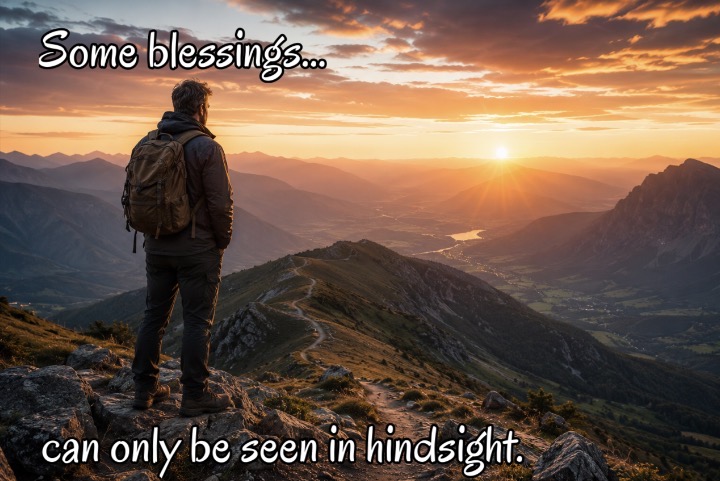
    We usually recognize those blessings only by looking backward.

    Very few people say in the middle of suffering,

    “I can already see why God allowed this.”

    Perspective often comes long after the pain.

    Perhaps that’s why faith is so essential.

    Faith trusts that God is good before we can understand what He is doing.

    Only later do we begin to see how He was weaving together circumstances we never could have imagined.

    Romans 8:28 isn’t a promise that everything is good.

    It’s a promise that God is working through everything for the good of those who love Him and are called according to His purpose.

    That doesn’t minimize grief.
    It doesn’t erase loss.
    It doesn’t pretend suffering isn’t real.

    It simply reminds us that God never wastes any of it.

    One day, I believe we’ll look back and discover that some of the moments we would have erased from our story became the very chapters God used to shape us most into the image of Christ.

    Final Word

    We spend much of our lives asking God to change our circumstances.

    Sometimes He does.

    But often, His greater miracle is using those circumstances to change us.

    Perhaps the greatest blessings aren’t always the ones that make life easier.

    Perhaps they’re the ones that make us more like Jesus.

  • Looking Back

    Looking Back

    “Remember Lot’s wife.” — Luke 17:32

    Those three words from Jesus have always fascinated me.

    Out of all the people and stories He could have referenced, Jesus pointed His listeners back to a woman whose name we don’t even know.

    Most people focus on what she did.

    She looked back.

    But I wonder if the deeper issue wasn’t where her eyes were focused.

    Perhaps it was where her heart remained.

    Genesis tells us that God was delivering Lot and his family from Sodom before judgment fell upon the city. The angels urged them to flee and gave a simple instruction:

    “Escape for your life. Do not look behind you.”

    Yet somewhere along the journey, Lot’s wife turned and looked back.

    Why?

    Scripture doesn’t tell us.

    Perhaps she missed her home.

    Perhaps she missed friends and memories.

    Perhaps she simply feared the uncertainty of what lay ahead.

    Whatever the reason, her heart was still connected to something God had called her to leave behind.

    The older I get, the more I realize that many of us are not trapped by sinful places.

    We’re trapped by familiar ones.

    We become comfortable in seasons that were once exactly where God wanted us to be… but are no longer where He is leading us. Hu

    Sometimes it’s a ministry.
    Sometimes it’s a job.
    Sometimes it’s a group of friends.
    Sometimes it’s a dream we have carried for decades.

    We know God is leading us forward, but part of us keeps looking over our shoulder.

    Not because the past was evil.

    But because it was known.

    The future is not.

    I remember nearly thirty years ago when I stepped away from teaching the youth class in McAlester.

    The hardest part wasn’t laying down the responsibility.

    The hardest part was not looking back.

    That season had shaped me.

    I loved those students.
    I loved the ministry.
    I loved what God had done there.

    But eventually I had to learn that following God sometimes means leaving a season you loved in order to embrace one you cannot yet see.

    Abraham left Ur.
    Moses left Midian.
    David left the pasture.
    The disciples left their nets, tax booth, and fig tree.

    None of them were given a complete roadmap.

    They were simply asked to trust God enough to take the next step. And often, the next step didn’t make sense until years later.

    Perhaps that’s why this story still speaks so powerfully today.

    Many of us are asking God for clarity about the future while secretly wishing He would restore the past.

    We want the old ministry.
    The old relationships.
    The old opportunities.
    The old version of ourselves.

    But what if God is not trying to recreate what was?

    What if He is trying to create something new?

    What if looking back isn’t always longing for our past life?

    What if sometimes it’s refusing to believe God can do something different in the future?

    That question has challenged me deeply.

    Because every season of life eventually ends.

    Children grow up.
    Careers change.
    Ministries evolve.
    Doors close.
    Dreams shift.

    The question isn’t whether seasons will change.

    The question is whether we will trust God when they do.

    Lot’s wife teaches us that there is danger in living with our feet pointed toward God’s future while our hearts remain anchored in yesterday.

    The past can be honored.
    The lessons can be remembered.
    The memories can be cherished.

    But they cannot become our destination.

    God never calls us backward.

    He always calls us forward.

    Final Word:

    Maybe the question isn’t:

    “What am I looking back at?”

    Maybe the better question is:

    “Do I trust God enough to believe that what lies ahead may be different from the past… and still be exactly where He wants me to be?”

    After all, it’s hard to move forward while you’re looking back.

  • Give Me Truth

    “Rather than love, than money, than fame, give me truth.”
    — Henry David Thoreau

    Truth sounds noble… until it costs you something.

    It’s easy to praise truth when it’s inspirational.

    It’s much harder when truth isolates you, threatens your comfort, damages your reputation, or costs you relationships.

    Biblical truth has always carried a price tag.

    Ask Noah.

    The man spent decades building an ark while the world mocked him as irrational and extreme. Yet the flood still came.

    Ask Elijah.

    One prophet standing against hundreds was declared a troublemaker and hunted by a king and queen because he refused to bow to a culture built on compromise.

    Ask Jeremiah.

    He loved his nation enough to tell them the truth, and they answered by throwing him into a pit.

    Ask John the Baptist.

    He lost his head because he refused to soften the truth about sin for the sake of political favor.

    Ask the apostles.

    Most of them died not because they were violent men, but because they would not deny what they had seen and heard about Jesus Christ.

    And ultimately, ask Jesus Himself.

    Truth was nailed to a cross by people who claimed to love God while rejecting the very Word standing in front of them.

    The cost of truth did not end at Calvary.

    Throughout history, men and women have continued to pay a price for refusing to abandon what they knew to be true.

    Dietrich Bonhoeffer stood against the lies and evil of Nazi Germany, fully aware that his convictions could cost him his freedom—and ultimately his life.

    Today, believers in parts of Africa gather for worship despite threats of violence, imprisonment, and death. Some have watched churches burn and loved ones suffer because they refused to deny Christ.

    In China and other restrictive nations, Christians continue meeting in underground churches, knowing that obedience may carry consequences most of us have never faced.

    Even in societies that celebrate freedom, standing on biblical convictions can carry a cost. Careers may be affected. Friendships may be strained. Reputations may suffer. The pressure is often less about denying Christ outright and more about remaining silent when His truth becomes unpopular.

    The forms may change.

    The cost remains.

    Every generation is eventually faced with the same question:

    What am I willing to lose in order to remain faithful to the truth?

    That’s the part modern culture often ignores:

    Truth is rarely hated when it’s vague.

    Truth becomes dangerous when it becomes specific.

    The world doesn’t mind spirituality that never confronts sin.

    It doesn’t mind Christianity that never requires repentance.

    It doesn’t mind churches that entertain but never convict.

    But biblical truth?

    Truth that calls people to surrender?

    Truth that challenges pride, lust, greed, hatred, hypocrisy, and self-worship?

    That kind of truth has always been costly.

    And yet, throughout history, every revival, every awakening, and every genuine move of God was built on men and women who decided truth mattered more than acceptance.

    John 8:32 (NKJV)

    “And you shall know the truth, and the truth shall make you free.”

    Notice:

    Jesus never said truth would make us comfortable.

    He said it would make us free.

    Final Word

    We live in a generation that often values comfort over conviction, platform over principle, and feelings over truth.

    Yet every generation has faced its own test.

    Noah faced it.

    Jeremiah faced it.

    John the Baptist faced it.

    Bonhoeffer faced it.

    Persecuted believers face it today.

    And now the question comes to us.

    Do I want truth badly enough to accept the cost that comes with it?

    Because truth will demand something from all of us.

    But truth offers something compromise never can:

    Freedom.

    “And ye shall know the truth, and the truth shall make you free.” (John 8:32)

    Truth may be costly, but the price of abandoning it is always higher.

  • When the Mirror Turns Around

    Most of us read ourselves into the role we’d like to play.

    We’re David facing Goliath.

    Daniel standing in the lion’s den.

    Joseph resisting temptation.

    Esther risking everything for her people.

    And to be fair, there are seasons when we find ourselves in those stories. There are times when we must stand in faith, endure hardship, or trust God in difficult circumstances.

    But the longer I live, the more I realize that Scripture was not written merely to inspire me.

    It was written to expose me.

    When I open God’s Word, I instinctively look for the hero. Yet many times, God points me toward someone else entirely.

    What if I’m not David in this chapter?

    What if I’m Saul holding the spear?

    What if I’m Martha distracted and frustrated?

    What if I’m Peter warming himself by the fire while denying the Lord?

    What if I’m Jonah running from God’s call?

    Or perhaps most uncomfortable of all…

    What if I’m Esau?

    I’ve always found Esau’s story troubling.

    How could someone trade a birthright for a bowl of stew?

    An inheritance.

    A blessing.

    A future.

    Given away for one temporary appetite.

    The more I’ve reflected on it, however, the less I find myself judging Esau and the more I find myself understanding him.

    Because I’ve done the same thing.

    Not for a bowl of stew.

    But for things that seemed important in the moment.

    Comfort.

    Convenience.

    Pride.

    Temporary satisfaction.

    The desire to have what I wanted instead of what God wanted.

    Many of the regrets we carry in life aren’t the result of ignorance. They come from moments when we knew the right path and chose another one anyway.

    That’s what makes Esau’s story so personal.

    He didn’t lose his birthright because he lacked information.

    He lost it because he valued the immediate more than the eternal.

    And if we’re honest, we’ve all stood in that same place at one time or another.

    The difficult conversation we avoided.

    The conviction we ignored.

    The prayer life we neglected.

    The relationship we damaged.

    The compromise we justified.

    The thing we knew we shouldn’t do but convinced ourselves wouldn’t matter.

    Scripture becomes powerful when it stops being a collection of heroic stories and becomes a mirror.

    A mirror doesn’t exist to flatter us.

    It exists to show us what is actually there.

    James compared God’s Word to a mirror for exactly that reason. We look into it and see ourselves. The question is whether we walk away unchanged or allow God to transform what He reveals.

    I’ve discovered that spiritual growth rarely begins when I see myself as David.

    It usually begins when I recognize the Esau, Jonah, Peter, or Martha hiding beneath the surface.

    Transformation begins when we stop asking, “Who is the villain in this story?” and start asking, “Lord, is it I?”

    The good news is that God specializes in restoring broken people.

    Peter denied Him, yet was restored.

    David failed, yet found mercy.

    Jonah ran, yet God still used him.

    The purpose of the mirror is not condemnation.

    The purpose of the mirror is correction.

    God shows us where we are so He can lead us to where we should be.

    So the next time you open your Bible, don’t just look for the hero.

    Look for yourself.

    You may discover that the greatest work God wants to do isn’t defeating a giant in front of you.

    It’s changing something within you.

    Final Thought:
    The Bible becomes life-changing when we stop auditioning for the hero’s role and allow God’s Word to reveal who we really are. Only then can He begin the work of transforming us into who He wants us to become.

  • Divine Disruptions – Day 1

    Jonah: When God Sends a Storm

    📖 “But the Lord sent out a great wind on the sea…” — Jonah 1:4 (NKJV)


    Jonah didn’t misunderstand God. He wasn’t unsure about his calling.
    He just didn’t like it.

    God said, “Arise, go to Nineveh…”
    Jonah said, “No thanks,” and ran the other way.

    This wasn’t fear—it was flat-out rebellion. Jonah didn’t want Nineveh spared. He didn’t want them forgiven. He hated them. He knew God would be merciful, and he didn’t want mercy for people he couldn’t stand.

    So he fled. Booked a ship. Headed to Tarshish like he could outrun the voice of God.

    But when Jonah ran, God didn’t chase him with silence.
    He chased him with a storm.


    “But the Lord sent out a great wind…”

    That one line says everything.

    The storm wasn’t from Satan. It wasn’t from sin.
    It was from God.

    A holy disruption. A divine intervention.
    A perfectly timed, unavoidable wake-up call.

    Jonah’s rebellion didn’t just affect him. His disobedience threatened the lives of everyone on that boat. That’s the thing about sin—it’s never private. It always has fallout. Always spills over onto the innocent. Always causes someone else to wonder, “Why is this happening?”

    But even as the boat rocked and the crew panicked, Jonah knew.
    He said, “I serve the God who made the sea.”
    He knew who was behind the wind.

    And here’s the grace in it all:
    God had already prepared a fish.

    The fish wasn’t judgment. It was protection.
    It was messy. It was uncomfortable. It stank. But it kept him alive and brought him back.


    That’s what God’s disruptions often feel like:
    Unpleasant. Inconvenient. Humbling.
    But merciful.

    He’ll interrupt your plans to protect your calling.
    He’ll break your boat before He lets you self-destruct.


    🙏 So here’s the question for today:

    • Are you running from something you’ve been clearly called to do?
    • Have others started to feel the weight of your decisions?
    • Could it be that the storm isn’t meant to crush you—but to bring you home?

    Jonah’s story reminds us that God doesn’t give up just because we do.
    He’ll shake the sea. He’ll send the storm. He’ll even prepare the fish.
    Because the call doesn’t get canceled just because you ran from it.

    He still wants you.
    Storm, scars, and all.


    📌 Closing Line:

    “When God doesn’t have your attention, He’ll disturb what does.”
    Just ask Jonah.

  • The Plastic Chair Was Never the Problem

    Key Scripture:
    “And you shall know the truth, and the truth shall make you free.” — John 8:32 (NKJV)
    “Be transformed by the renewing of your mind.” — Romans 12:2b (NKJV)


    I came across an image recently that caught me off guard—and convicted me more than I’d like to admit.

    It was a horse. Big, strong, muscular. But it was standing still, tied by a rope to a flimsy plastic lawn chair. That horse could’ve broken free without even trying. But it didn’t. Not because it couldn’t—but because it believed it was bound.

    And right then, I saw myself.

    For the past month, I’ve allowed distractions to pull me away from the very disciplines that gave me life—prayer, time in the Word, pouring truth into others through every platform God gave me. One small excuse turned into a week. One neglected moment of prayer turned into silence. Then came the guilt. The disappointment. The rope.

    Not one of those things—distraction, laziness, or even failure—was stronger than my calling or the presence of God in my life. But somewhere in my head, I gave them that power. I started believing that I had to feel on fire to be faithful. I told myself I needed to wait until I was inspired, until life calmed down, until I “got it together.”

    But that was the rope talking. That was the plastic chair.

    Jesus didn’t die and rise again to set us halfway free. The bondage we face now isn’t always external. Sometimes, it’s just a lie we’ve believed for too long.

    And that’s where the real battle is won: not just by cutting the rope—but by renewing the mind that believed it held us.

    Romans 12:2 doesn’t say we’re transformed by doing better. It says we’re transformed by the renewing of our mind. That’s where it starts. That’s where the chair loses its grip.

    So here I am—coming back to the things I’ve neglected. Not because I feel worthy, but because I now see the truth. The enemy will try to convince us we’re too far gone. That God’s disappointed. That we’re disqualified.

    But listen to me: that chair has no power.

    The truth is that God is waiting—not with condemnation, but with open arms.
    The truth is that freedom isn’t earned, it’s claimed.
    The truth is that your calling doesn’t evaporate when you get distracted.
    It waits—right where you left it.


    Reflection Questions:

    1. What lies have I believed about myself that are keeping me tied down?
    2. Where have I allowed distractions to become spiritual chains?
    3. What truth do I need to replace those lies with today?

    Closing Prayer:
    Father, I confess that I’ve allowed myself to become entangled in lies and distractions. I’ve believed the rope was real, even when You’ve already given me freedom. Help me today to renew my mind—to replace the lies with truth. I want to walk in the freedom Jesus died to give me. Pull me back into the disciplines I’ve neglected, and meet me in that place. I’m coming home. In Jesus’ name, amen.