Tag: Faithfulness

  • Long Before the Furnace Was Lit

    Long Before the Furnace Was Lit

    Genesis 39:7–10; Daniel 1:8; Daniel 3:16–18; Luke 16:10 NKJV

    Everyone remembers the furnace.

    We remember Shadrach, Meshach, and Abed-Nego standing while everyone around them bowed. We remember their answer to Nebuchadnezzar:

    Our God is able.

    But if not.

    We will not bow.

    What we may not consider is how long it took to form the faith behind that answer.

    The three Hebrews did not begin building their convictions while the furnace was being heated. That was no place to begin deciding whom they would worship. The pressure was too great, the cost was too high, and the moment demanded an immediate answer.

    Their decision had been made long before the music began.

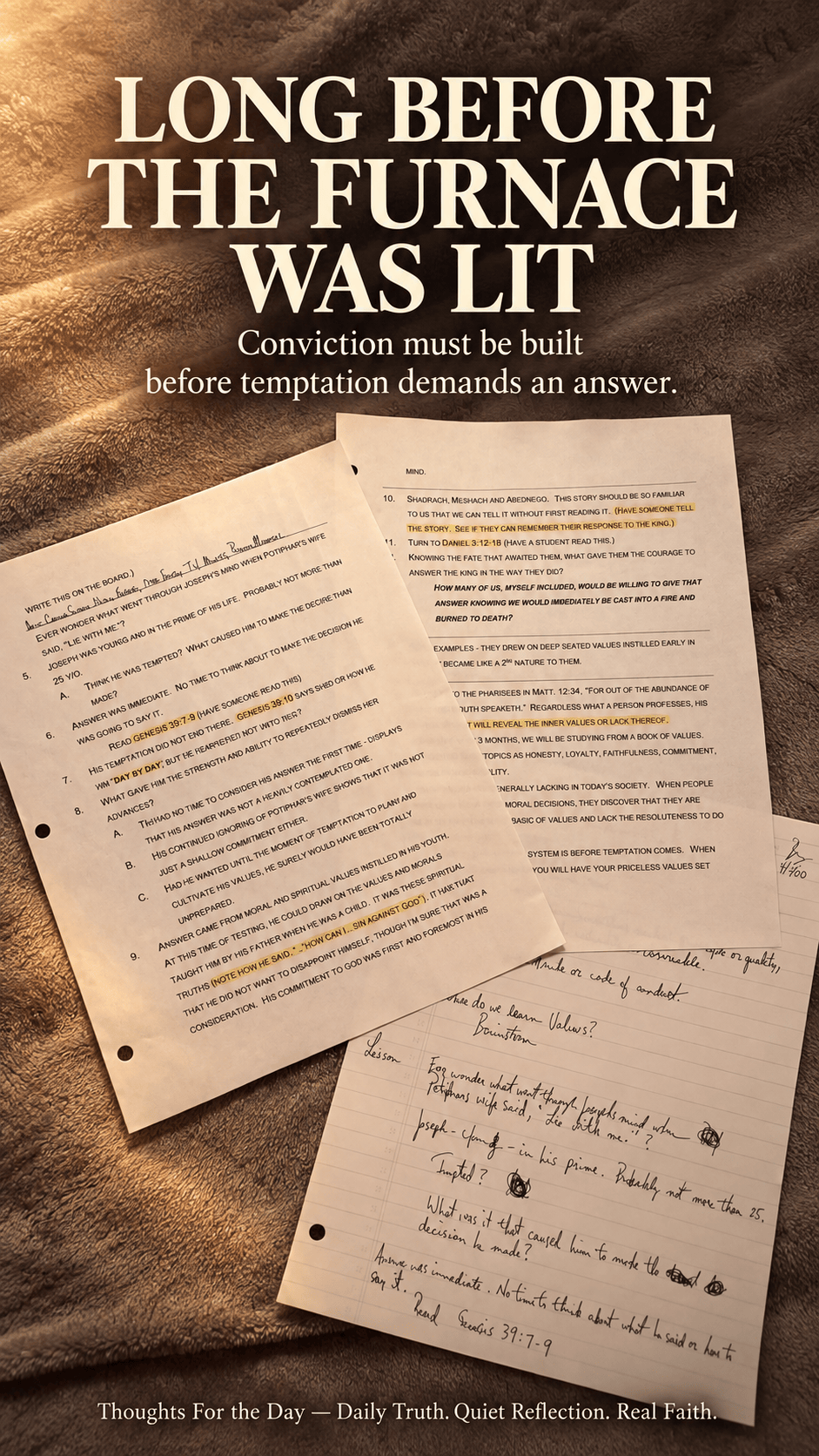
    Years ago, I taught a Sunday-school series called Values That Last. One of those lessons centered on another young man far from home: Joseph.

    Joseph had been betrayed by his brothers, carried into Egypt, and sold as a slave. He was separated from his father, his family, and everything familiar. Then Potiphar’s wife repeatedly attempted to draw him into sin.

    Joseph did not need time to decide whether her offer was wrong. His response was immediate:

    “How then can I do this great wickedness, and sin against God?”
    — Genesis 39:9 NKJV

    Joseph did not merely refuse once. Scripture says she spoke to him day by day, and he continued to refuse.

    Potiphar’s house was not where Joseph began developing his convictions.

    The temptation revealed his integrity.

    It did not create it.

    Joseph’s response came from truth that had been instilled in his youth, buried deeply within his heart, and made personal before the temptation arrived. He was no longer standing beside his father. There was no teacher in the room reminding him what was right. As far as Joseph knew, no one who loved him would ever learn what he chose to do.

    But Joseph knew that God would know.

    When I taught that lesson, I told those young people that they might someday find themselves a thousand miles from home, surrounded by people who did not know them and apparently accountable to no one. If they waited until that moment to decide what they believed and how they intended to live, it would be too late.

    Conviction must be built before temptation demands an answer.

    The same truth appears in the lives of Daniel, Shadrach, Meshach, and Abed-Nego.

    The Bible does not record the lessons they heard as children. It does not tell us the names of the parents, teachers, or spiritual leaders who helped form them. But Daniel 1 shows us the convictions they carried into captivity.

    Babylon changed their location. It changed their names. It began teaching them a new language, a new literature, and a new way of life.

    But Babylon encountered something already present within them.

    “But Daniel purposed in his heart that he would not defile himself with the portion of the king’s delicacies, nor with the wine which he drank.”
    — Daniel 1:8 NKJV

    Daniel spoke, and the four young men stood together in that decision.

    Even that was not the beginning of their faith. It was the first recorded evidence of a faith already being lived. Before they refused to bow before the king’s image, they had refused to compromise at the king’s table.

    The table prepared them for the furnace.

    The private decision prepared them for the public stand.

    Jesus said:

    “He who is faithful in what is least is faithful also in much.”
    — Luke 16:10 NKJV

    Faithfulness in smaller matters may not feel dramatic. Prayer when no crisis is present does not attract much attention. Reading Scripture when no immediate answer is required may appear ordinary. Obeying God when compromise would be easy and invisible may never become a story anyone else tells.

    But those quiet acts are forming something within us.

    They teach the heart where to turn.

    They settle questions before pressure asks them.

    They establish whom we serve before another voice demands our allegiance.

    This is why parents, teachers, and churches must plant truth early. Convictions do not pass automatically from one generation to the next. They must be taught, modeled, repeated, and lived.

    But there also comes a moment when inherited instruction must become personal conviction.

    Joseph could not rely upon Jacob’s presence in Potiphar’s house.

    The four Hebrew youths could not rely upon Jerusalem while living in Babylon.

    The truth they had received had to become the truth by which they lived.

    None of us knows exactly what test may come tomorrow. Most of us will never stand before a literal fiery furnace. But we will encounter moments when compromise offers an easier road, when obedience carries a cost, or when no one appears to be watching.

    That moment is not the time to begin building faith.

    Crisis does not usually give us time to develop convictions. It calls upon the convictions we have already developed.

    The furnace revealed the faith of Shadrach, Meshach, and Abed-Nego.

    It did not create it.

    The stand you may need tomorrow is being formed by the truth you receive, the convictions you settle, and the choices you make with God today.

  • Close the Door

    Close the Door

    “When all that generation had been gathered to their fathers, another generation arose after them who did not know the LORD nor the work which He had done for Israel.”
    —Judges 2:10 NKJV

    A meme recently appeared in my Facebook feed with a sobering observation:

    Samson did not lose his strength because Delilah was stronger than he was. He lost it because he continued giving access to someone he knew was dangerous.

    There is considerable truth in that statement—but Samson’s failure did not begin with Delilah.

    It began generations earlier.

    God had commanded Israel to remove the corrupting influences from the land He had given them:

    “And you shall make no covenant with the inhabitants of this land; you shall tear down their altars. But you have not obeyed My voice. Why have you done this? Therefore I also said, ‘I will not drive them out before you; but they shall be thorns in your side, and their gods shall be a snare to you.’”
    —Judges 2:2–3 NKJV

    Israel did not completely obey.

    They left people, practices, and altars in place that God had commanded them to remove. What appeared tolerable in one season eventually became a snare in another.

    Then Joshua’s generation passed away.

    “When all that generation had been gathered to their fathers, another generation arose after them who did not know the LORD nor the work which He had done for Israel.”
    —Judges 2:10 NKJV

    This new generation may have known something about Israel’s history. They may have recognized the names of Abraham, Moses, and Joshua. But they did not know the Lord in the covenantal, life-governing way the previous generation had known Him.

    Somewhere, the transmission of truth had broken down. Whether the testimony had not been taught, had not been modeled, or had simply not been received, the result was the same: the knowledge of God no longer shaped how that generation lived.

    The surrounding culture was ready to fill the emptiness.

    Israel began serving the Baals. They adopted the practices of the nations around them. They gradually surrendered the distinctiveness God had called them to maintain.

    A spiritual vacuum never remains empty for long.

    When the knowledge of God no longer governs a heart, a home, or a generation, another voice will gladly take its place.

    By the time Samson entered the story, compromise was already woven into Israel’s culture. His personal choices reflected the pattern of his nation.

    Israel allowed dangerous influences to remain in the land.

    Samson allowed Delilah to remain close to his heart.

    Israel tolerated what God had warned would become a snare.

    Samson trusted someone who repeatedly demonstrated that she intended to betray him.

    Delilah did not hide her intentions particularly well. Samson gave her a false explanation for his strength, and she immediately used that information against him. When it failed, she asked again. Then she did the same thing again.

    Every supposed secret was followed by another ambush.

    Samson saw the pattern. He knew what she was doing.

    Yet he stayed.

    “And it came to pass, when she pestered him daily with her words and pressed him, so that his soul was vexed to death…”
    —Judges 16:16 NKJV

    Notice how the erosion occurred:

    Daily words.

    Continual pressure.

    Repeated access.

    Delilah did not—could not—overpower Samson physically. What the Philistine armies could not conquer from the outside, persistent influence gradually reached from the inside.

    Finally, Samson “told her all his heart.”

    His hair was not magical. His strength came from God. His uncut hair was the outward sign of his Nazirite consecration—his separation unto the Lord from his mother’s womb.

    Samson did more than reveal the secret of his strength. He gave a destructive influence access to the place of his consecration.

    That is what makes the story so serious.

    We sometimes believe we can repeatedly entertain an influence without eventually being influenced by it. We imagine that because we recognize the danger, we are protected from it.

    Samson recognized what Delilah was doing. Recognition did not protect him because he refused to remove her access.

    We may recognize that a conversation continually feeds bitterness but keep participating in it.

    We may know that certain entertainment awakens desires we have been trying to surrender but keep watching.

    We may follow voices that mock holiness, weaken our confidence in Scripture, normalize disobedience, or fill us with anger—and tell ourselves that we are strong enough to remain unaffected.

    But repeated access becomes influence.

    Influence becomes pressure.

    Pressure, when entertained long enough, can become surrender.

    Not every person who disagrees with us is dangerous. Not every difficult conversation is an attack. Sometimes God uses people who challenge us to expose pride, correct error, and lead us closer to truth.

    The question is whether an influence moves us toward obedience or gradually makes disobedience seem reasonable.

    Does the voice strengthen our faith or continually undermine it?

    Does the relationship encourage our consecration or repeatedly ask us to compromise it?

    Does the atmosphere produce the fruit of the Spirit, or does it continually feed anger, lust, pride, bitterness, confusion, and unbelief?

    We can love someone without allowing that person to shape our convictions. We can minister to people without surrendering our spiritual direction to them. Jesus welcomed sinners, ate with them, and showed them compassion—but they did not determine His identity or redirect His mission.

    Closing a door does not necessarily mean that we hate the person outside.

    Sometimes it means that we have finally recognized the value of what God has placed inside.

    The darkest moment in Samson’s story came after his hair had been cut:

    “And she said, ‘The Philistines are upon you, Samson!’ So he awoke from his sleep, and said, ‘I will go out as before, at other times, and shake myself free!’ But he did not know that the LORD had departed from him.”
    —Judges 16:20 NKJV

    “But he did not know.”

    This may be the most dangerous place a person can reach—not merely distant from God, but so spiritually insensitive that the distance is no longer recognizable.

    Samson still remembered how strength had felt. He still knew the movements. He still expected the same result.

    “I will go out as before.”

    But yesterday’s experience had become a substitute for present consecration. Samson assumed that because God had moved through him before, God would continue moving through him now.

    He had become so accustomed to the gift that he failed to recognize the absence of the Giver.

    That danger remains.

    We can continue using spiritual language while our prayer life disappears. We can maintain religious routines while our sensitivity to God grows dull. We can remember what His presence once felt like and mistake the memory for present spiritual health.

    We can continue singing, teaching, posting, attending church, and saying all the right things while something within us is slowly becoming cold.

    Spiritual decline rarely announces itself loudly.

    Often, it happens one compromise, one ignored conviction, and one open door at a time—until we attempt to go out “as before” and discover that something vital has changed.

    Centuries after Samson, Solomon gave this instruction:

    “Keep your heart with all diligence,
    For out of it spring the issues of life.”

    —Proverbs 4:23 NKJV

    I have often wondered when Solomon first spoke those words.

    Did he write them earlier in life, before his wives and concubines turned his heart away from God? Was this wisdom he clearly understood and faithfully taught, but eventually failed to practice?

    Or were these the words of an older man looking back upon the spiritual wreckage created by an unguarded heart?

    Scripture does not tell us.

    But it does tell us this:

    “For it was so, when Solomon was old, that his wives turned his heart after other gods; and his heart was not loyal to the LORD his God, as was the heart of his father David.”
    —1 Kings 11:4 NKJV

    The man who warned others to keep their hearts failed to keep his own.

    Solomon possessed wisdom unlike any other man of his time. Samson possessed strength no other man could match.

    But Samson’s strength did not guard his consecration for him.

    Solomon’s wisdom did not guard his heart for him.

    Spiritual gifts are not substitutes for spiritual vigilance.

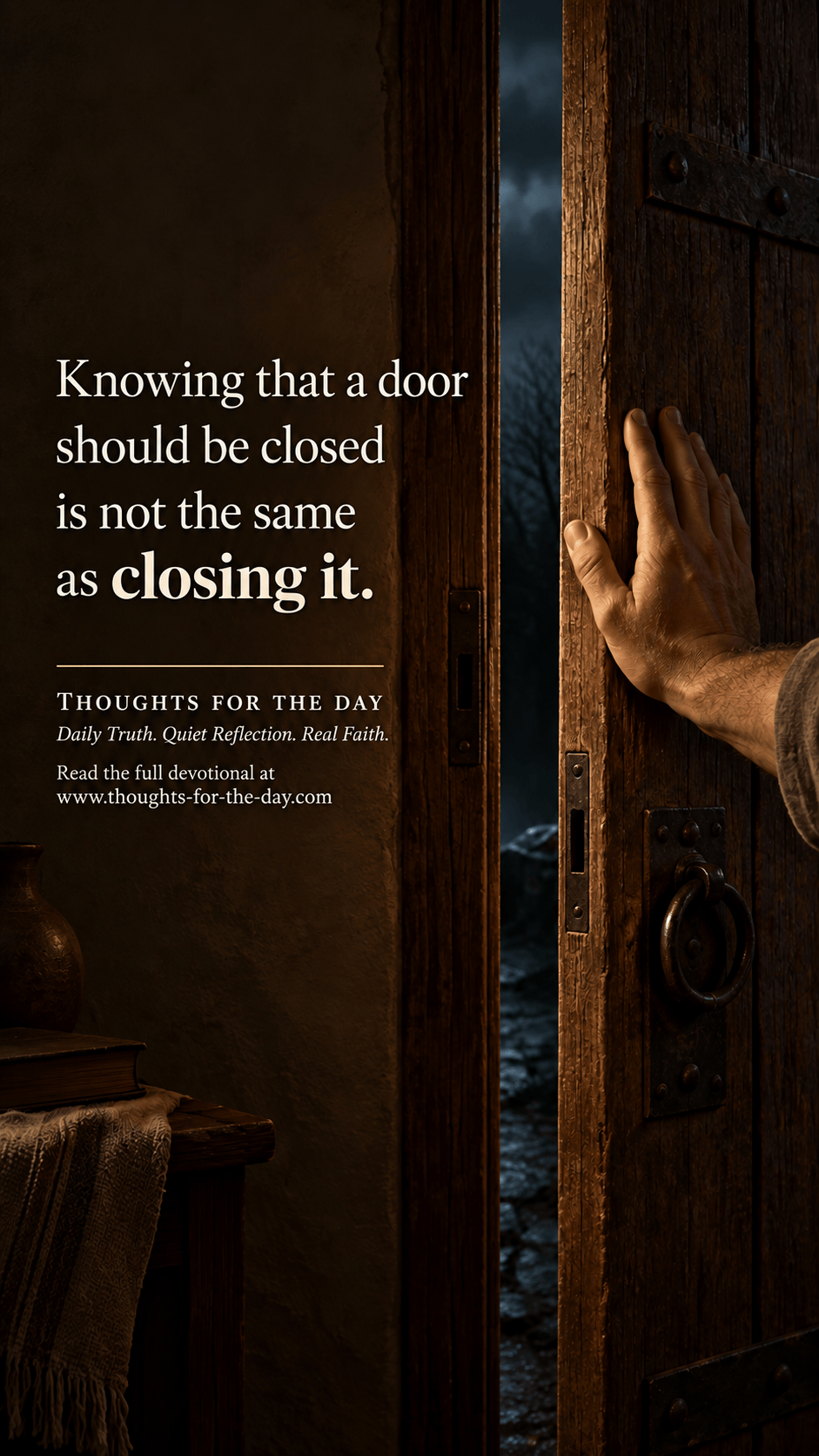
    Knowing the truth does not automatically mean we will obey it. Recognizing a danger does not protect us when we continue allowing it access. Knowing that a door should be closed is not the same as closing it.

    Samson knew Delilah was dangerous, yet he continued giving her access.

    Solomon knew foreign wives would turn his heart from God, yet Scripture says he “clung to these in love.”

    Both men understood more than they obeyed.

    Both men allowed affections to overrule convictions.

    Both discovered that what we tolerate long enough can eventually take what we never intended to surrender.

    This warning does not end with us. Judges 2 reminds us that the doors one generation leaves open may become the snares that capture the next.

    If we do not teach those coming behind us what God has done, other voices will tell them that He has done nothing.

    If we do not explain why His Word matters, the surrounding culture will offer them another standard.

    If our homes contain more outrage than prayer, more entertainment than worship, and more criticism than testimony, we should not be surprised when the next generation knows our opinions but does not know our God.

    We cannot force another generation to believe. Every person must respond to God individually. But we are responsible for what we teach, what we model, what we tolerate, and which doors we leave standing open.

    There is mercy even in Samson’s story:

    “However, the hair of his head began to grow again after it had been shaven.”
    —Judges 16:22 NKJV

    His consequences did not disappear. His eyes were not restored, and the years he had squandered were not returned. But God had not forgotten him. Samson prayed again, and God heard him.

    Grace offers restoration, but grace should never be used to make compromise appear harmless.

    Perhaps there is a voice you have continued entertaining even though you know where it is leading.

    Perhaps there is an attitude entering your home that is changing its spiritual atmosphere.

    Perhaps there is a relationship, conversation, habit, or source of influence that keeps reaching for the place of your consecration.

    Do not wait until it has taken what you never intended to surrender.

    Guard your heart.

    Not casually. Not occasionally. With all diligence.

    Be careful which voices receive continual access to it. Pay attention to what weakens your convictions, disturbs the spiritual atmosphere of your home, or gradually makes disobedience seem reasonable.

    Remember what God has done.

    Teach it to those coming behind you.

    Remain sensitive enough to recognize His voice—and humble enough to respond when He warns you.

    When God reveals that something has become a snare, do not keep testing your strength against it.

    Close the door.

    Some doors must be closed—not because we hate the person outside, but because we understand the value of what God has placed within.
  • Two Kings. Two Prophets. Two Hearts.

    Two Kings. Two Prophets. Two Hearts.

    Last weekend, Lisa and I had the opportunity to see David at Sight & Sound in Branson.

    The production was outstanding.

    Like most people, I expected to leave thinking about Goliath.

    Instead, I couldn’t stop thinking about Nathan.

    As I watched the prophet confront David over his sin with Bathsheba and Uriah, I found myself comparing that scene with another confrontation recorded in Scripture.

    Two kings.

    Two prophets.

    Two sins.

    Two completely different responses.

    King Saul was confronted by Samuel after sparing King Agag and keeping the best of the Amalekite livestock, despite God’s clear command to destroy everything.

    King David was confronted by Nathan after committing adultery with Bathsheba and arranging for Uriah to be killed in battle.

    Neither man sought out correction.

    God sent a prophet to them.

    Both men had sinned.

    Both men were confronted.

    But that’s where the similarities end.

    When Samuel confronted Saul, his first response wasn’t confession.

    It was self-defense.

    “I have obeyed…”

    “The people took of the spoil…”

    “It was to sacrifice unto the Lord…”

    Excuse followed excuse.

    Responsibility was shifted.

    Blame was shared.

    Even after finally saying, “I have sinned,” Saul immediately added another request:

    “Honor me now, I pray thee, before the elders of my people.”

    Even in repentance, he was still concerned about preserving his image.

    Then Nathan stood before David.

    He didn’t begin with an accusation.

    He told a story.

    A rich man stole the only lamb a poor man possessed.

    David was furious.

    “The man that hath done this thing shall surely die!”

    Then Nathan spoke four words that have echoed through history.

    “Thou art the man.”

    At that moment, David could have done exactly what Saul had done.

    He could have blamed Bathsheba.

    He could have blamed loneliness.

    He could have blamed the pressures of leadership.

    He could have blamed anyone but himself.

    Instead, David uttered one of the shortest—and most powerful—confessions in all of Scripture.

    “I have sinned against the LORD.”

    No excuses.

    No blame shifting.

    No attempts to justify himself.

    Just honest repentance.

    David’s sin was enormous.

    Adultery.

    Deception.

    Murder.

    None of it was minimized.

    The consequences were real, painful, and far-reaching.

    His family suffered.

    His kingdom suffered.

    David himself suffered.

    Repentance does not erase earthly consequences.

    But it does restore fellowship with God.

    I’ve often wondered why preachers spend far more time talking about David and Goliath than David and Nathan.

    Perhaps it’s because Goliath is easier.

    We all like sermons that ask,

    “What giant are you facing?”

    Nathan asks a far more uncomfortable question.

    “Where are you refusing God’s correction?”

    One sermon inspires us.

    The other examines us.

    One points to battles around us.

    The other exposes battles within us.

    As I reflected on the production afterward, another thought settled into my heart.

    The greatest difference between Saul and David wasn’t that one sinned and the other didn’t.

    Both failed.

    Both needed mercy.

    The difference was what happened after God confronted them.

    Saul defended himself.

    David humbled himself.

    One protected his reputation.

    The other surrendered his heart.

    I don’t believe God is looking for people who never fail.

    If He were, none of us would qualify.

    I believe He’s looking for people who remain teachable.

    People who are willing to hear hard truth.

    People who care more about holiness than appearance.

    People who, when confronted by the Spirit of God, are willing to say,

    “Lord… You’re right.”

    Because every one of us will eventually have a “Thou art the man” moment.

    The question isn’t whether correction will come.

    The question is what kind of heart it will find.

    Final Word

    David wasn’t called “a man after God’s own heart” because he never sinned.

    He was called that because when God exposed his sin, he didn’t harden his heart.

    He humbled it.

    The difference between Saul and David wasn’t the seriousness of their failures.

    It was the condition of their hearts after they were confronted.

    May we never become so concerned with protecting our reputation that we stop listening to God’s correction.

    Because the path to restoration doesn’t begin with defending ourselves.

    It begins with four simple words…

    “I have sinned, Lord.”

  • Lord, Use Me — Even in the Humble Things

    “Jesus, use me. O Lord, don’t refuse me. Surely there’s a work that I can do. Even though it’s humble, Lord help my will to crumble. For though the cost be great, I’ll work for you.”

    These lyrics from a song my mother used to hum while folding laundry or picking tomatoes have echoed in my heart lately. Back then, I thought it was just a sweet old tune. Now I know better. It’s a prayer of surrender. A plea for purpose. A cry of commitment.

    We often associate “working for God” with grand gestures—preaching, missions, miracles. But more often, the work is humble.

    It’s obedience when no one sees.

    Faithfulness in the mundane.

    Forgiveness when it hurts.

    Jesus said,

    “He who is faithful in what is least is faithful also in much.” (Luke 16:10, NKJV)

    And again,

    “Take up your cross daily, and follow Me.” (Luke 9:23, NKJV)

    The cross doesn’t always look like suffering on a public stage. Sometimes it looks like dying to your pride in a private moment.

    Think of William Tyndale—burned at the stake for translating the Bible. His work was humble, slow, unseen for years. Yet because of him, we hold the Word of God in our hands today.

    Today, ask yourself:

    What work has God called you to that you’ve been resisting because it’s “too small”?

    Have you asked God to use you but ignored His invitations to humble service?

    Is your will still on the throne, or have you let it crumble at the foot of the cross?

    There is a work you can do. But you’ll never do it if you wait for applause, comfort, or control.

    Today, make the same choice that old song proclaims:

    Even though it’s humble, Lord, I’ll work for You.