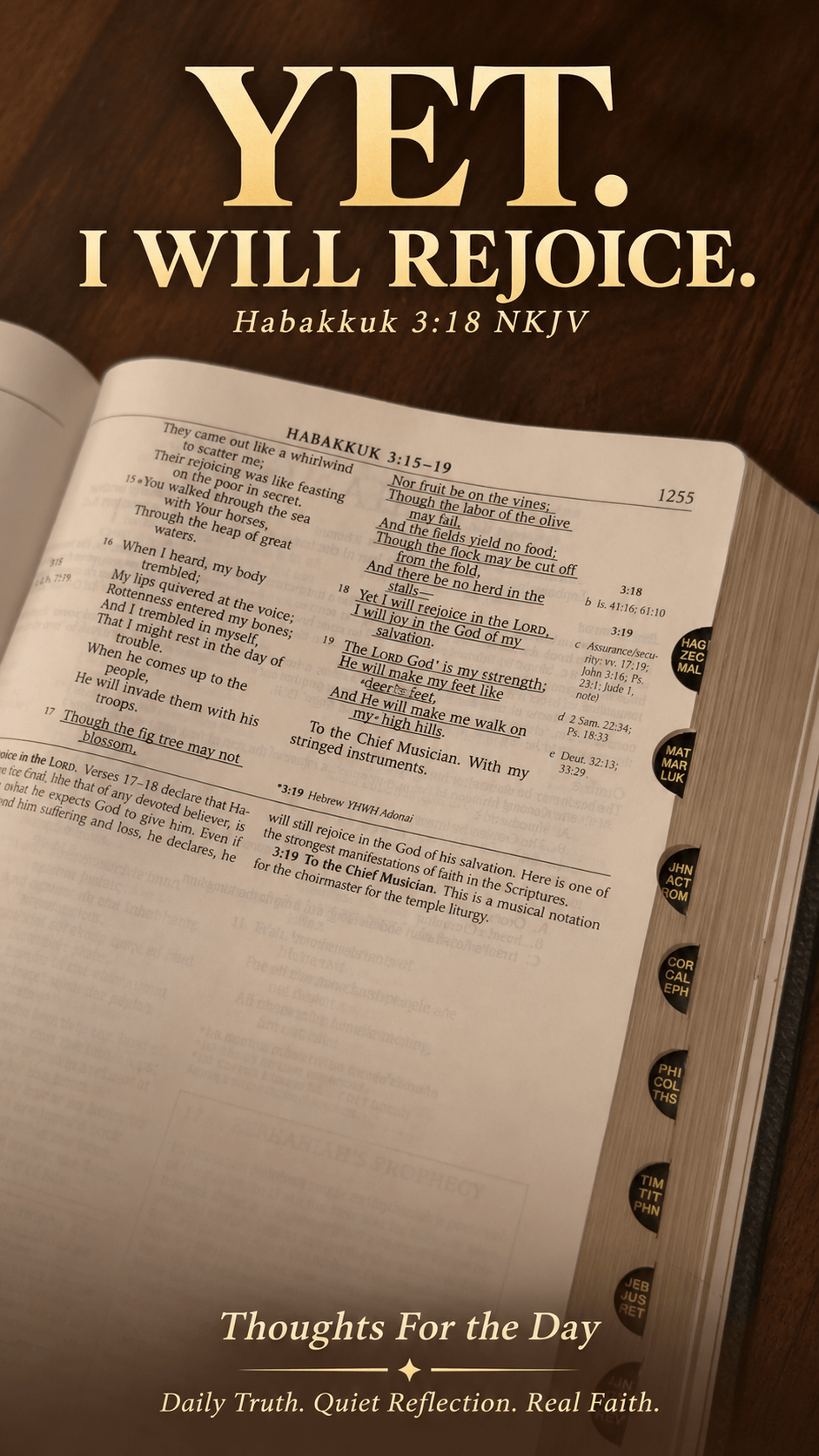
Habakkuk 3:17–19 NKJV
One night in 2023, I couldn’t sleep.
It was sometime after midnight during the months after my now ex-wife had left without warning. I remained in Oklahoma dealing with the fallout and facing the sale of the house. The life I’d known was coming apart, and I couldn’t see what waited for me beyond that season.
So I did what I’ve often done when sleep would not come.
I got up, opened my Bible where the pages landed, and began to read.
I found myself in Habakkuk:
“Though the fig tree may not blossom,
Nor fruit be on the vines;
Though the labor of the olive may fail,
And the fields yield no food;
Though the flock may be cut off from the fold,
And there be no herd in the stalls—
Yet I will rejoice in the LORD,
I will joy in the God of my salvation.
The LORD God is my strength;
He will make my feet like deer’s feet,
And He will make me walk on my high hills.”
Habakkuk was describing more than a disappointing harvest.
The fig tree, vines, olives, fields, flocks, and herds represented food, income, stability, and the expectation of tomorrow. He imagined every familiar source of provision failing at once. There would be nothing growing in the fields, nothing gathered from the trees, and nothing remaining in the stalls.
Then he said one of the most powerful words in Scripture:
Yet.
He didn’t say the losses were insignificant. He didn’t call an empty field full or pretend the failed harvest didn’t matter. He named each loss before declaring his response.
“Yet I will rejoice in the LORD.”
His rejoicing wasn’t attached to evidence that conditions were improving. He didn’t say he would rejoice when the fig tree blossomed again, when fruit returned to the vines, or when the stalls were filled.
He resolved to rejoice in the God of his salvation while the branches were still bare.
Notice the wording: “I will joy in the God of my salvation.”
Habakkuk is doing more than reporting an emotion. In that sentence, joy is a verb—a response he resolves to make while the fields remain empty. Joy still involves the heart, but it is not held hostage by whatever he feels in that moment. His sorrow may be real, but it will not decide whether God receives his worship.
As I read those words that night, I was reminded of an exercise from my final semester of college.
In a class called Philosophy of Life, we were asked to imagine that we’d been diagnosed with cancer and given six months to live. We began by writing down everything that mattered to us. As we moved through the imagined dying process, we had to surrender those things one at a time.
Some were surprisingly easy to release. Possessions, accomplishments, and plans quickly lost their importance.
Then the choices became painful.
My final four were:
- My family
- My wife
- My Bible
- My faith
I released my family first, then my wife. Some classmates criticized me for letting go of my wife while keeping my Bible.
But the exercise wasn’t asking us to decide whom we loved most. It was forcing us to confront what death eventually requires us to release. The truth was that death would separate us no matter how tightly I wanted to hold on.
Eventually, I was left with only two things.
My Bible…
and my faith.
My Bible had been my spiritual roadmap. God’s Word had sustained me through seasons of plenty, loss, sorrow, and uncertainty. But the Bible in my hands was still a physical object. The time would come when I would be too weak to pick it up or focus my eyes long enough to read it.
The faith formed within me through that Word was different.
I could not surrender it.
By the time the exercise ended, there was hardly a dry eye in the classroom. What began as an assignment had forced us to examine what would remain when everything temporary was gone.
Years later, that lesson no longer felt hypothetical.
I was awake after midnight, facing the loss of my marriage, my home, and the future I thought I knew. The things I had once imagined surrendering in a classroom were being removed from my life in ways I had never expected.
Habakkuk did not promise me that the house would not be sold. The passage did not promise that my marriage would be restored. It did not explain why any of it was happening.
It gave me a word for the middle of it:
Yet.
Though life does not look as I expected—yet I will rejoice.
Though I cannot see what comes next—yet I will rejoice.
Though something precious has been lost—yet I will rejoice in the LORD.
This is not forced cheerfulness. Rejoicing doesn’t require us to call loss good. It declares that God remains good when the things we received from Him are no longer in our hands.
Habakkuk continues:
“The LORD God is my strength.”
He doesn’t find strength in a changing forecast or early signs of another harvest. His strength is the Lord Himself.
God gives him feet like the deer—steady feet capable of walking across difficult and elevated ground. The terrain may remain steep, but God will give him what he needs to walk through it.
Perhaps something in your life looks empty today.
You may be staring at a bare branch, an empty field, or a future that no longer resembles the one you planned. You do not have to deny what has been lost. Habakkuk did not.
But loss does not get the final word.
There is another word faith can speak before anything changes:
Yet.
I may not understand this season, yet I will rejoice in the LORD.
I may not see the answer, yet I will joy in the God of my salvation.
I may feel weak, yet the LORD God is my strength.
Habakkuk’s joy was not rooted in his ability to hold on to everything he loved. His joy was rooted in the God who would still be holding him when everything else was gone.
Final Word: Rejoicing does not call the loss good. It declares that God remains good.

