Tag: Heart Check

  • Two Kings. Two Prophets. Two Hearts.

    Two Kings. Two Prophets. Two Hearts.

    Last weekend, Lisa and I had the opportunity to see David at Sight & Sound in Branson.

    The production was outstanding.

    Like most people, I expected to leave thinking about Goliath.

    Instead, I couldn’t stop thinking about Nathan.

    As I watched the prophet confront David over his sin with Bathsheba and Uriah, I found myself comparing that scene with another confrontation recorded in Scripture.

    Two kings.

    Two prophets.

    Two sins.

    Two completely different responses.

    King Saul was confronted by Samuel after sparing King Agag and keeping the best of the Amalekite livestock, despite God’s clear command to destroy everything.

    King David was confronted by Nathan after committing adultery with Bathsheba and arranging for Uriah to be killed in battle.

    Neither man sought out correction.

    God sent a prophet to them.

    Both men had sinned.

    Both men were confronted.

    But that’s where the similarities end.

    When Samuel confronted Saul, his first response wasn’t confession.

    It was self-defense.

    “I have obeyed…”

    “The people took of the spoil…”

    “It was to sacrifice unto the Lord…”

    Excuse followed excuse.

    Responsibility was shifted.

    Blame was shared.

    Even after finally saying, “I have sinned,” Saul immediately added another request:

    “Honor me now, I pray thee, before the elders of my people.”

    Even in repentance, he was still concerned about preserving his image.

    Then Nathan stood before David.

    He didn’t begin with an accusation.

    He told a story.

    A rich man stole the only lamb a poor man possessed.

    David was furious.

    “The man that hath done this thing shall surely die!”

    Then Nathan spoke four words that have echoed through history.

    “Thou art the man.”

    At that moment, David could have done exactly what Saul had done.

    He could have blamed Bathsheba.

    He could have blamed loneliness.

    He could have blamed the pressures of leadership.

    He could have blamed anyone but himself.

    Instead, David uttered one of the shortest—and most powerful—confessions in all of Scripture.

    “I have sinned against the LORD.”

    No excuses.

    No blame shifting.

    No attempts to justify himself.

    Just honest repentance.

    David’s sin was enormous.

    Adultery.

    Deception.

    Murder.

    None of it was minimized.

    The consequences were real, painful, and far-reaching.

    His family suffered.

    His kingdom suffered.

    David himself suffered.

    Repentance does not erase earthly consequences.

    But it does restore fellowship with God.

    I’ve often wondered why preachers spend far more time talking about David and Goliath than David and Nathan.

    Perhaps it’s because Goliath is easier.

    We all like sermons that ask,

    “What giant are you facing?”

    Nathan asks a far more uncomfortable question.

    “Where are you refusing God’s correction?”

    One sermon inspires us.

    The other examines us.

    One points to battles around us.

    The other exposes battles within us.

    As I reflected on the production afterward, another thought settled into my heart.

    The greatest difference between Saul and David wasn’t that one sinned and the other didn’t.

    Both failed.

    Both needed mercy.

    The difference was what happened after God confronted them.

    Saul defended himself.

    David humbled himself.

    One protected his reputation.

    The other surrendered his heart.

    I don’t believe God is looking for people who never fail.

    If He were, none of us would qualify.

    I believe He’s looking for people who remain teachable.

    People who are willing to hear hard truth.

    People who care more about holiness than appearance.

    People who, when confronted by the Spirit of God, are willing to say,

    “Lord… You’re right.”

    Because every one of us will eventually have a “Thou art the man” moment.

    The question isn’t whether correction will come.

    The question is what kind of heart it will find.

    Final Word

    David wasn’t called “a man after God’s own heart” because he never sinned.

    He was called that because when God exposed his sin, he didn’t harden his heart.

    He humbled it.

    The difference between Saul and David wasn’t the seriousness of their failures.

    It was the condition of their hearts after they were confronted.

    May we never become so concerned with protecting our reputation that we stop listening to God’s correction.

    Because the path to restoration doesn’t begin with defending ourselves.

    It begins with four simple words…

    “I have sinned, Lord.”

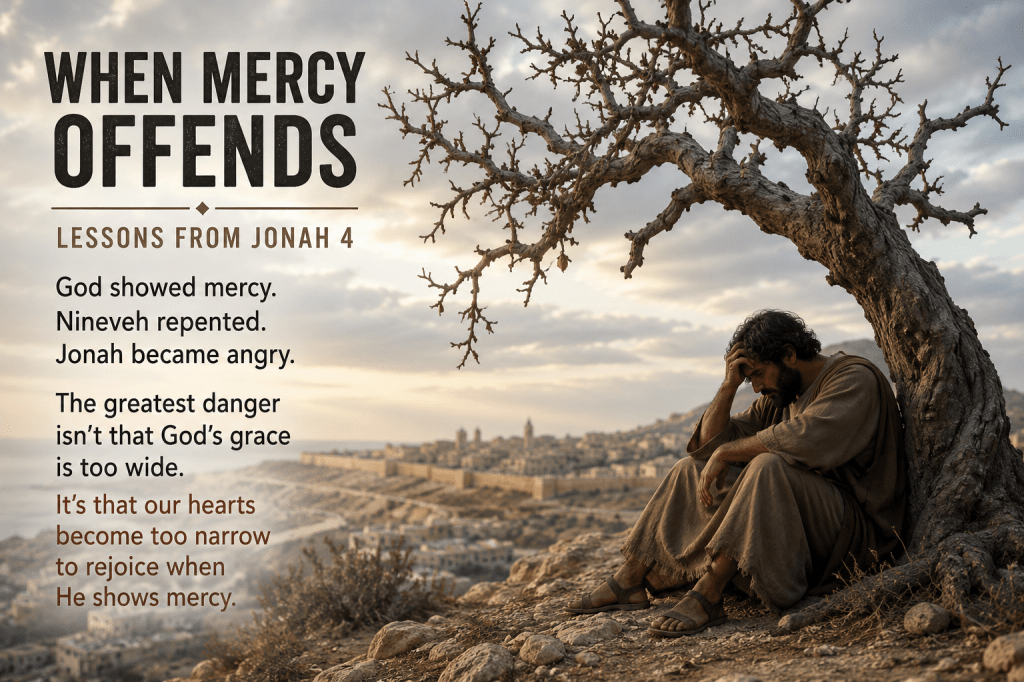
  • Sunday Studies – Mercy Offends: Lessons from Jonah 4

    Sunday Studies – Mercy Offends: Lessons from Jonah 4

    Most of us know the story of Jonah.

    We remember the storm.

    The great fish.

    The reluctant prophet finally walking through the streets of Nineveh proclaiming God’s coming judgment.

    What often surprises people is that the real climax of the book doesn’t happen when Jonah is swallowed by the fish.

    It happens after Nineveh repents.

    The greatest revival recorded in the Old Testament had just taken place.

    From the king to the common citizen, the people humbled themselves before God. They fasted, repented, and turned from their violence. In response, God withheld the judgment He had promised.

    If we were writing the story, this would be the perfect ending.

    The prophet preached.

    The people repented.

    God showed mercy.

    Everyone celebrates.

    Instead, Jonah chapter 4 opens with these startling words:

    “But it displeased Jonah exceedingly, and he became angry.” (Jonah 4:1)

    Jonah wasn’t angry because his message failed.

    He was angry because it succeeded.

    He had witnessed exactly what every prophet should long to see—repentance, mercy, and revival.

    And he hated it.

    That should stop every one of us in our tracks.

    Why Was Jonah Angry?

    Jonah explains it himself.

    “I knew that You are a gracious and merciful God, slow to anger and abundant in lovingkindness…” (Jonah 4:2)

    Notice what Jonah is saying.

    He isn’t questioning God’s character.

    He knew God’s character perfectly.

    He simply didn’t want God’s mercy extended to those people.

    The Assyrians weren’t misunderstood.

    They were notoriously cruel. They conquered nations through terror, torture, and brutality. Humanly speaking, Jonah’s hatred made sense.

    What didn’t make sense to Jonah was that God’s mercy could be greater than Nineveh’s wickedness.

    Our Jonah Moments

    Before we’re too hard on Jonah, we should ask ourselves a difficult question.

    Who is our Nineveh?

    Who do we quietly believe has crossed the line beyond God’s mercy?

    Maybe it’s a murderer.

    A rapist.

    A child molester.

    An abusive spouse.

    A corrupt politician.

    Someone who destroyed your family.

    Someone who betrayed your trust.

    Most of us have someone.

    We may never say it aloud, but somewhere deep inside we think,

    “Lord… surely not them.”

    That’s where Jonah meets us.

    Justice and Mercy

    This is where many people struggle.

    If God forgives someone guilty of terrible crimes, does that mean justice no longer matters?

    Not at all.

    Scripture never teaches that forgiveness removes earthly consequences.

    David was forgiven, but still lived with painful consequences.

    Moses was forgiven, yet never entered the Promised Land.

    The thief on the cross received mercy, but still died under Roman execution.

    A murderer who genuinely repents may still spend the rest of his life in prison.

    A child molester who truly comes to Christ should still face every legal consequence and every necessary safeguard to protect others.

    Grace does not erase justice.

    It restores a sinner’s relationship with God.

    Those are not the same thing.

    What Forgiveness Looks Like

    Perhaps you’re thinking,

    “That’s easy to say until it’s your child.”

    For one Oklahoma father, it was.

    In 2006, ten-year-old Lindsay Wagoner was raped and murdered. For thirteen years, her father, Bill Wagoner, carried the crushing weight of hatred toward the man who had taken his daughter’s life.

    Eventually, Bill came to a painful realization.

    The man who murdered Lindsay had already stolen enough from his family.

    He wasn’t going to allow him to steal the rest of his life as well.

    In 2019, Bill chose to meet face-to-face with the man who murdered his daughter. He forgave him and shared with him the message of Jesus Christ and the forgiveness that had first been extended to him.

    That meeting didn’t change what had happened.

    It didn’t erase the murder.

    It didn’t remove the prison sentence.

    It didn’t make evil good.

    But it did break the chains that hatred had wrapped around a grieving father’s heart.

    Bill’s story reminds us that forgiveness is never declaring evil to be acceptable.

    It is refusing to allow evil to have the final word.

    Jonah could preach repentance to Nineveh.

    Bill Wagoner lived it.

    One wanted judgment to have the final word.

    The other chose to let mercy have it.

    That is the crossroads every follower of Christ eventually reaches.

    The Foot of the Cross Is Level

    The uncomfortable truth is this:

    The ground at the foot of the cross is perfectly level.

    The respectable church member and the violent criminal are both saved exactly the same way.

    Neither earns forgiveness.

    Neither deserves forgiveness.

    Both stand before God entirely because of grace.

    That doesn’t make their sins equally destructive in this life.

    But it does remind us that salvation has never been based upon the size of our sin.

    It has always been based upon the greatness of our Savior.

    Jonah, the Older Brother… and Us

    Jonah wasn’t the only one to struggle with this.

    Jesus told the story of the prodigal son.

    Most of us celebrate the younger brother coming home.

    But the older brother became angry because someone he believed deserved judgment received mercy instead.

    The Pharisees struggled with tax collectors.

    Peter struggled with Gentiles receiving the Holy Ghost.

    The workers in Jesus’ vineyard parable struggled when those who worked only one hour received the same wage.

    Again and again, Scripture exposes the same temptation.

    We love mercy…

    …until it’s given to someone we don’t think deserves it.

    Looking Into the Mirror

    The Book of Jonah ends strangely.

    There’s no neat conclusion.

    No record of Jonah changing his heart.

    Instead, God simply asks,

    “Is it right for you to be angry?” (Jonah 4:4)

    Then the book ends.

    Almost as though God intentionally leaves the final chapter unfinished.

    Because the last chapter isn’t really about Jonah.

    It’s about us.

    Will we rejoice only when God’s mercy reaches people like us?

    Or will we celebrate whenever another sinner finds forgiveness—even someone we believed was beyond redemption?

    The measure of our understanding of grace isn’t how thankful we are that God forgave us.

    It’s whether we can rejoice when He forgives someone we never thought deserved it.

    Final Word

    The real miracle in Jonah isn’t that God spared Nineveh.

    It’s that God patiently pursued Jonah while his heart was resisting mercy.

    The greatest danger isn’t that God’s grace is too wide.

    It’s that our hearts become too narrow to rejoice when His grace reaches someone we never thought it should.

    If God had drawn the line where we often wish He would…

    none of us would be invited to the Marriage Supper of the Lamb.

  • Divine Disruptions – Day 4

    Divine Disruptions – Day 4

    Pharaoh: When Pride Outlives the Plagues

    📖 “But Pharaoh hardened his heart at this time also…” — Exodus 8:32 (NKJV)


    Pharaoh didn’t miss what God was saying.
    He just didn’t like what it required.

    And that’s what makes his story so dangerous—it shows us that spiritual blindness isn’t always about ignorance. Sometimes it’s about arrogance.

    God didn’t start small with Pharaoh. He sent Moses with a simple but loaded message:

    “Let My people go.”
    Pharaoh’s response? “Who is the Lord, that I should obey His voice?” (Exodus 5:2)

    And right there, the line was drawn.
    Pharaoh didn’t just reject the message—he rejected the authority behind it.


    🔥 Then the disruption began.

    God sent plagues.
    Not just natural disasters, but direct attacks on the Egyptian gods—each plague a divine dismantling of Egypt’s pride, power, and control.

    • The Nile turned to blood—a death blow to Egypt’s economy and spirituality.
    • Frogs swarmed their homes.
    • Dust became lice.
    • Disease struck their livestock.
    • Boils covered their bodies.
    • Hail pounded their crops.
    • Locusts devoured what was left.
    • Darkness covered the land.
    • And finally, death entered every Egyptian home.

    Nine chances to bow.
    Nine divine warnings to surrender.
    And yet… Pharaoh hardened his heart. Again. And again. And again.


    “And the Lord hardened Pharaoh’s heart…” (Exodus 9:12)

    That verse shakes me. Because it’s not just that Pharaoh resisted—God eventually confirmed it.

    God gave Pharaoh opportunity after opportunity to repent.
    But Pharaoh was more committed to being right than being righteous.
    He didn’t want to lose control.
    He didn’t want to look weak.
    He didn’t want to give up the throne.

    So God gave him over to the very pride he refused to let go.


    ⚠️ Here’s the warning that hits us today:

    You can be surrounded by miracles… and still choose rebellion.
    You can feel conviction… and still ignore it.
    You can see God working… and still harden your heart.

    Divine disruptions are supposed to wake us up.
    But if we resist long enough, they stop being invitations—and become judgments.


    Pharaoh’s stubbornness didn’t just cost him personally.
    It broke a nation.
    His army drowned. His people suffered. His name became synonymous with rebellion.

    And here’s the moment that seals it:

    Pharaoh’s story doesn’t end in repentance.
    It ends in a watery grave—at the bottom of the very sea those he pursued had just walked through.
    Because sometimes, what we chase in rebellion… becomes the very thing that destroys us.

    He watched the people of God walk through freedom—and followed them into judgment.


    🙏 Reflection:

    • Have I confused God’s patience with His approval?
    • What repeated disruptions have I been writing off as coincidence?
    • Is my pride blinding me to the cost of disobedience?

    When God doesn’t have your attention, He’ll disturb what does.
    Just ask Pharaoh.