Tag: Hope In Christ

  • Grace Changed the Tense

    Grace Changed the Tense

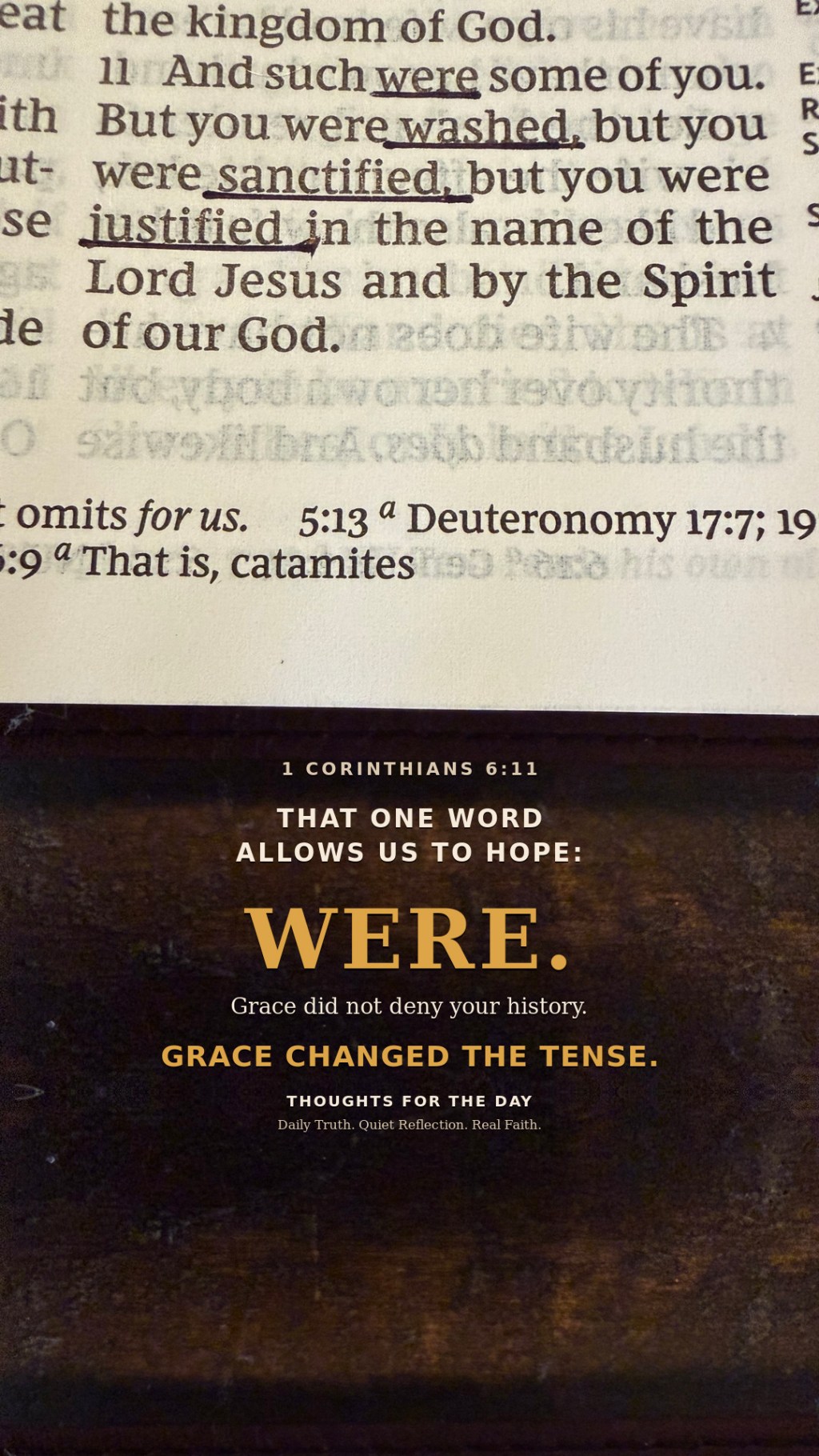
    “And such were some of you. But you were washed, but you were sanctified, but you were justified in the name of the Lord Jesus and by the Spirit of our God.”
    —1 Corinthians 6:11, NKJV

    We all have a history.

    For some, that history is relatively quiet. For others, it is dark, painful, and overpowering. It follows them into every new season and casts a shadow over everything they might still become.

    The past begins speaking:

    This is what you did.
    This is who you are.
    This is what you will always be.

    Eventually, something that happened—or something we did—stops feeling like one chapter of our story. It becomes the title we place over the entire book.

    I know the weight of that kind of history because I have lived beneath it.

    I know what it is to look back at choices I made, people I hurt, and consequences I could not undo—and believe that my past had already determined my future.

    For a long time, I did not merely remember what I had done. I allowed it to pronounce a sentence over who I was, what I could become, and whether God could ever use me again.

    I am not writing about hopelessness as a theory.

    I have felt it.

    I know what it is to believe that the darkest chapter of your life has become the title of your entire story.

    Then I read Paul’s words to the church at Corinth.

    In the preceding verses, Paul gives an uncomfortable list of sins and destructive ways of life. He writes about sexual immorality, idolatry, adultery, theft, greed, drunkenness, reviling, and extortion.

    He does not minimize their past.

    He does not soften sin by calling it a mistake, a personality trait, or an unfortunate stage of life.

    He tells the truth.

    Then he writes one word that makes hope possible:

    Were.

    And such were some of you.”

    Not are.

    Not will always be.

    Not are, but now attend church.

    Were.

    That one word does not erase the sentence that came before it. It places the sentence where it belongs—in the past.

    Paul was not writing about hypothetical people. He was writing to a church where people could hear that list and say:

    That was me.
    That was my life.
    That was what controlled me.

    But that is not where Jesus left me.

    The word were means the darkest truth about yesterday does not have to remain the defining truth about today.

    It means history is real—but it is not destiny.

    It means the chapter happened—but the story did not have to end there.

    It means no matter how long someone has lived under the power of sin, Jesus can move that identity from the present tense into the past.

    But Paul does not stop with were. He follows it with three powerful interruptions:

    But you were washed.

    What had stained them had been cleansed.

    But you were sanctified.

    They had been set apart for God and given a new belonging.

    But you were justified.

    The charges against them no longer determined their standing before God.

    They did not change their tense through willpower, respectability, or religious performance. God intervened:

    “…in the name of the Lord Jesus and by the Spirit of our God.”

    Grace did not pretend that their former lives were harmless.

    Grace changed what possessed the authority to define them.

    That is what gave me hope.

    God did not tell me that my past did not matter. He showed me that it did not have to remain my identity.

    I could not go backward and undo my history. I could not erase every consequence, retrieve every lost opportunity, or remove every scar.

    But Jesus could do something I could never do.

    He could change the tense of my story.

    Perhaps your history has convinced you that there is no future beyond what you have done. Maybe shame continues speaking about your past in the present tense.

    But if Paul could look across a church filled with people carrying histories like these and say, “Such were some of you,” then no one has traveled so far into darkness that Jesus cannot redeem their story.

    “Were” is not permission to return to the old life.

    It is the declaration that you are no longer required to remain there.

    You can tell the truth about your past without allowing it to predict your future.

    You were bound—but you were washed.

    You were lost—but you were sanctified.

    You were guilty—but you were justified.

    Grace did not deny your history.

    Grace changed the tense.

  • Where Is Your Faith Anchored

    Where Is Your Faith Anchored

    “It is better to trust in the Lord than to put confidence in man.” ~ Psalm 118:8 (NKJV) ~

    Where is your faith anchored?

    It’s an easy question to answer when life is calm.

    It’s much harder to answer when someone you admire disappoints you.

    When someone you trusted walks away.

    When someone you respected falls.

    That’s when you discover what—or who—your faith has really been resting upon.

    Every time a well-known Christian leader falls…

    Social media erupts.

    Headlines spread.

    Phones buzz with text messages.

    Office conversations begin.

    Church lobbies fill with opinions.

    Some rush to defend them.

    Others rush to condemn them.

    But almost no one stops to ask the question that matters most.

    Where was my faith anchored before they fell?

    As a boy, I often heard my pastor, Rev. E. G. Bass, say something that has stayed with me for decades:

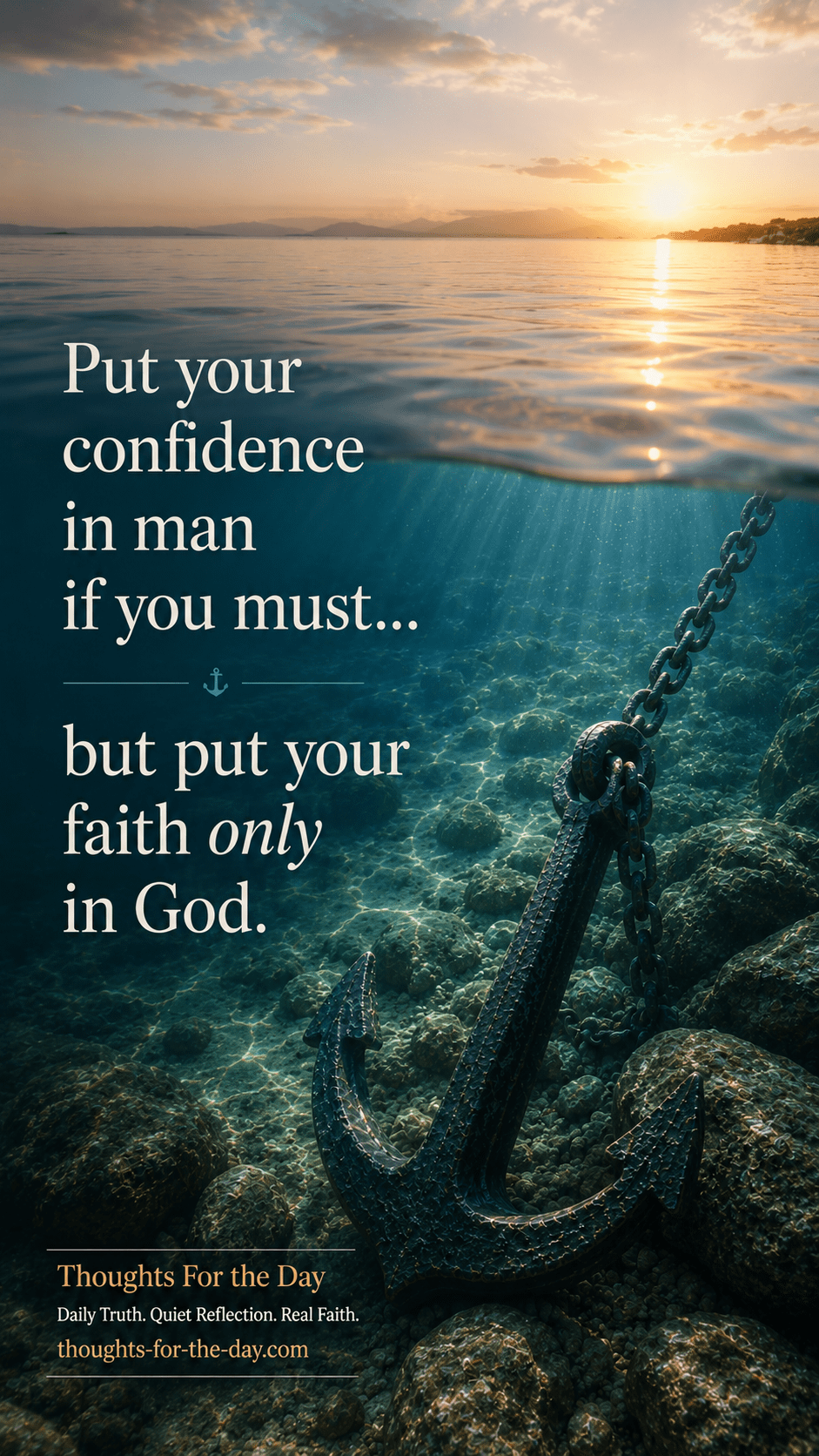
    “Put your confidence in man if you must, but put your faith only in God.”

    The older I’ve become, the more I’ve realized he was simply putting Psalm 118:8 into everyday language.

    The Bible tells us to honor faithful leaders.

    To pray for them.

    To learn from them.

    But it never tells us to build our faith upon them.

    Why?

    Because every pastor…

    Every evangelist…

    Every teacher…

    Every Christian…

    Is still a sinner in need of God’s grace.

    The Bible never hides that reality.

    Noah stumbled.

    Abraham failed.

    Moses disobeyed.

    David sinned.

    Peter denied the Lord.

    Yet the story of Scripture has never been about perfect people.

    It has always been about a perfect Savior working through imperfect people.

    So when a leader falls, our faith should not fall with them.

    Christianity was never built upon pastors.

    It was never built upon apostles.

    It was never built upon denominations.

    It was built upon Jesus Christ.

    A pastor’s failure cannot undo an empty tomb.

    A minister’s sin cannot erase the cross.

    Someone else’s unfaithfulness cannot change God’s faithfulness.

    Some who fall repent and are restored.

    Some never return.

    God’s mercy remains available.

    Whether they receive it is a choice for which they are personally responsible.

    But regardless of what anyone else chooses…

    Jesus Christ remains exactly who He has always been.

    Yesterday.

    Today.

    And forever.

    Final Word

    Love your pastor.

    Pray for your pastor.

    Be thankful for faithful spiritual leaders.

    But never ask another person to bear a weight only Christ can carry.

    As Rev. E. G. Bass used to say,

    “Put your confidence in man if you must, but put your faith only in God.”

  • Before and After

    Before and After

    📖 “Behold, I go forward, but He is not there; and backward, but I cannot perceive Him… But He knoweth the way that I take…” — Job 23:8-10

    It started as an ordinary Thursday.

    You weren’t looking for your life to change.

    You were just going to work.

    Going to the doctor.

    Going home.

    Then one conversation.

    One phone call.

    One sentence.

    …and suddenly your life had a before and an after.

    At first, it didn’t seem real.

    Surely there had been a misunderstanding.

    Maybe the tests were wrong.

    Maybe they meant someone else.

    Maybe tomorrow would somehow put everything back the way it was.

    But tomorrow came.

    And so did the questions.

    “What happens now?”

    “How am I going to get through this?”

    “What if everything changes?”

    The future that once seemed so certain suddenly became filled with uncertainty.

    The plans you had carefully made no longer seemed guaranteed.

    You found yourself lying awake at night, replaying conversations, imagining outcomes, searching for answers that refused to come.

    So you did what believers have always done.

    You prayed.
    You searched the Scriptures.
    You waited.
    You listened.

    And if you’re honest…

    heaven seemed painfully quiet.

    Not because you stopped believing.

    Not because you walked away.

    But because you couldn’t understand how God could feel so silent when your world had become so loud.

    Job understood that feeling.

    He searched in every direction.

    Forward.
    Backward.
    To the left.
    To the right.

    Everywhere he expected to find God…

    he found silence instead.

    Yet in the middle of his searching, Job spoke words that have comforted weary hearts for thousands of years.

    He didn’t say, “Now I understand.”

    He didn’t say, “Everything is going to be all right.”

    He didn’t even say, “I know where God is.”

    He simply declared what he knew to be true.

    “But He knoweth the way that I take.”

    What a remarkable statement.

    Job couldn’t see God.

    But he believed God could still see him.

    He couldn’t trace God’s hand.

    But he trusted God’s heart.

    Maybe that’s exactly where you are today.

    You’ve looked in every direction you know to look.

    You’re still waiting.
    Still praying.
    Still hoping.
    Still wondering.

    If that’s your story…

    hold on to Job’s.

    Your ability to see God has never determined His ability to see you.

    He knows where you are.

    He knows what you’re carrying.

    He knows every question you haven’t spoken aloud.

    He knows every tear that no one else has seen.

    He knows every burden you’ve tried to carry by yourself.

    And even if today you cannot say, “I know the way He is taking…”

    you can still rest in this unchanging truth:

    But He knows the way I take.

  • Independence Day and the Kingdom That Cannot Be Shaken

    Independence Day and the Kingdom That Cannot Be Shaken

    Today America celebrates 250 years of independence.

    Two hundred fifty years.

    That is an extraordinary milestone.

    Today there will be parades, flags waving in the breeze, backyard cookouts, fireworks lighting the night sky, and families gathering to celebrate the freedoms we often take for granted.

    And we should be thankful.

    The liberties we enjoy have come at an immeasurable cost. Countless men and women have sacrificed—some giving everything—to preserve those freedoms for future generations.

    But today also serves as a reminder of another truth.

    Every nation is temporary.

    History is filled with kingdoms and empires that once seemed unshakable. They rose to greatness, shaped the world for generations, and eventually became pages in history books.

    America, as we know it, will not escape that reality.

    No nation does.

    Some look at the political division, the cultural conflict, and the uncertainty surrounding our future and wonder what lies ahead.

    As a Christian, those things concern me.

    But they do not define my hope.

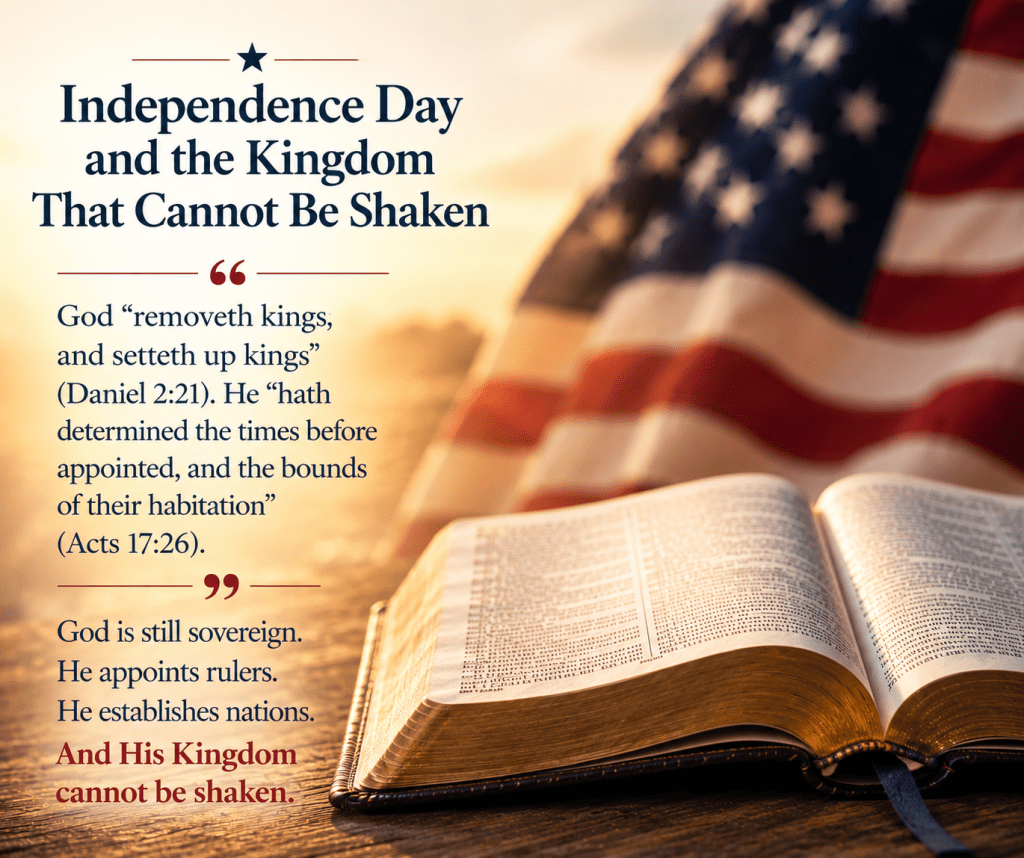
    Because Scripture reminds us that God “removeth kings, and setteth up kings” (Daniel 2:21).

    Paul declared that God “hath made of one blood all nations of men… and hath determined the times before appointed, and the bounds of their habitation” (Acts 17:26).

    God is still sovereign.

    He appoints rulers.

    He establishes nations.

    He determines their boundaries.

    He raises kingdoms up.

    And when His purposes have been fulfilled, He brings them down.

    That doesn’t mean every leader is righteous.

    It doesn’t mean every decision is wise.

    It doesn’t mean Christians stop praying, voting, serving, or standing for truth.

    It means we do those things with confidence instead of fear.

    Our hope has never rested in Washington.

    Our peace has never depended upon who occupies an office.

    Our future has never been secured by any political party.

    Our hope is found in the King whose throne has never been threatened.

    So today…

    Celebrate this nation.

    Thank God for its freedoms.

    Pray for its leaders.

    Honor those who have served.

    Work to make your community better.

    But remember that your highest citizenship is not found beneath the Stars and Stripes.

    It is found in the Kingdom of God.

    Because one day every flag will be lowered.

    Every earthly government will come to an end.

    Every nation will become part of history.

    But the Kingdom of our Lord will endure forever.

    Final Thought

    I’m grateful to be an American.

    But even more, I’m grateful to belong to a Kingdom that will never fall.

    Happy Independence Day.

    May God continue to bless America—not merely with prosperity and peace, but with hearts that humble themselves before Him.