Genesis 39:7–10; Daniel 1:8; Daniel 3:16–18; Luke 16:10 NKJV
Everyone remembers the furnace.
We remember Shadrach, Meshach, and Abed-Nego standing while everyone around them bowed. We remember their answer to Nebuchadnezzar:
Our God is able.
But if not.
We will not bow.
What we may not consider is how long it took to form the faith behind that answer.
The three Hebrews did not begin building their convictions while the furnace was being heated. That was no place to begin deciding whom they would worship. The pressure was too great, the cost was too high, and the moment demanded an immediate answer.
Their decision had been made long before the music began.
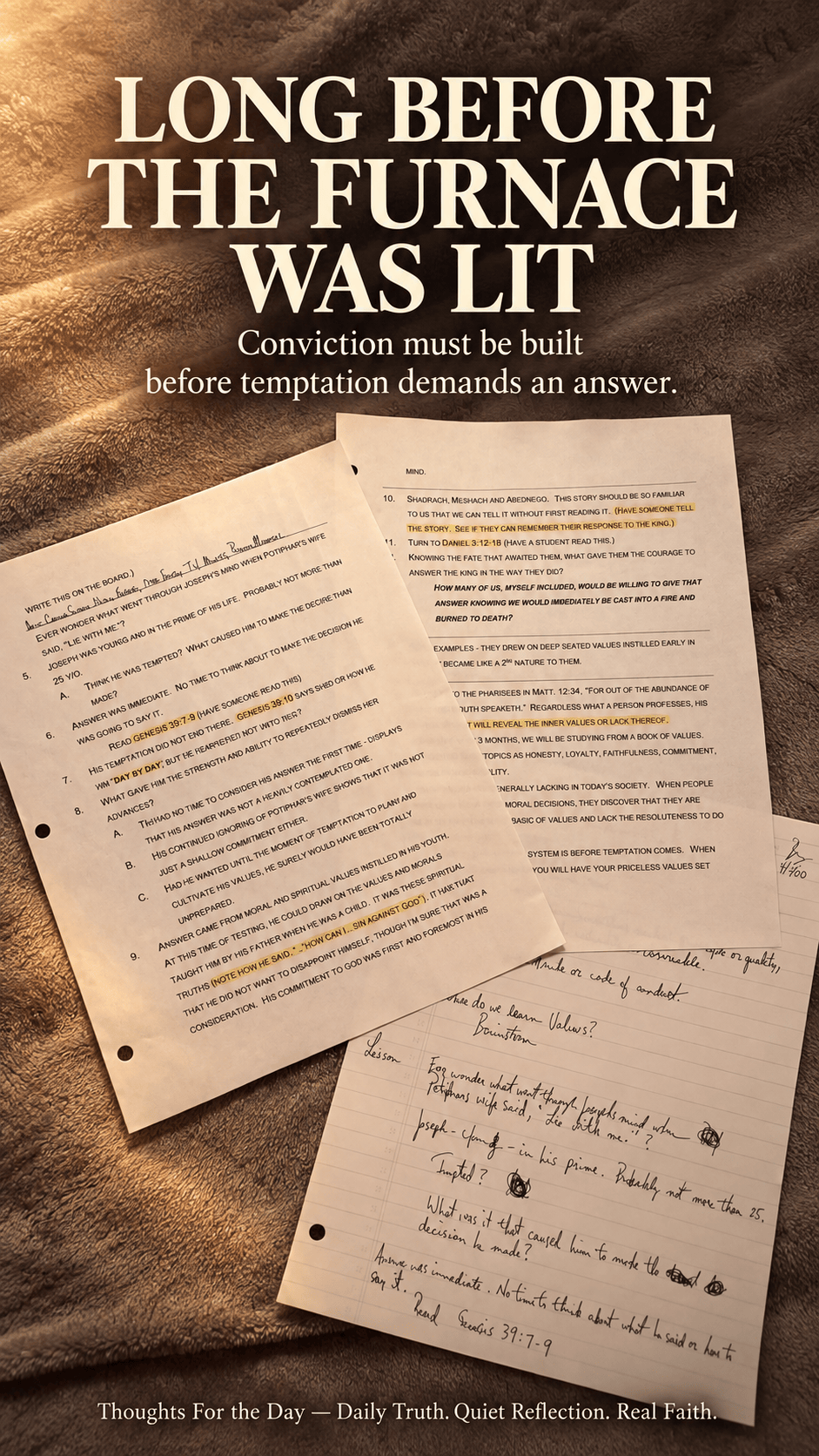
Years ago, I taught a Sunday-school series called Values That Last. One of those lessons centered on another young man far from home: Joseph.
Joseph had been betrayed by his brothers, carried into Egypt, and sold as a slave. He was separated from his father, his family, and everything familiar. Then Potiphar’s wife repeatedly attempted to draw him into sin.
Joseph did not need time to decide whether her offer was wrong. His response was immediate:
“How then can I do this great wickedness, and sin against God?”
— Genesis 39:9 NKJV
Joseph did not merely refuse once. Scripture says she spoke to him day by day, and he continued to refuse.
Potiphar’s house was not where Joseph began developing his convictions.
The temptation revealed his integrity.
It did not create it.
Joseph’s response came from truth that had been instilled in his youth, buried deeply within his heart, and made personal before the temptation arrived. He was no longer standing beside his father. There was no teacher in the room reminding him what was right. As far as Joseph knew, no one who loved him would ever learn what he chose to do.
But Joseph knew that God would know.
When I taught that lesson, I told those young people that they might someday find themselves a thousand miles from home, surrounded by people who did not know them and apparently accountable to no one. If they waited until that moment to decide what they believed and how they intended to live, it would be too late.
Conviction must be built before temptation demands an answer.
The same truth appears in the lives of Daniel, Shadrach, Meshach, and Abed-Nego.
The Bible does not record the lessons they heard as children. It does not tell us the names of the parents, teachers, or spiritual leaders who helped form them. But Daniel 1 shows us the convictions they carried into captivity.
Babylon changed their location. It changed their names. It began teaching them a new language, a new literature, and a new way of life.
But Babylon encountered something already present within them.
“But Daniel purposed in his heart that he would not defile himself with the portion of the king’s delicacies, nor with the wine which he drank.”
— Daniel 1:8 NKJV
Daniel spoke, and the four young men stood together in that decision.
Even that was not the beginning of their faith. It was the first recorded evidence of a faith already being lived. Before they refused to bow before the king’s image, they had refused to compromise at the king’s table.
The table prepared them for the furnace.
The private decision prepared them for the public stand.
Jesus said:
“He who is faithful in what is least is faithful also in much.”
— Luke 16:10 NKJV
Faithfulness in smaller matters may not feel dramatic. Prayer when no crisis is present does not attract much attention. Reading Scripture when no immediate answer is required may appear ordinary. Obeying God when compromise would be easy and invisible may never become a story anyone else tells.
But those quiet acts are forming something within us.
They teach the heart where to turn.
They settle questions before pressure asks them.
They establish whom we serve before another voice demands our allegiance.
This is why parents, teachers, and churches must plant truth early. Convictions do not pass automatically from one generation to the next. They must be taught, modeled, repeated, and lived.
But there also comes a moment when inherited instruction must become personal conviction.
Joseph could not rely upon Jacob’s presence in Potiphar’s house.
The four Hebrew youths could not rely upon Jerusalem while living in Babylon.
The truth they had received had to become the truth by which they lived.
None of us knows exactly what test may come tomorrow. Most of us will never stand before a literal fiery furnace. But we will encounter moments when compromise offers an easier road, when obedience carries a cost, or when no one appears to be watching.
That moment is not the time to begin building faith.
Crisis does not usually give us time to develop convictions. It calls upon the convictions we have already developed.
The furnace revealed the faith of Shadrach, Meshach, and Abed-Nego.
It did not create it.
The stand you may need tomorrow is being formed by the truth you receive, the convictions you settle, and the choices you make with God today.


