“There is therefore now no condemnation to those who are in Christ Jesus…”
—Romans 8:1, NKJV
In a sermon about labels, Bishop Tim Hill told a story from his childhood.
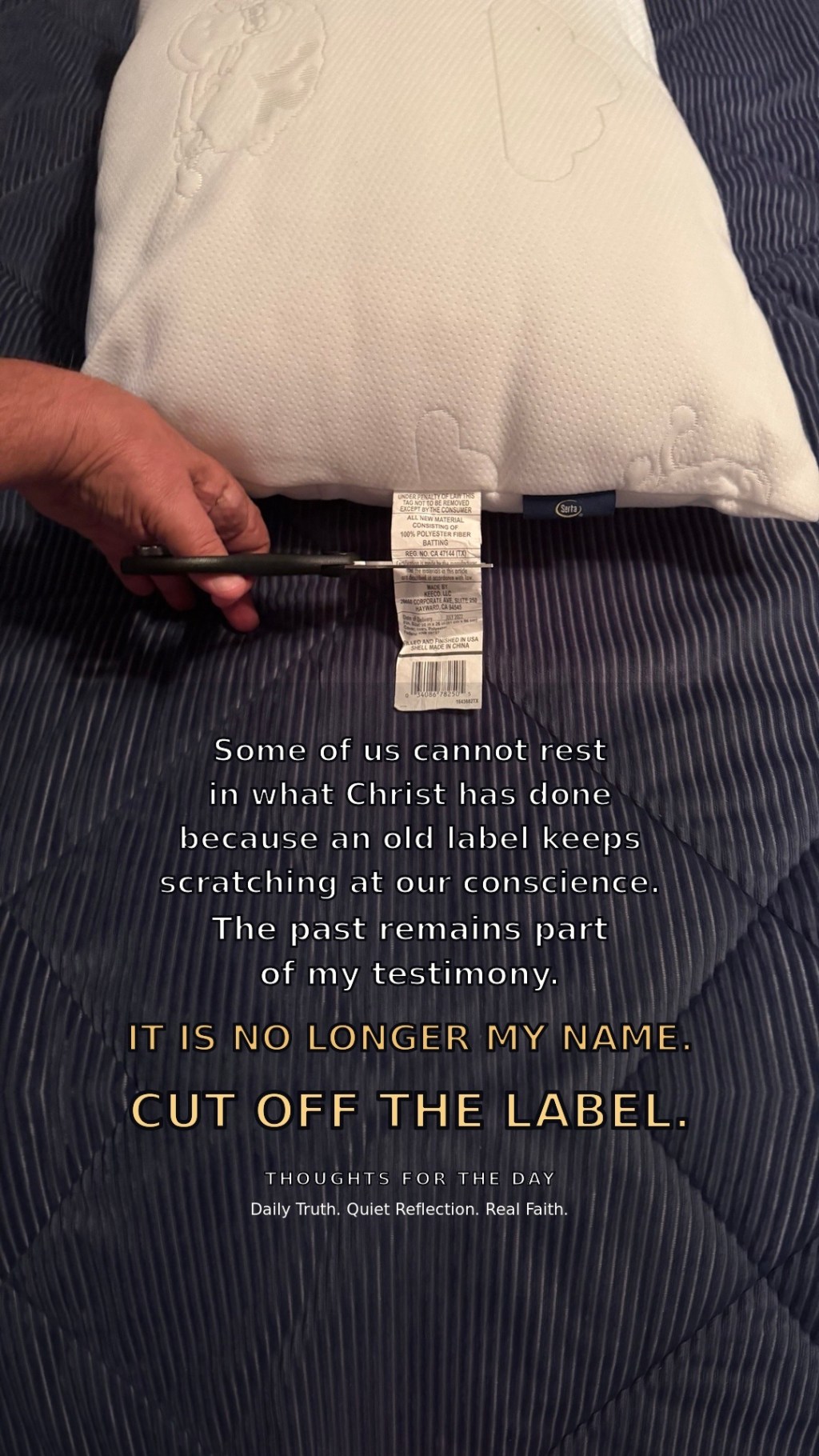
He was six years old when he received his first pillow. That night, something kept scratching the back of his neck. He turned over, adjusted the pillow, and tried to get comfortable, but the irritation remained.
Finally, he found the problem.
It was the label.
So he cut it off.
The pillow was not defective. There was nothing wrong with what was inside it.
The label was interfering with his rest.
Some people cannot rest in what Christ has done because an old label keeps scratching at their conscience.
They turn over the memories.
They replay the failure.
They rehearse every accusation.
They wonder whether they were truly forgiven, whether restoration is actually possible, and whether God could ever use someone with their history.
I know that feeling because I lived beneath those labels for years.
Some were given to me by other people. Others grew from things I had actually done.
That is what made them so difficult to challenge.
I had failed.
Therefore, I believed I was a failure.
I had committed adultery.
Therefore, I believed adulterer was my permanent name.
My marriage ended.
Therefore, I believed I was disqualified from ever being useful to God again.
Because there was truth in the history, I assumed there must also be truth in the verdict.
The accusations followed me everywhere:
How can you stand on a platform and sing while separated from your wife?
How can you stand before a classroom and teach teenagers how to live for God when you could not hold your own marriage together?
How could God ever use an adulterer who sacrificed his family for a few moments of pleasure?
Eventually, nobody else needed to ask those questions.
I had learned to ask them myself.
Other people had attached the labels, but I began introducing myself by them.
Every opportunity was filtered through the label.
Every prompting from God was answered by the label.
Every evidence of grace was followed by the same question:
Yes, but do You remember what I did?
Of course God remembered.
He knew the entire truth—more completely than I did.
But He also knew what He had done with it.
There is a difference between conviction and condemnation.
Conviction says:
“You sinned. Bring it into the light. Repent. Accept responsibility. Make right whatever you can, and allow God to change you.”
Condemnation says:
“Your sin is your name. You are permanently ruined. Stay away from God because He could never want you again.”
Conviction tells the truth about what we have done.
Condemnation takes the worst thing we have done and uses it to rename us.
Conviction leads us to the cross.
Condemnation chains us to the scene of the crime long after the blood has been applied.
Accountability says, “I did this.”
Condemnation says, “This is all I am.”
I am not minimizing what happened.
People were hurt. Trust was broken. A family was altered. Repentance did not erase every consequence or remove every scar.
“Under the blood” is not a religious phrase that allows us to avoid responsibility.
It does not mean the sin never happened.
It does not mean nobody was hurt.
It does not mean consequences disappeared.
It means the sin was confessed, brought to God, and placed beneath the saving work of Jesus Christ.
The event remains part of the history.
But it no longer possesses naming rights.
Paul did not avoid the former lives of the believers in Corinth. He named what some of them had been, and then he declared:
“And such were some of you. But you were washed, but you were sanctified, but you were justified…”
—1 Corinthians 6:11, NKJV
What they had done remained part of their testimony.
It was no longer their name.
That is the difference grace makes.
The label may accurately describe where Jesus found us.
It does not possess the authority to describe where Jesus left us.
So when the accusation asks:
“Do you remember what you did?”
Yes. I remember.
But it is under the blood.
“What about the people you hurt?”
I have not forgotten them, and I do not minimize their pain.
But it is under the blood.
“You will always be an adulterer.”
No. That may accurately describe what I did.
It does not get to decide who I am after repentance, forgiveness, and the transforming work of God.
The label says, adulterer.
The blood says, washed.
The label says, failure.
Grace says, restored.
The label says, disqualified forever.
God says, “Such were some of you.”
Cutting off the label does not mean tearing pages out of our testimony. Those pages reveal what grace overcame.
The scar may remain.
The memory may remain.
The consequences may remain.
But the label has to go.
It is time to stop introducing ourselves by what Jesus died to redeem.
It is time to stop allowing an old label to interfere with our rest in what Christ has done.
The past remains part of my testimony.
But it is no longer my name.
Cut off the label.
Keep the testimony.
Give God the glory.