Tag: prayer

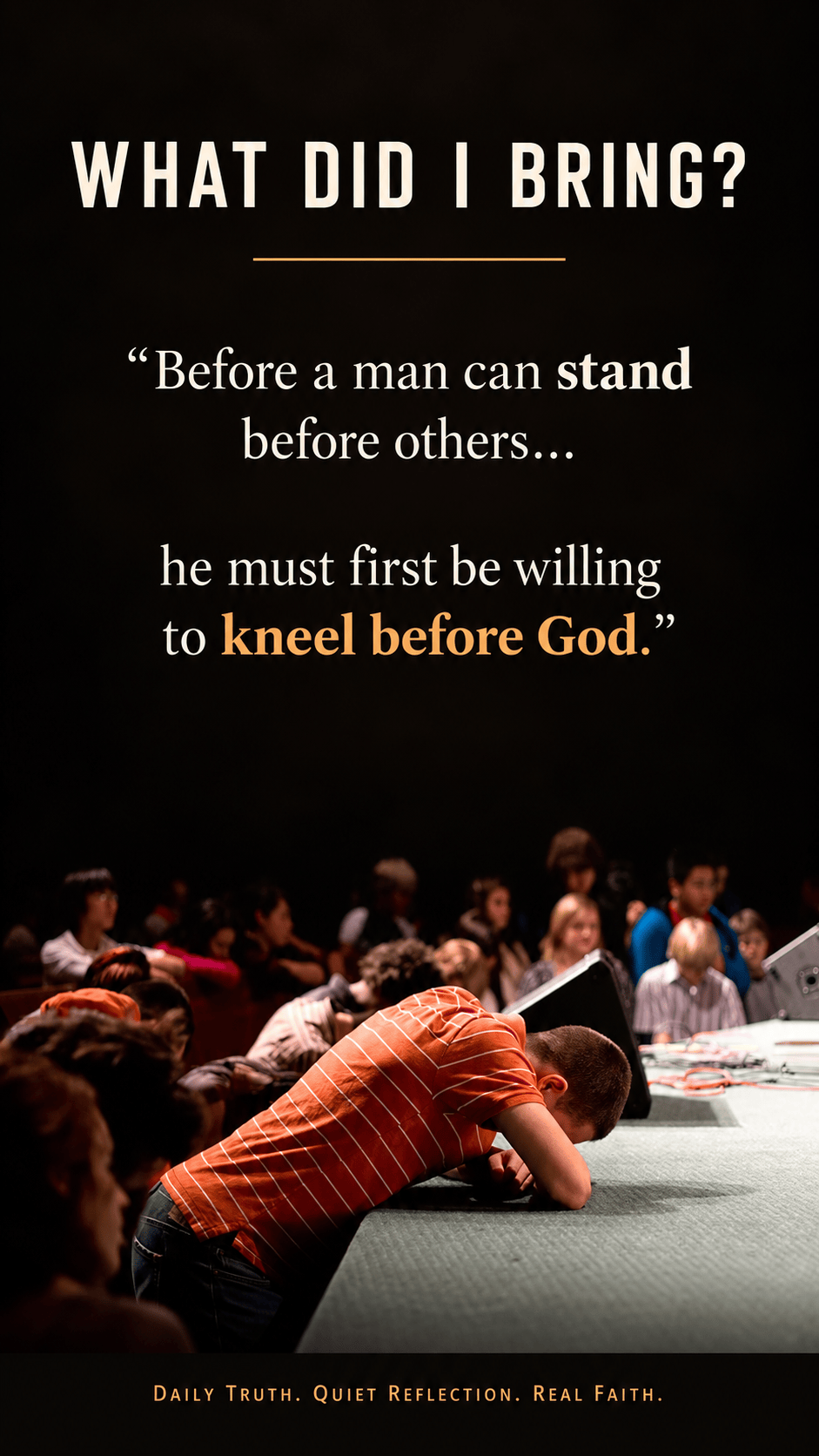
  • What Did I Bring?

    What Did I Bring?

    A couple of days ago, my friend Christi Rogers shared a post about someone standing in a quiet sanctuary before service began. The instruments were waiting. The microphones were silent. The pews had not yet filled.

    At the heart of the reflection was one penetrating question:

    What did I bring?

    As someone who has taught Sunday School and served in worship ministry, I know something about what happens before a service begins.

    Someone arrives early.

    Someone rehearses while others are still getting ready at home. Someone studies a lesson no one will see them preparing. Someone prays over the sanctuary, the musicians, the preacher, and the people who will soon occupy the empty seats. Someone carries a burden for what God may want to accomplish.

    By the time the congregation arrives, there has already been a pouring out.

    It is easy to enter that prepared place and become a consumer without realizing it. We listen to the musicians, receive the teaching, respond to the preaching, and enjoy an atmosphere shaped by someone else’s preparation.

    Then we evaluate what we received.

    Did I like the music?

    Did the sermon speak to me?

    Did I feel anything today?

    But worship was never intended to be something performed by a few people while everyone else waits to be moved. The musicians may lead us, but they cannot worship for us. The preacher may feed us, but he cannot bring our surrender to the altar. Someone else may help prepare the room, but no one else can bring our offering.

    So perhaps, before asking what we received from the service, we should ask:

    What did I bring into the presence of God?

    When Getting There Is the Offering

    Before that question becomes a source of condemnation, it must be covered with grace.

    There are Sundays when we arrive ready to pour ourselves out in worship. There are other Sundays when simply making it through the doors requires nearly everything we have.

    Grief may have emptied us.

    Depression may have followed us into the sanctuary.

    Exhaustion may have taken our voice.

    Private devastation may be hiding behind the smile we managed to put on before leaving the car.

    Coming needy does not make us less spiritual. The church is a body, and we will not all be strong on the same Sunday. Sometimes we help carry someone else. Sometimes we are the ones who need to be carried.

    Hannah entered the house of the Lord as a woman overwhelmed by sorrow. She did not arrive with a triumphant song. She could not even form an audible prayer.

    Scripture says:

    “Now Hannah spoke in her heart; only her lips moved, but her voice was not heard.”
    —1 Samuel 1:13, NKJV

    Eli saw her lips moving and mistakenly assumed she was drunk. Hannah explained that she was a woman of sorrowful spirit who had “poured out” her soul before the Lord.

    To the person watching, it may have appeared that Hannah brought nothing. There was no song, no shout, and no eloquent prayer.

    But she had not come empty-handed.

    She brought her broken heart and poured it out before God.

    Romans 8:26 tells us that when we do not know how to pray, the Spirit helps us in our weakness and intercedes for us “with groanings which cannot be uttered.”

    God does not mistake silence for emptiness.

    Sometimes the only offering we can bring is trembling lips, falling tears, and a prayer too painful to speak. God understands every word we cannot find.

    The Sacrifice of Praise

    There are seasons when we desperately need to receive. But there are also seasons when God calls us out of a settled posture of spiritual consumption and asks us to pour.

    Hebrews 13:15 says:

    “Therefore by Him let us continually offer the sacrifice of praise to God, that is, the fruit of our lips, giving thanks to His name.”
    —Hebrews 13:15, NKJV

    Two words stand out:

    Continually. Sacrifice.

    Praise is not meant to depend upon the music being right, the song being familiar, the week having gone well, or our emotions cooperating.

    If praise is offered continually, there will be times when it flows freely—and times when it costs us something.

    A sacrifice of effort.

    We turn our attention toward God. We quiet the distractions, engage our minds, open our mouths, and participate. We do not wait passively for the musicians to produce a feeling before we respond.

    A sacrifice of pride.

    We stop managing how we appear to everyone around us. We acknowledge that we are not self-sufficient—that we need God, depend upon God, and owe everything to God.

    A sacrifice of self.

    We surrender our preferences, expectations, comfort, and desire to be served. Worship is not about whether they sang our favorite song in our preferred style at the volume we wanted.

    The sacrifice is not being offered to us.

    We are offering it to Him.

    Sometimes the sacrifice is not the song. It is the self we must lay down in order to sing it.

    The Pride We Were Taught to Protect

    The sacrifice of pride is deeply personal for me.

    Many of us—especially men of my generation—were taught that real men do not cry. They do not lose control of their emotions. They keep everything together so they can remain strong for everyone else.

    That teaching can produce dependable men.

    It can also produce isolated men.

    We become so accustomed to carrying the burden that we no longer know how to admit when it has become too heavy. We become so committed to appearing strong that we struggle to be honest about our need.

    Then we carry the same armor into worship.

    We feel something stirring within us, but immediately become aware of who may be watching. Our voice tightens. Our hands remain at our sides. The tears begin to rise, and we force them back—not because God has not touched us, but because we have been trained to protect the image of the man who always has himself under control.

    Self-control is biblical. Emotional suppression is not.

    Surrendering to God is not the same as being governed by our emotions. Tears are not necessarily evidence that a man has lost control. Sometimes they are evidence that he has finally stopped pretending he does not need God.

    Jesus wept openly.

    David poured his anguish into the Psalms.

    Peter wept bitterly after denying the Lord.

    Hebrews tells us that Jesus prayed with vehement cries and tears.

    Their tears did not diminish their strength.

    We were taught that we must be the rock for everyone else. But we are not the Rock.

    Jesus is.

    “It Was Before the LORD”

    When the Ark of the Covenant was brought into Jerusalem, David danced before the Lord with all his might.

    Michal watched from a window and despised him.

    She was concerned with how the king appeared. David was concerned with the One before whom the king was worshiping.

    When she mocked what she considered his undignified behavior, David answered:

    “It was before the LORD… And I will be even more undignified than this, and will be humble in my own sight.”
    —2 Samuel 6:21–22, NKJV

    David was not manufacturing an emotional spectacle. He had decided that his title, reputation, and another person’s opinion would not determine his response to God.

    Before the Lord, the king was simply another worshiper.

    That was David’s sacrifice of pride.

    Sometimes our sacrifice may be allowing the tear to fall instead of immediately wiping it away. It may be lifting our hands without first surveying the room. It may be kneeling when pride tells us to remain standing. It may be walking forward for prayer or telling someone, “I am not doing well, and I need you to pray for me.”

    Before I can lift my hands in worship, I may first have to lay down my pride.

    And there may always be a Michal watching from the window.

    But my worship was never for the Michal’s.

    It was before the Lord.

    One Danced. One Wept.

    There is a beautiful contrast between David and Hannah.

    David’s worship was expressive, and Michal considered it undignified.

    Hannah’s prayer was nearly silent, and Eli misunderstood it entirely.

    David was judged because people could see too much.

    Hannah was judged because people could understand too little.

    One danced. One wept. Both were misunderstood. And God saw the heart of each.

    Not everyone must worship like David. Not every sacrifice of praise will be loud, exuberant, or outwardly expressive. Sometimes worship dances. Sometimes worship weeps. Sometimes it shouts. Sometimes it can only whisper.

    The common thread is not the outward expression.

    It is the inward surrender.

    David once declared:

    “Nor will I offer burnt offerings to the LORD my God with that which costs me nothing.”
    —2 Samuel 24:24, NKJV

    So, what did I bring?

    Perhaps I brought thanksgiving.

    Perhaps I brought praise.

    Perhaps I brought a burden for someone sitting near me.

    Perhaps I brought a broken heart, trembling lips, and a prayer I could not speak.

    Perhaps I brought the willingness to admit that I needed someone else to help carry me.

    Or perhaps the most costly thing I brought was the self I had worked so hard to protect.

    I will not always enter His presence feeling strong. I will not always bring the same offering.

    Some days I may bring a shout.

    Some days I may bring a whisper.

    Some days I may bring nothing but tears.

    But I do not want to come merely asking what someone else has prepared for me. I want to enter His presence with an honest and surrendered heart.

    Before I ask, “What am I going to receive today?” perhaps I should stop and ask:

    Jesus, what am I bringing to You?
  • The Blessing You Didn’t Pray For

    The Blessing You Didn’t Pray For

    “Every good gift and every perfect gift is from above…” — James 1:17

    A song came to mind this week that asks a series of thought-provoking questions.

    What if the things we call hardships are sometimes the very means by which God accomplishes His greatest work in our lives?

    It isn’t asking whether pain is enjoyable.
    It isn’t suggesting that loss somehow becomes pleasant.

    Instead, it challenges us to consider a difficult possibility:

    What if some of God’s greatest blessings arrive in packages we would never choose to open?

    That thought immediately took me back through Scripture.

    Joseph certainly wouldn’t have chosen betrayal by his brothers.
    He wouldn’t have chosen slavery.
    He wouldn’t have chosen prison.

    Yet years later, he could look back and see that God had been working through every painful chapter.

    David probably wouldn’t have chosen years of hiding in caves while running for his life.

    Moses likely wouldn’t have volunteered for forty years in the wilderness.

    Naomi certainly wouldn’t have chosen famine, widowhood, and the loss of her sons.

    None of those experiences felt like blessings when they were happening.

    Yet every one of them became part of God’s greater purpose.

    I wonder how many blessings I’ve almost missed because I was looking for the wrong wrapping paper.

    We naturally think blessings look like answered prayers.

    Open doors.
    Good health.
    Financial provision.
    Restored relationships.

    There is no question those things can be tremendous gifts from God.

    But sometimes His greatest gifts are quieter.

    A disappointment that redirected our lives.
    A closed door that protected us from walking somewhere we shouldn’t.
    A season of waiting that taught us patience.
    A trial that stripped away our self-reliance and taught us complete dependence upon Him.

    None of us pray for those things.

    Yet many of us would honestly say they became turning points in our walk with Christ.

    I’ve noticed something else.

    We usually recognize those blessings only by looking backward.

    Very few people say in the middle of suffering,

    “I can already see why God allowed this.”

    Perspective often comes long after the pain.

    Perhaps that’s why faith is so essential.

    Faith trusts that God is good before we can understand what He is doing.

    Only later do we begin to see how He was weaving together circumstances we never could have imagined.

    Romans 8:28 isn’t a promise that everything is good.

    It’s a promise that God is working through everything for the good of those who love Him and are called according to His purpose.

    That doesn’t minimize grief.
    It doesn’t erase loss.
    It doesn’t pretend suffering isn’t real.

    It simply reminds us that God never wastes any of it.

    One day, I believe we’ll look back and discover that some of the moments we would have erased from our story became the very chapters God used to shape us most into the image of Christ.

    Final Word

    We spend much of our lives asking God to change our circumstances.

    Sometimes He does.

    But often, His greater miracle is using those circumstances to change us.

    Perhaps the greatest blessings aren’t always the ones that make life easier.

    Perhaps they’re the ones that make us more like Jesus.

  • Don’t Quit at 40: The Power of Day 41

    The number 40 appears over and over in Scripture. It’s the number of testing, trial, and preparation.

    It rained 40 days. On day 41, Noah saw dry land.

    Moses fasted and received God’s commandments on day 41.

    Israel wandered 40 years. Year 41? They entered the land.

    Goliath shouted threats for 40 days. On day 41, David shut his mouth for good.

    Jonah warned Nineveh for 40 days. Day 41, God relented.

    Jesus fasted and was tempted for 40 days. Day 41, Satan was gone.

    After resurrection, Jesus appeared for 40 days. Day 41? He ascended.

    What’s the pattern? Trial ends. Transition begins.

    You might be stuck in your “40.” It feels like a no-man’s land—like nothing’s happening. Like God’s not moving. But Daniel prayed and fasted for 21 days before the angel broke through. And the angel said something worth writing on your wall:

    “I have come because of your words.” (Daniel 10:12)

    You have no idea what’s moving because of your prayers. There’s resistance. There’s warfare. There’s testing. But don’t give up.

    Galatians 6:9 reminds us:

    “Let us not grow weary while doing good, for in due season we shall reap if we do not lose heart.”

    We talk about Day 1 faith. Let’s talk about Day 41 faith—the kind that survives 40 days of silence, struggle, and opposition. The kind that refuses to quit one day before the miracle.

    Your 41 is coming.

    God is not done.

    Don’t stop now.

  • The Opportunity You Ignored Might Be the Answer You Prayed For

    We’ve all been there. We pray sincere prayers—God, make me more patient. Give me courage. Help me love better. And then life barrels forward, full of interruptions, discomfort, and frustrating people… and we miss the point.

    I read a story recently that stopped me in my tracks.

    A man prayed earnestly for three things: patience, courage, and compassion. That day, he yelled at his neighbor, hid during a crisis, and turned away a hungry stranger. That night, in confusion and disappointment, he asked God why He hadn’t answered. God’s reply was simple and devastating: “I gave you opportunities—but you weren’t paying attention.”

    It’s sobering, isn’t it?James 4:3 (NKJV) says,

    “You ask and do not receive, because you ask amiss, that you may spend it on your pleasures.”

    Sometimes, what we call unanswered prayer is actually a misunderstood one. We want to feel different, but God wants us to become different. That requires pressure. It demands participation.

    We say, “Lord, take this from me,” and He says, “Lay it down.”

    We ask, “Change me,” and He says, “Follow Me.”

    He will empower, but we must obey.

    We don’t get stronger by avoiding the weight—we get stronger by lifting it. And when we ask God to grow us, we must expect the workout, not just the wish. The opportunity, not just the outcome.

    So today, pause and ask:

    What opportunities have I ignored?

    Where did I choose comfort over growth?

    Where did I miss Him, because I wasn’t paying attention?

    He may not hand you patience—but He’ll hand you someone that tests it.

    He may not drop compassion into your heart—but He’ll place someone in your path who needs it.

    He may not drop courage in your lap—but He’ll give you a moment to stand tall.

    The answer to your prayer might not look like a gift. It might look like a challenge. But make no mistake—it’s an answer all the same.

  • Resting in the Word: Real Renewal for Real Life

    We’ve all been there—running on empty, putting out fires, barely holding it together. We throw up a quick prayer while driving, scan a verse meme on social media, and wonder why we still feel so disconnected and drained.

    But God doesn’t invite us to survive—He calls us to abide.

    “Be still, and know that I am God” (Psalm 46:10).

    It’s a command, yes—but it’s also an invitation. Back in verse 1, we’re reminded:

    “God is our refuge and strength, a very present help in trouble.”

    So why are we looking everywhere else but Him?

    When we take time to rest in the Word, we’re not being lazy—we’re getting aligned.

    The benefits of regularly engaging the Bible aren’t just spiritual (though that alone should be reason enough). Mental clarity improves. Emotional health stabilizes. Family life strengthens. Even social bonds grow deeper when we’re rooted in truth instead of tossed by feelings.

    The Bible says:

    “He shall be like a tree planted by the rivers of water… whose leaf shall not wither” (Psalm 1:3).

    That’s fruitfulness. That’s stability. That’s the promise of rest.

    And how do we access that?

    “How can a young man cleanse his way? By taking heed according to Your word… Your word I have hidden in my heart, that I might not sin against You” (Psalm 119:9,11).

    Intentional time in Scripture does more than inform—it transforms. It purifies the path. It recalibrates our compass. It strengthens what the world is trying to tear down.

    Paul reminded Timothy,

    “Be diligent to present yourself approved to God, a worker who does not need to be ashamed, rightly dividing the word of truth” (2 Timothy 2:15).

    That diligence? It’s our lifeline.

    And in our darkest moments, we echo Jeremiah:

    “This I recall to my mind, therefore I have hope… The Lord is my portion… Therefore I hope in Him” (Lamentations 3:21-26).

    Let’s be honest: what’s standing in the way of your stillness?Let’s name it. Let’s challenge it. And let’s carve out time to rest in the Word—not just visit it on occasion. Your spirit, your very soul, depends on it.

  • The Faithfulness of God in Delayed Answers

    Waiting on God is one of the hardest things we do as believers. And if we’re honest, it’s one of the places where doubt creeps in the fastest. Why hasn’t God answered yet? Did I do something wrong? Is He even listening?

    Maybe you’ve been praying for healing, for a breakthrough, for clarity. Maybe you’ve been faithful, doing everything right, but the doors remain closed. It’s frustrating. It’s discouraging. But here’s what we need to remember: God’s faithfulness isn’t proven by immediate answers—it’s revealed in His perfect timing.

    “Through the Lord’s mercies we are not consumed, because His compassions fail not. They are new every morning; great is Your faithfulness.” (Lamentations 3:22-23, NKJV)

    Think about Joseph. He had dreams of leadership, of purpose, of God’s hand on his life. But before the palace, there was a pit. Before influence, there was injustice. Before fulfillment, there was waiting—years of it. If Joseph had judged God’s faithfulness by his circumstances, he would have given up. But God was working in the waiting, shaping Joseph into the leader he was called to be.

    The same is true for us. When we don’t see movement, we can trust that God is still at work. When we feel forgotten, we can hold on to the truth that He never leaves His children behind. And when we wonder if He’ll come through, we remember that He always has, and He always will.

    So what do we do while we wait? We worship. We trust. We obey. Because the God who promised is the God who always fulfills.

    Are you in a season of waiting? Let’s walk this journey together. Drop a comment below—I’d love to pray for you.

  • Between the Altar and the Door

    Ever had a powerful moment with God—one of those times when your heart is stirred, your eyes fill with tears, and you just know something is changing—only to have that feeling disappear before you even leave the building?I was driving home from work today, jamming out to Pandora as usual, when The Altar and the Door by Casting Crowns came on. I’ve heard it countless times, but today, these lyrics hit differently:

    And I cry like so many times before
    But my eyes are dry before I leave the floor
    Oh Lord, I’ll try
    But this time, Jesus, how can I be sure
    I will not lose my follow thru
    Between the altar and the door.

    Ouch. That’s me. Too many times, I’ve stood in church, tears falling, heart open, making commitments to God—only to let distractions, doubts, and daily life steal my follow-through before I even hit the parking lot.

    Jesus spoke about this exact struggle in the Parable of the Sower:

    When they hear, Satan comes immediately and takes away the word that was sown in their hearts. (Mark 4:15, NKJV)

    It’s not that our intentions at the altar aren’t real. It’s that the enemy knows if he can snatch the seed before it takes root, it won’t grow. And honestly? Sometimes, he doesn’t even have to work that hard. We let our minds wander, our schedules take over, and before we know it, that powerful moment with God feels like a distant memory.

    So how do we keep that fire from fading?

    1. Stay in the Word – Feelings fade, but God’s truth remains. “Your word I have hidden in my heart, that I might not sin against You.” (Psalm 119:11)
    2. . Pray Constantly – Prayer isn’t just for the altar; it’s for the drive home, the dinner table, the chaos of everyday life. “Pray without ceasing.” (1 Thessalonians 5:17)
    3. Live It Out – Faith isn’t just an emotion; it’s action. “But be doers of the word, and not hearers only, deceiving yourselves.” (James 1:22)
    4. Be Accountable – We were never meant to walk this road alone. “As iron sharpens iron, so a man sharpens the countenance of his friend.” (Proverbs 27:17)

    This time, I don’t want to lose my follow-through. I don’t want to leave my commitment at the altar. I want to carry it with me through the door and into my daily life.

    What about you? What’s one step you can take today to make sure your faith doesn’t fade the moment you walk away?