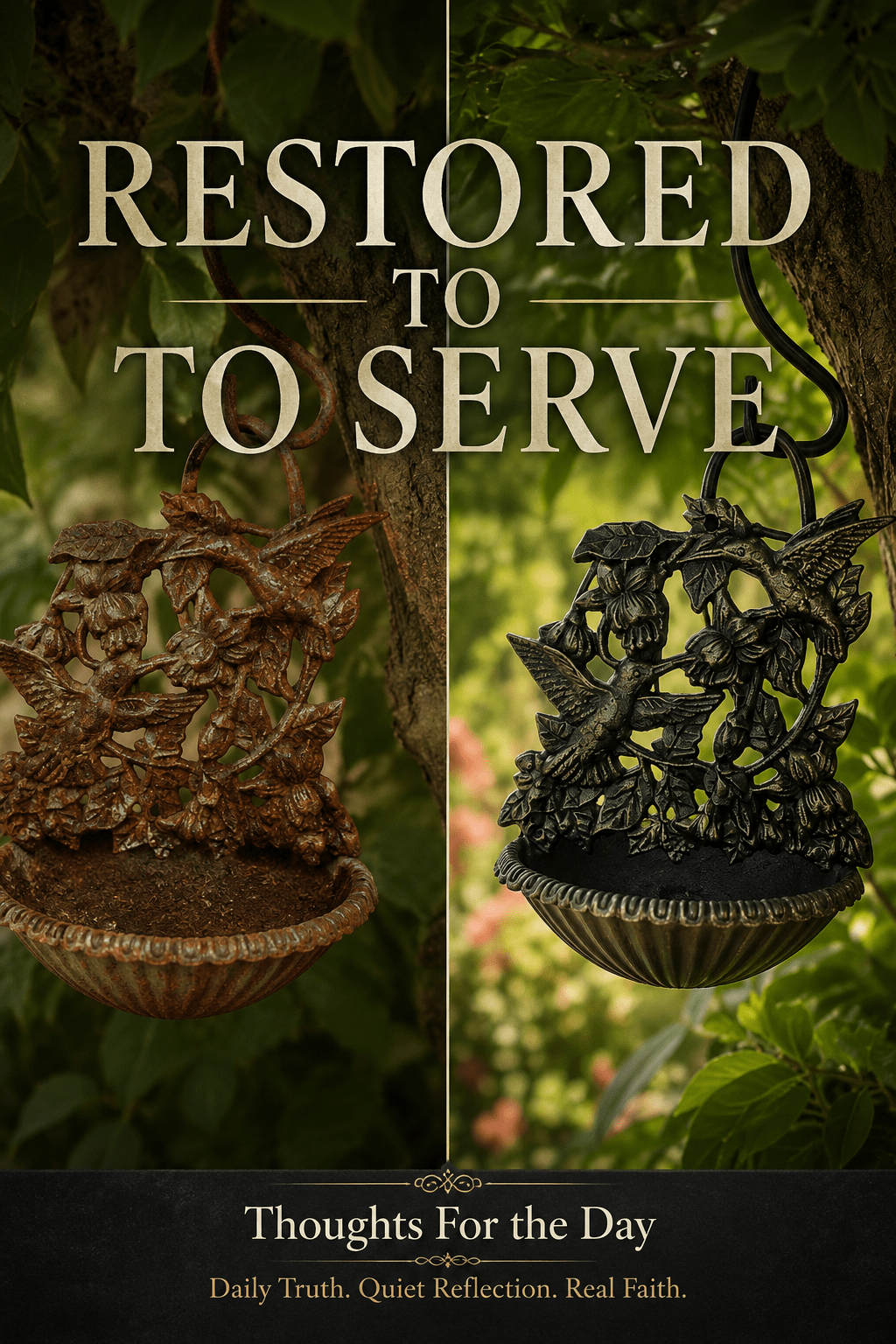
Most people would have walked right past it.
Buried beneath years of rust, grease, carbon, and neglect was an old piece of cast iron that looked like it belonged in the scrap pile.
Meals had been cooked in it.
Fires had burned beneath it.
Time had left its mark.
Layer after layer had accumulated until the original surface was almost completely hidden.
Most people would have seen something ruined.
I saw the beauty of what it could be.
That is the difference between someone who only sees the present condition and someone who understands the restoration process.
Restoring cast iron is not quick.
It begins with a wire brush, scraping away as much loose rust, grease, and grime as possible. It is dirty work. Dust flies. Old buildup breaks loose. What has clung to the piece for decades does not always surrender easily.
But the wire brush can only reach so far.
Many pieces have deep grooves, decorative patterns, tight corners, and hidden spaces that cannot be thoroughly cleaned by hand.
Once the wire brush has removed as much as possible, the piece goes into the electrolysis tank…
Lowered beneath the surface and left there.
Sometimes for hours.
Sometimes for days.
Some pieces take longer than others.
To someone unfamiliar with the process, it may appear that nothing is happening. The piece is simply sitting beneath the water.
But beneath the surface, a work is taking place that the eye cannot fully see.
The rust begins to loosen.
The corrosion begins to release its grip.
The buildup that once seemed permanently attached begins separating from the iron.
When the piece is removed, it is scrubbed and inspected.
Sometimes the work is complete.
Sometimes rust and crust remain.
When that happens, the piece goes back into the tank.
The process is not repeated because it failed.
It is repeated because the work is not finished.
Eventually, the metal is stripped down to the bare surface.
No paint covering the rust.
No seasoning applied over years of grime.
No attempt to disguise what is underneath.
Everything that does not belong must be removed.
Only then can the restoration continue.
Watching that process has often reminded me of what God does in our lives.
We accumulate things… and some of them are obvious.
Sin.
Shame.
Pride.
Bitterness.
Compromise.
But other things build gradually.
Attitudes we picked up from people around us.
Habits we never questioned.
Influences we allowed into our minds.
Offenses we refused to release.
Wounds we buried instead of bringing to God.
Excuses we repeated until we began believing them.
One layer may not seem significant.
Neither does one meal’s worth of grease left on a skillet.
But over time, layer builds upon layer until what was once beautiful becomes hidden beneath what has accumulated.
That buildup can become so familiar that we begin to believe it is simply who we are.
“That is just the way I am.”
“My family has always been like this.”
“I have carried this for so long that I will never change.”
But God never mistakes the buildup for the person beneath it.
He sees what others may overlook.
He sees what sin has covered.
He sees what shame has hidden.
He sees what years of neglect, pain, and poor choices have obscured.
And still, He does not walk past us.
Instead, He begins the work of restoration.
Sometimes His work feels like the wire brush.
Conviction can be uncomfortable.
Correction can feel abrasive.
God begins confronting the things we have allowed to cling to us.
He exposes attitudes we defended.
He challenges habits we excused.
He reveals influences that have been shaping us in ways we did not recognize.
That process is not always pleasant.
But the wire brush is not destroying the iron.
It is removing what never belonged there.
Then there are the deeper places.
The corners we cannot reach ourselves.
The hidden wounds.
The secret motives.
The fears buried beneath years of self-protection.
The parts of our hearts we do not fully understand.
David prayed:
“Search me, O God, and know my heart;
Try me, and know my anxieties;
And see if there is any wicked way in me,
And lead me in the way everlasting.”
—Psalm 139:23–24, NKJV
David understood that there were places within him that required more than human effort.
Some things cannot be scrubbed away through determination alone.
They require the searching, cleansing work of God.
Sometimes we find ourselves in a season much like that cast iron sitting beneath the water.
Hidden.
Waiting.
Wondering whether anything is changing.
We pray, but do not immediately see the answer.
We repent, yet still feel the pull of old habits.
We ask God to heal us, but the pain does not disappear overnight.
From the outside, it may appear that nothing is happening.
But beneath the surface, God is working.
He is loosening what has held us.
He is reaching places we could never reach on our own.
He is separating us from things that once seemed permanently attached.
And sometimes that work takes longer than we expected.
Not because we are worth less.
Not because the Restorer has forgotten us.
But because every life has a different history.
Different wounds.
Different struggles.
Different layers that have accumulated along the way.
God knows exactly what He is working with.
And He knows exactly what it will take to restore us.
Sometimes God brings us out of the process, and we discover that more work remains.
Back into His hands we go.
More conviction.
More surrender.
More healing.
More learning.
More letting go.
That does not mean the process failed.
It means the work is not finished.
Paul wrote:
“Being confident of this very thing, that He who has begun a good work in you will complete it until the day of Jesus Christ.”
—Philippians 1:6, NKJV
God is not discouraged when He finds another layer.
He knew every layer was there before He began.
And He is committed to finishing what He started.
There is something else every experienced restorer understands.
You cannot season over the buildup.
Seasoning over grease, carbon, and rust is counterproductive.
It may temporarily cover the surface, but it does not restore the iron.
It would be like spraying primer over a rusty fender and then covering it with paint without first removing or treating the corrosion.
It might look better for a little while.
But the rust is still there.
Still spreading.
Still weakening the metal beneath the fresh coat.
God does not work that way.
He does not paint over sin.
He does not cover corruption with a religious appearance.
He does not simply make us look better on the outside while leaving the condition of the heart untouched.
God is not interested in cosmetic righteousness.
Isaiah put it plainly:
“But we are all like an unclean thing,
And all our righteousnesses are like filthy rags…”
—Isaiah 64:6, NKJV
Our own righteousness cannot cleanse what sin has corrupted.
We can polish the outside.
We can change our appearance.
We can learn the right words, adopt the right behaviors, and convince everyone around us that everything is fine.
But God sees beneath the surface.
And He loves us too much to simply paint over what needs to be removed.
God doesn’t season over our sin.
He cleanses us.
He strips away what doesn’t belong and brings us back to the bare surface—not to leave us exposed, but to make all things new.
And that brings us to the beauty of 2 Corinthians 5:17:
“Therefore, if anyone is in Christ, he is a new creation; old things have passed away; behold, all things have become new.”
—2 Corinthians 5:17, NKJV
At first, restoration and new creation may sound like different ideas.
But restoring cast iron helps us see how beautifully they work together.
The restored piece is still the same iron.
It has not been discarded and replaced.
Yet after being stripped, cleansed, and renewed, it appears completely new.
The rust is gone.
The grime is gone.
The old layers no longer define it.
The craftsmanship that was hidden can finally be seen.
On detailed cast iron pieces, the transformation can be remarkable.
Before restoration, rust may obscure every fine feature.
Afterward, feathers appear on birds.
Veins emerge in leaves.
Petals become visible on flowers.
Details that seemed lost were not necessarily gone.
They were hidden beneath the corrosion.
That is what God does.
He does not erase our history.
He changes what defines us.
The past may have left scars.
Neglect may have caused pitting.
Consequences may remain.
But the corrosion no longer owns the piece.
Sin no longer has the final word.
Shame no longer determines our identity.
The old life no longer defines who we are in Christ.
After the metal is clean, the seasoning begins.
A light coat of oil.
Heat.
Cool.
Another coat.
More heat.
Again and again until the bare iron develops a strong, protective finish.
That process also takes time.
One coat is not enough.
In the same way, spiritual maturity is built through repeated acts of faith and obedience.
Prayer.
Scripture.
Worship.
Faithfulness.
Forgiveness.
Surrender.
Choosing what is right when nobody is watching.
Choosing it again tomorrow.
And again the next day.
God forms character layer by layer.
But restoration has another purpose.
A beautifully restored skillet is not meant to spend the rest of its existence sitting on a shelf.
It was made to be used.
Again.
And again.
And again.
Years of neglect did not change what the skillet was created to do.
The rust did not change its purpose.
The grime did not change its purpose.
Even decades of sitting unused did not change its purpose.
Those things only kept it from fulfilling that purpose.
And maybe you need to hear this today:
What has happened to you has not changed why God created you.
Your failures did not erase His purpose.
Your years away from Him did not erase His purpose.
The things you allowed to accumulate did not erase His purpose.
God does not restore us simply so we can look back and admire how far we have come.
He restores us to usefulness.
Paul wrote:
“…he will be a vessel for honor, sanctified and useful for the Master, prepared for every good work.”
—2 Timothy 2:21, NKJV
Useful to the Master.
That is the purpose of restoration.
And there is something beautiful about the usefulness of cast iron.
A skillet does not exist merely for itself.
It feeds people.
Meal after meal.
Year after year.
When properly cared for, a piece that has already served one generation can serve another.
And another.
Its restoration becomes a blessing to people who had nothing to do with restoring it.
Maybe ours should too.
God restores us so that what He has done in us can become a blessing to someone else.
So we can love.
Serve.
Teach.
Encourage.
Disciple.
Give.
Forgive.
Tell someone else where we found hope when we had none.
Our restoration was never intended to end with us.
The skillet’s greatest days do not have to be behind it.
Neither do yours.
You may feel covered in too much rust.
You may believe too much grime has accumulated.
You may look at your scars, your history, and your failures and conclude that you belong in the scrap pile.
But the Restorer sees differently.
He sees beneath the buildup.
He sees beyond your present condition.
He sees what His grace can uncover.
He sees what His Spirit can cleanse.
And He sees the purpose for which you were created.
Most people might have walked right past.
But the Restorer stopped.
He saw value beneath the corrosion.
He knew what could be restored.
And He knew it could be useful again.
God never mistakes the crusty exterior for the beauty of the soul beneath it.
He sees what lies beneath.
He knows what He created.
And He has not forgotten why He created it.
He is still in the business of restoration.
And He still has a purpose for the restored.
“And I will restore to you the years that the swarming locust has eaten…”
—Joel 2:25, NKJV