Tag: Thanksgiving

  • The One Who Came Back

    The One Who Came Back

    Luke 17:11–19

    Thanksgiving has a way of filling our attention. We think about the meal, the people, the empty chairs, the travel, the timing, and everything that still needs to be done. Somewhere in the middle of it all, we pause and say we’re thankful.

    Luke 17 asks me a more pointed question: Has my gratitude actually turned my attention back toward Jesus?

    As Jesus entered a village, ten men with leprosy stood at a distance and called out to Him. “Jesus, Master, have mercy on us!”

    Jesus told them to go show themselves to the priests. Luke doesn’t tell us that anything changed before they started walking. They had His word, and they moved in obedience to it.

    “As they went, they were cleansed.”

    All ten went. All ten were cleansed. All ten received the mercy they’d cried out for.

    Then Luke slows the story down and draws our attention to one of them. When he saw that he’d been healed, he turned back.

    That matters to me. His gratitude changed his direction.

    He’d been walking toward the priests, but now his steps carried him back to Jesus. He glorified God with a loud voice, fell at Jesus’ feet, and gave Him thanks. Luke then tells us something else about him: he was a Samaritan.

    That detail wasn’t incidental. Jews and Samaritans carried generations of religious and ethnic hostility. Yet Jesus repeatedly drew attention to people from Samaria. He “needed” to go through Samaria, where He met a woman at a well. In another story, it was a Samaritan who stopped and showed mercy when others passed by. And here, out of ten men who were cleansed, the one who returned to give thanks was a Samaritan.

    The man many would have regarded as the outsider was the one who came all the way back to Jesus’ feet. The foreigner recognized what mercy had done—and knew where to return with his thanks.

    Jesus asked, “Were there not ten cleansed? But where are the nine?”

    Luke doesn’t tell us why the others didn’t return. We don’t need to turn them into villains or invent motives for them. Jesus’ question creates enough tension on its own.

    The difference wasn’t that only one had been cleansed. All ten had received the gift. But the story doesn’t end with cleansing.

    Jesus told the man who returned, “Arise, go your way. Your faith has made you well.”

    The King James Version says, “thy faith hath made thee whole.”

    That distinction matters. Luke uses one word for what happened to all ten and another for what Jesus declared over the man who came back. All ten were cleansed. The returning Samaritan heard Jesus speak of being made whole.

    He hadn’t returned to bargain for something more. He returned because he recognized the source of the mercy he’d already received. And at Jesus’ feet, he heard Jesus connect his faith with wholeness.

    There’s a difference between receiving mercy and returning to the One who gave it.

    I can enjoy what God has provided without stopping to recognize His hand in it. I can celebrate an answered prayer, breathe easier after a difficult season, or move quickly into whatever comes next. The gift is real, and the relief is real. But gratitude does more than enjoy what has been given. Gratitude turns our attention back toward the Giver.

    That’s what the Samaritan did. He saw. He turned. He glorified God. He fell at Jesus’ feet. He gave thanks.

    His gratitude wasn’t merely something he felt. It affected what he did next.

    Today, many of us will thank God for food, family, shelter, provision, and another year. Those are good gifts, and we should name them. But before the day is over, I want to go one step further.

    What has Jesus done for me that I don’t want to hurry past?

    Maybe He carried you through a season you weren’t sure you’d survive. Maybe He forgave you when you finally admitted you were wrong. Maybe He sent someone to sit beside you, gave you strength for one more day, or opened your eyes to mercy you hadn’t noticed before.

    Name it. Then take your thanks back to Him.

    You don’t need an elaborate prayer. You can simply say, “Jesus, I see what You did for me. I know where this mercy came from. Thank You.”

    Final Word
    Ten men cried for mercy. Ten men were cleansed. One came back—and heard Jesus say that his faith had made him whole.

    This Thanksgiving, enjoy the gifts God has placed in your hands. Then let gratitude turn your attention—and your steps—back toward Jesus.


  • God Many It For Good

    God Many It For Good

    Genesis 50:15–21

    When Jacob died, Joseph’s brothers started wondering what he was going to do to them.

    They knew what they’d done. They’d sold their brother and let their father believe he was dead. Years later, they’d gone to Egypt looking for food and found Joseph in a position to give it to them. Now, with their father gone, they wondered if Joseph had been waiting until then to pay them back.

    So they sent word asking him to forgive them.

    And… Joseph wept.

    I’m glad Scripture tells us that. I’ve heard what Joseph says in verse 20 so many times that I can get there without stopping long enough to sit with verse 17. Here was a man who could see what God had done through those years and still weep when his brothers brought up what they’d done to him. I think there has to be room for both of those things in a life of faith.

    When his brothers came and bowed before him, Joseph asked, “Am I in the place of God?” Then he told them plainly what he understood about those years. They’d intended evil against him. But God meant it for good.

    Joseph was clear about whose choice it was to sell him. He was just as clear that God had been at work through those years, preserving lives in the midst of famine. Joseph could look at his brothers and see some of the very people whose lives had been preserved. Then he told them he’d provide for them and their little ones.

    I can read the whole account in one sitting. Joseph had to live through years of it. When he was in the pit, he couldn’t see storehouses full of grain. When he was in prison, he couldn’t see the children who would one day eat because there was food in Egypt. As we talked about yesterday, the Lord had been with him through it all—including the pit and the prison. By the time Joseph spoke these words to his brothers, he could see what God had been doing through years he couldn’t understand while he was living them.

    That’s what I hear in Terrian’s “Testimony,” the song that started this week’s reflections. It makes me look back at my own story and ask what, exactly, I’m giving thanks for. Joseph helps me answer that. I’m not thankful for every wound. I’m thankful for the mercy of Jesus that met me there.

    I don’t have to rewrite the painful parts of my story to recognize His faithfulness. I can thank Him for the person who sat with me, for the room to tell the truth, and for the strength to take another step when I couldn’t see how any of it might be redeemed.

    Sometimes the good He brings becomes visible later in the way we respond to somebody else’s pain. What I’ve lived through has taught me to slow down and listen. I know how much it matters when somebody gives you room to speak without rushing you or telling you that you ought to be over it by now. The wound wasn’t good. But Jesus can keep it from having the final word.

    Maybe you can name some good He’s brought out of a painful stretch. If you can, thank Him for that specific thing. And if you’re still a long way from seeing any good, you can tell Him that. Joseph had years between the pit and this conversation. Your prayer this Thanksgiving may be as simple as, “Lord, this still hurts. Help me trust You with what I can’t see.”

    Final Word
    I keep thinking about those children Joseph promised to feed. I can imagine their parents watching them eat and having a whole new reason to thank God. When I look back this Thanksgiving, that’s what I want to pay attention to. Where did the Lord sustain me? Who did He send to help? And where can I see His faithfulness today, even if I’m still waiting to understand some of what happened?

    I may still have questions about parts of the story, but I can thank Him for the faithfulness I can see.

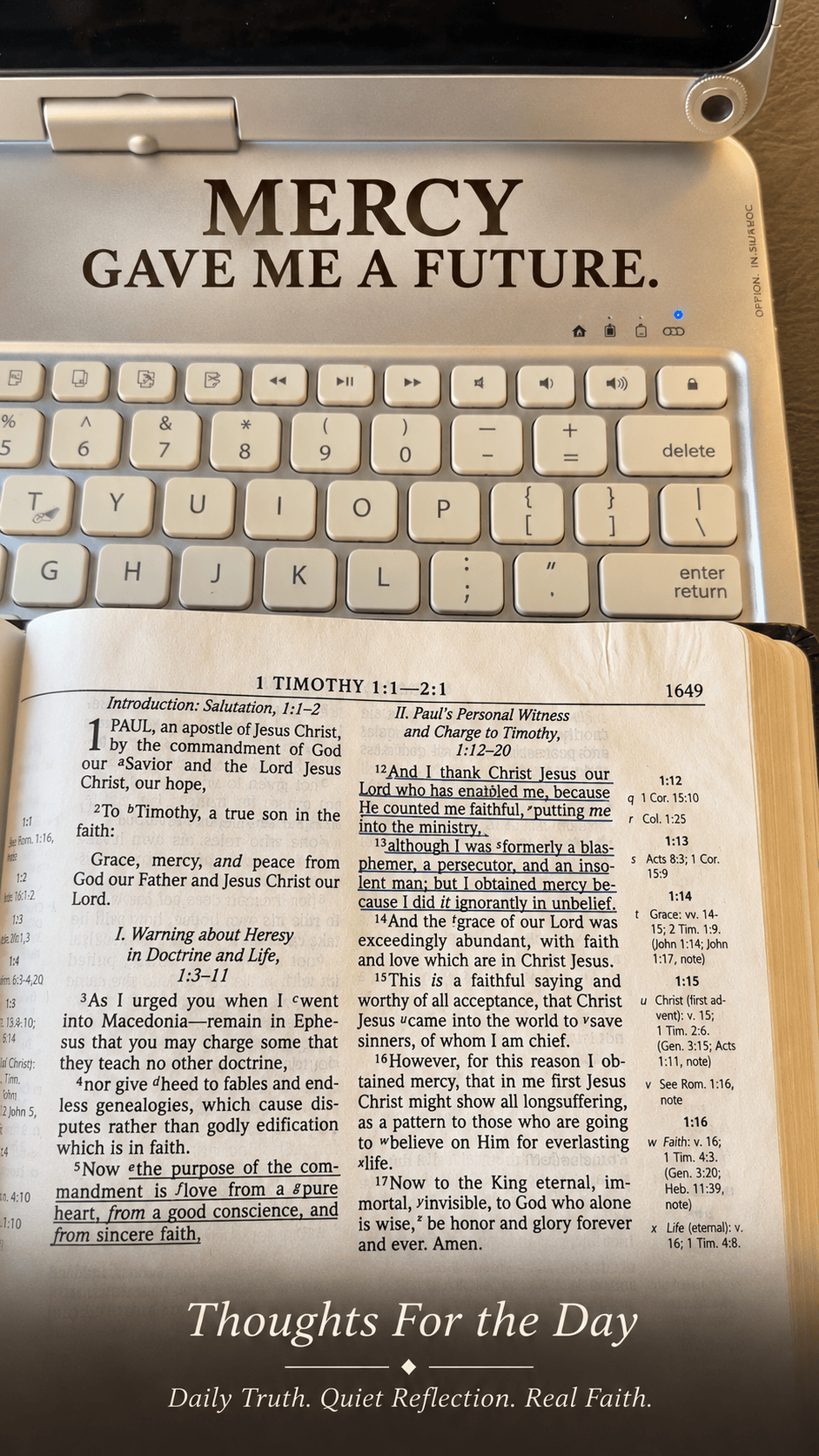
  • Mercy Gave Me A Future

    Mercy Gave Me A Future

    1 Timothy 1:12–16

    Before Paul tells Timothy what kind of man he used to be, he thanks Jesus for letting him serve.

    I might’ve told it the other way around. I’d have started with what I did wrong and worked my way toward what God did about it. Paul starts with gratitude. Jesus gave him strength and entrusted him with ministry. Then, in the very next verse, Paul calls himself a blasphemer, a persecutor, and an insolent man.

    Take a minute with that word persecutor. There were real people facing real consequences on the receiving end of what Paul did. His ignorance and unbelief helps explain why he acted as he did, and the harm he caused was real. Years later, he could still name it plainly in a letter to a man he was teaching how to serve.

    Right there in verse 13, after naming the man he’d been, Paul writes something so simple, yet so profound, “but I obtained mercy.”

    That’s where his future changed.

    Paul calls the Lord’s grace “exceedingly abundant.” Think about what that grace looked like in his life. He came to believe in the very Jesus he’d opposed, and he would spend the remainder of his life caring for people he once would’ve persecuted. And when he thanked Jesus for putting him into ministry, he also thanked Him for the strength to do it.

    I’d already finished this devotional and had it ready to post before I went to church this past Sunday. We had a visiting minister at Ozark Mountain Pentecostals, Bro. Tyler Bushnell, who preached a message called “You Serve, He Will Elevate”. He asked two questions that stayed with me after church. “Where are you serving right now?” and “What has God given you that you can use right now?”

    I’ve spent enough time over the past year wondering what serving now would look like for me. I used to teach Sunday school to teenagers. I knew where I’d be and who I’d be talking to. These days, I sit down to write and know that I may never meet the person who reads it. I can wonder what the Lord has for me down the road and then realize there’s something He’s already given me to do today. Bro. Tyler’s questions made me stop long enough to see it.

    He talked about Joseph serving wherever he found himself: he served his father at home, he served faithfully in Potiohar’s household, and he continued to serve even when unfairly imprisoned. I kept thinking about the part he emphasized. Throughout Genesis 39 there of a recurring phrase, “The Lord was with Joseph”. I needed that reminder. I can ask God to show me what comes next, and I can thank Him for being with me in the work He’s given me now.

    I think we can get turned around here. Sometimes I catch myself going back over something I’ve already repented of, as though feeling bad about it one more time will show Jesus I meant it the first time. If there’s something I can put right, there’s value in doing that. And when I sit down to write or have a chance to encourage somebody, I can receive that opportunity with gratitude. Jesus is the One who forgave me. He’s also the One I ask for strength to do what’s in front of me.

    Paul tells Timothy why his story matters to the next person who hears it. “Christ Jesus came into the world to save sinners.” Paul includes himself in that sentence. Then he says the patience Jesus showed him was an example for those who would come to believe in Him for everlasting life. I’m glad Paul told the whole story. Somebody who’s all but given up on themselves can read it and have a reason to come to Jesus.

    Final Word
    This Thanksgiving, I’m grateful Jesus had mercy on me. I’m also grateful I get to sit down and write these words, and that He gives me the strength to keep doing it. When I think about the future His mercy gave me, I can see part of it right here in what I get to do today.

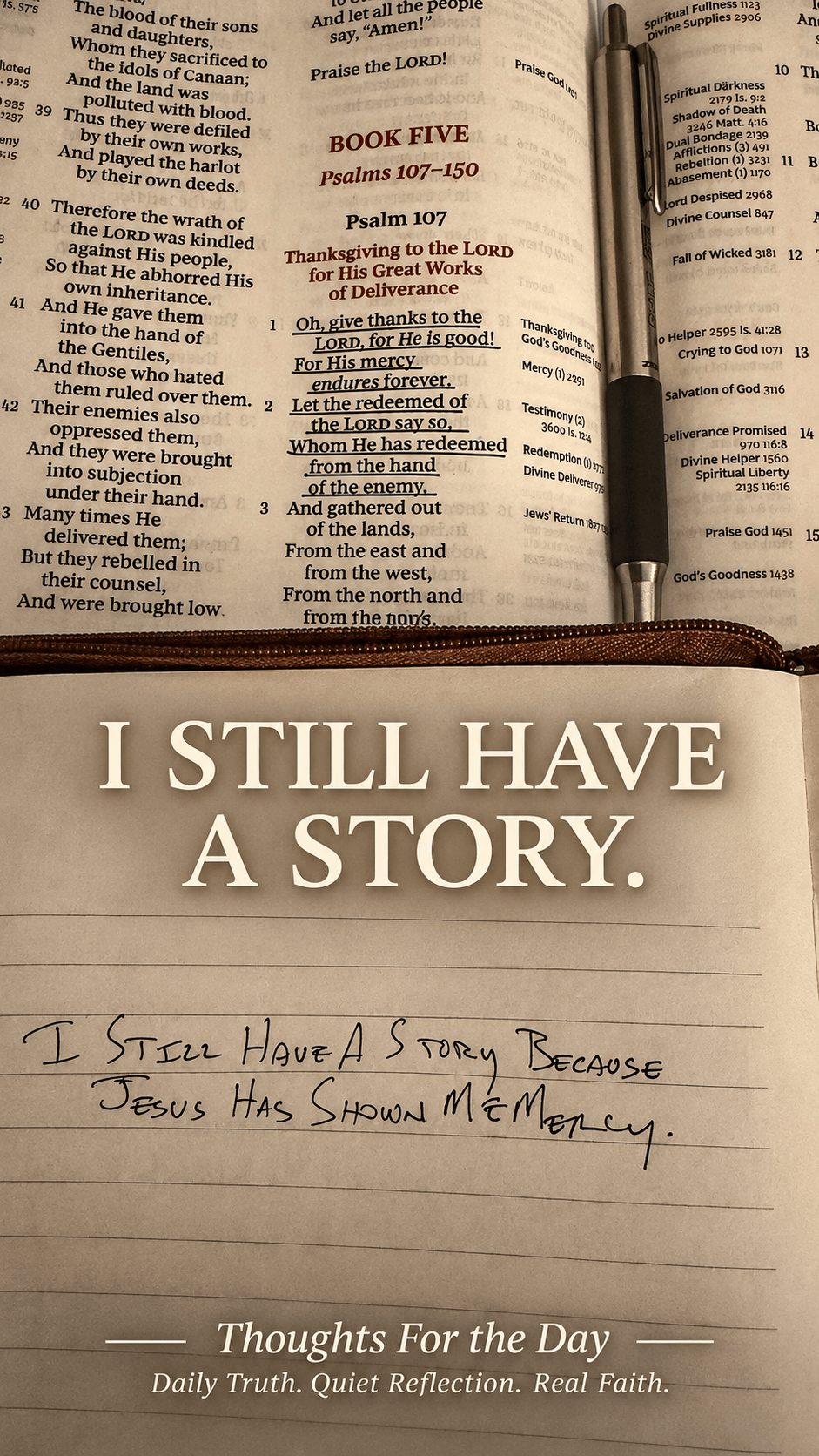
  • I Still Have A Story

    I Still Have A Story

    Psalm 107:1–2

    Recently, I heard Chresten Tomlin sing Living, Breathing, Walking Testimony. The chorus took me right back to a place I remember all too well.

    “…but they can’t take away my story
    ‘Cause I’m a living, breathing, walking testimony.”

    In 2025 I walked away from more than a few conversations wondering whether I had any business serving God. How could I teach somebody about trusting Him when parts of my own life had fallen apart? With the choices I’d made, what did I have left to offer?

    I kept turning those words over in my mind long after the conversations ended. I knew what I’d done. I still regretted those choices, even though I’d repented and Jesus had forgiven me. But every time it came up again, I felt like I was being condemned all over again. And somewhere in all that, I started to believe I was through. Done. That God couldn’t use somebody like me again.

    I’d started to live as though Jesus had taken back the forgiveness He’d already given me.

    Thanksgiving is a few days away. I’ll thank God for my family, for the people who love me, and for the ordinary provision I’m prone to take for granted. But there’s something I want to thank Him for first. Jesus had mercy on me.

    Psalm 107 opens in verse one by giving thanks to the Lord for His goodness and enduring mercy. Then the psalmist tells the people He’s rescued what to do with that gratitude.

    “Let the redeemed of the LORD say so,
    Whom He has redeemed from the hand of the enemy,”

    —Psalm 107:2 (NKJV)

    Those two verses belong together. The first tells me why I give thanks. The second gives me a reason to open my mouth.

    An honest testimony makes room for the whole truth. I can say I was wrong and thank Jesus for forgiving me. I can admit some memories still hurt and remember how He sustained me. I can take responsibility for the choices I made and trust Him with what comes next.

    I used to think about serving in terms of where I’d stood before and whether I’d ever stand there again. These days, I’m grateful for the opportunities right in front of me. There were prayers I kept praying. There were Scriptures that kept reaching me. There are people I can listen to and encourage today.

    And then there’s this page.

    Being able to sit here and share my testimony means something to a man who once wondered whether he ought to stop altogether. I hope these words reach somebody who’s been wounded and is wondering the same thing.

    Maybe for you, “they” is just one person. You can still hear what they said, and some days you wonder if you have anything left to offer. I know what that’s like. Here’s what I wish somebody had said to me when I was there.

    They don’t get to define you. They don’t get to tell your story. You can tell the truth about what happened, including the parts you wish you could do over. Whatever brought you to this point, you can trust Jesus with what comes next. That person, those cirsumstances, your sin… they don’t get to decide how your story ends.

    Maybe you’re walking into Thanksgiving with a part of your story you still find hard to talk about. Start with a mercy you can name. It might be the forgiveness you asked God for after finally admitting you were wrong. It might be a verse that helped you pray again, or a person who gave you enough room to tell the truth. Thank Jesus for that much today, even if there’s still a lot to work through.

    And when you have a chance to share it, even with just one person, tell them what He did for you. I want my story—and yours—to help somebody else trust Him.

    Final Word
    I still have a story because Jesus has shown me mercy. And this Thanksgiving, that’s where I’m starting.