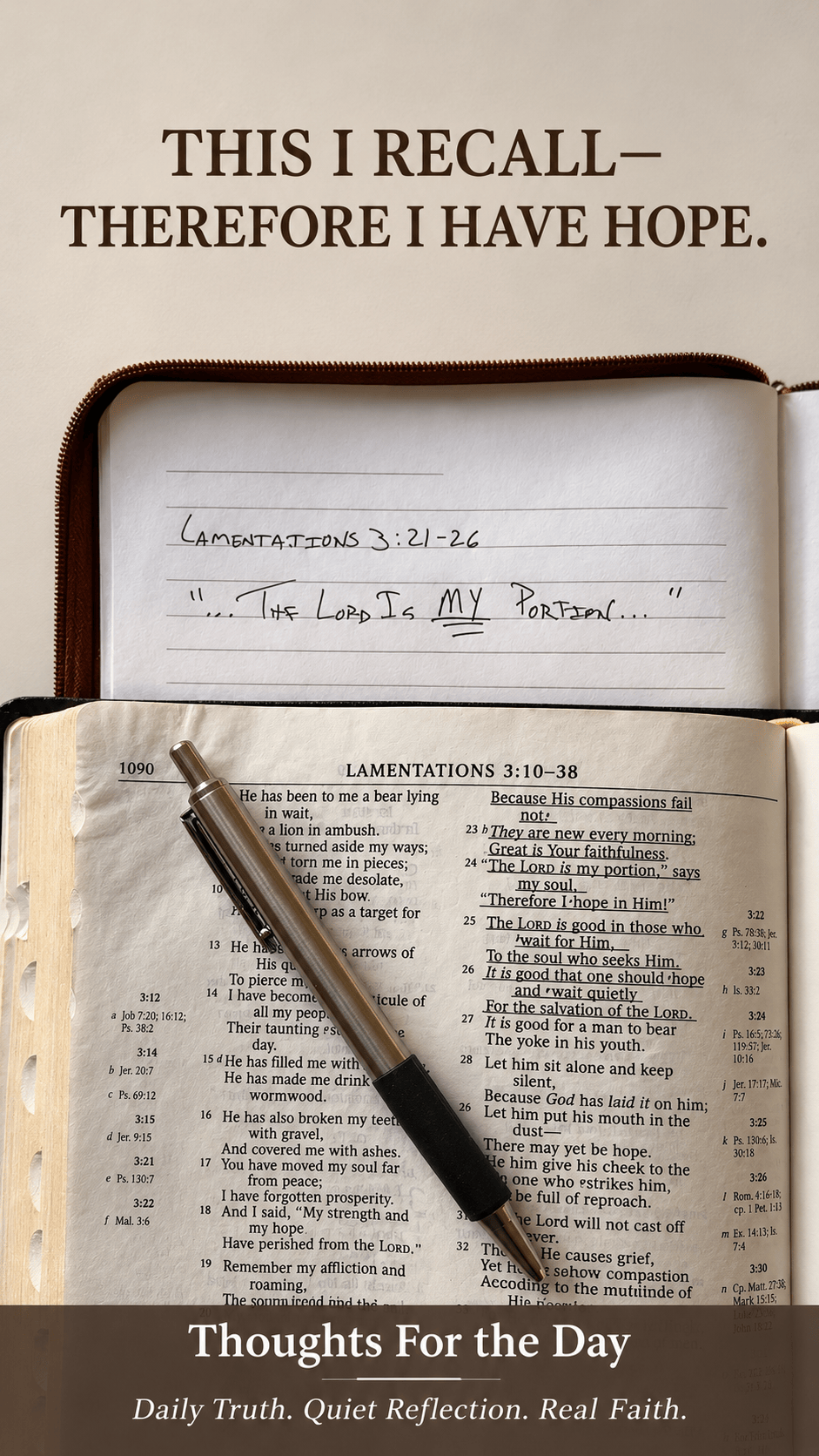
Lamentations 3:17–26 NKJV
There are seasons when remembering hurts.
The mind returns to what happened. What was said. What is missing. We remember how life used to feel, before the loss, before the uncertainty, before something changed that we could not put back together.
Sometimes those memories arrive before our feet ever touch the floor.
That is the emotional weight behind the familiar words in Lamentations 3. Before Jeremiah speaks of mercy renewed each morning, he describes a soul far from peace. Prosperity has become a distant memory. His strength feels gone, and even his hope in the Lord seems to have perished.
He remembers his affliction, and his soul sinks beneath its weight.
We need to let those words speak before rushing toward the verses we like to quote. The hope that follows rises from within an honest lament. These are words spoken in the presence of devastation.
Then comes the turn:
“This I recall to my mind,
Therefore I have hope.”
—Lamentations 3:21 NKJV
Notice the deliberate action: I recall.
The preceding verses describe memories that bow his soul down. Now he brings something else to mind: the Lord’s mercy, His unfailing compassion, His faithfulness.
The circumstances have not suddenly improved. No announcement arrives between verses 20 and 21 declaring that everything has been restored.
But mercy remembered interrupts present despair.
We know how easily the mind rehearses a painful conversation. We can revisit a disappointment until we remember every detail. We can count what has gone wrong while barely noticing how much attention we have given it.
Recalling God’s truth requires intention, too.
That does not mean every painful thought will disappear because we read scripture. Grief does not follow a timetable, and a weary mind may need to return to the same truth many times throughout the day.
Still, there is something we can deliberately bring into that conversation.
God’s compassion has not been exhausted. His faithfulness has not expired. The morning finds us needing mercy again, and His mercy is there.
This is more than positive thinking. Its foundation is God’s character. We have reason to hope because of who He is, always has been, and always will be – even while we struggle with what has happened.
Then Jeremiah makes a declaration that reaches deeper:
“The LORD is my portion.”
—Lamentations 3:24 NKJV
A portion is an allotted share—what belongs to someone, what they can call their own.
We often measure our security by the portions we can see: a dependable income, good health, a familiar home, relationships we expect to last. These are meaningful gifts, and losing them can leave us feeling as though the ground has disappeared beneath us.
Into that emptiness comes this confession: the Lord Himself is my portion.
His gifts matter. We can thank Him for every provision, every answered prayer, every person whose presence has enriched our lives. We can also mourn deeply when something precious is gone.
But our relationship with Him reaches beyond the things we receive from His hand.
When familiar supports give way, we can still belong to Him. We can still seek Him. We can bring Him the questions we cannot answer and the sorrow we cannot resolve.
The passage moves toward waiting quietly for the Lord’s salvation. There is room here for hope that has not yet seen the answer.
Hebrews 11:1 gives language to that trust:
“Now faith is the substance of things hoped for, the evidence of things not seen.”
—Hebrews 11:1 NKJV
We may not yet see how God will carry us through. We may have no indication that our circumstances are about to change. But remembering His faithfulness gives us a foundation for trusting Him with what remains unseen. Our hope rests in the One we have come to know.h
Perhaps today your mind keeps returning to something you have lost.
You do not have to pretend it did not matter.
But as you remember it, deliberately recall one truth about God that the loss cannot remove. Write it down. Read it aloud. Bring it back to mind when the painful memory returns.
His compassion has not failed.
His faithfulness remains.
He is still your portion.
Let that truth have a place in your thoughts today.
Final Word: When your mind rehearses what you have lost, deliberately recall who God remains.

