Tag: Trust God

  • Still Called to Be Faithful — Part II

    Still Called to Be Faithful — Part II

    1 Peter 1:6–7; Job 23:10

    Yesterday, we considered a truth that remains after the votes are counted: We are still called to be faithful.

    We still have responsibilities to fulfill, neighbors to love, and a Savior to follow.

    But knowing our calling hasn’t changed doesn’t mean answering that call will always be easy.

    We may still feel disappointed, concerned, relieved, or hopeful. But whatever we feel about an election, the rest of life hasn’t stopped.

    There are still bills to pay. Relationships still need attention. Medical questions remain unanswered. Some burdens were waiting for us long before we knew the results. In many cases, long before the election cycle even began.

    The question now is, how do we remain faithful when our feelings are unsettled and the way ahead is uncertain?

    Peter wrote to believers who knew something about difficult circumstances:

    “In this you greatly rejoice, though now for a little while, if need be, you have been grieved by various trials”
    —1 Peter 1:6 NKJV

    Peter made room for rejoicing and grief in the same sentence.

    Their hope was real. So was their pain.

    He went on to describe the genuineness of their faith as “much more precious than gold that perishes, though it is tested by fire” (1 Peter 1:7 NKJV).

    That passage reaches far beyond our response to an election. Peter was addressing believers facing trials because of their allegiance to Christ. His words help us consider what we depend on when remaining faithful becomes difficult.

    It’s one thing to speak about trusting God when circumstances reassure us.

    Continuing to trust Him when we have questions asks something more of us.

    Sometimes it asks us to keep obeying while we’re afraid.

    Sometimes it asks us to speak graciously when anger would come more easily.

    And sometimes it asks us to examine something we’ve felt certain about for years.

    Over the past few years, I’ve had to do a lot of that.

    As I’ve grown in my walk with God, I’ve had to examine convictions I’d held for a long time. New evidence and a closer examination of Scripture have challenged some things I once felt certain about.

    Sometimes, I’ve had to return to the very passages I’d used to defend those beliefs and ask whether I had understood them correctly.

    That hasn’t always been comfortable.

    There’s history attached to a conviction. Things we’ve taught. Decisions we’ve made. Ways we’ve understood other people and their circumstances.

    Examining those beliefs can require us to acknowledge that our certainty exceeded our understanding.

    But faithfulness to God includes being willing to receive His correction.

    I’m learning to ask: Am I allowing Scripture to shape what I believe, or am I asking it to defend what I’ve already decided?

    That question requires honesty.

    Can I acknowledge a legitimate concern even when it challenges a conviction I hold deeply?

    Acknowledging that concern doesn’t automatically require abandoning the conviction, but it does require listening honestly and being willing to examine whether my understanding, application, or conduct needs correction.

    We can be convinced of a biblical principle and still mishandle the person standing in front of us.

    We can also hold an interpretation so tightly that we become unwilling to examine it in light of Scripture.

    Remaining faithful includes remaining teachable.

    We bring our conclusions before God with the same surrender we bring our unanswered questions.

    “Lord, help me understand.”

    “Show me where I need correction.”

    “Help me obey what You’ve shown me.”

    Then we carry that willingness into ordinary life.

    We tell the truth when exaggeration would strengthen our argument.

    We check a claim before passing it along, even when it supports our position.

    We listen without preparing a cutting response.

    We apologize when we’ve spoken carelessly.

    We keep our promises, do our work honestly, and care for people whose concerns differ from our own.

    These choices may attract very little attention, but they still matter.

    They are places where our trust in Jesus becomes visible. How we respond can either strengthen or weaken our testimony.

    Trusting God’s sovereignty also leaves room for discernment. We can recognize wrongdoing, question decisions, and work toward change. We remain responsible for the spirit and conduct we bring to those efforts.

    Our concern about what someone else may do doesn’t release us from what Jesus has already asked of us.

    Earlier this week, we considered the foundation beneath a storm-damaged house. Then we brought our overwhelmed hearts to God and asked Him to lead us.

    Now we have another question to consider:

    Can I remain faithful to what God has already shown me while I’m uncertain about what comes next?

    Job didn’t understand everything happening around him. Yet even within the struggle, he expressed confidence in God:

    “But He knows the way that I take;
    When He has tested me, I shall come forth as gold.”

    —Job 23:10 NKJV

    Job’s confidence rested in God’s knowledge of his way, even while his own understanding remained limited.

    We may end this week with circumstances that are still unresolved.

    We may still have questions. We may have something to reconsider, someone to ask forgiveness from, or a responsibility that feels heavier than we’d like.

    We can entrust those things to God and take the next faithful step.

    What is one thing Jesus has already shown you that you need to put into practice today?

    This is my prayer…

    Lord, keep my heart teachable and my life anchored in You. Correct my understanding where it needs correction. Help me speak truthfully, listen humbly, and treat people with care. When I cannot see what comes next, give me the courage to obey what You have already shown me.

    I am still called to be faithful.

    Help me answer that call today.

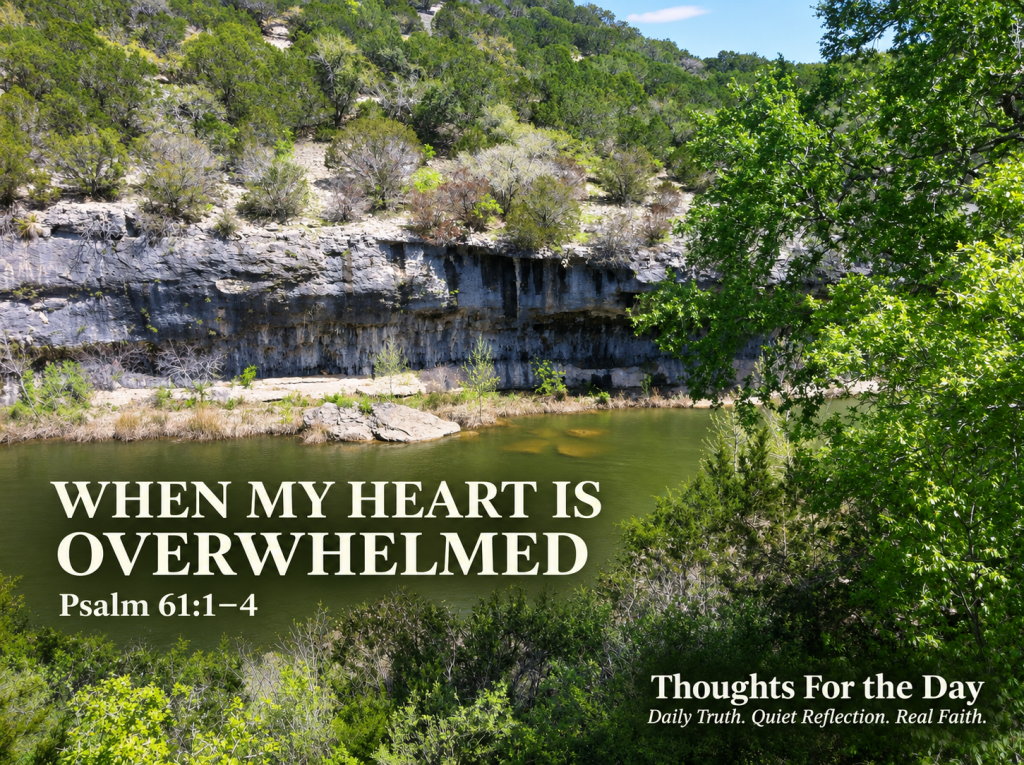
  • When My Heart Is Overwhelmed

    When My Heart Is Overwhelmed

    Psalm 61:1–4

    Sometimes the hardest part of a difficult season is waking up already tired.

    Nothing new has happened, but the weight of what’s already happening is enough.

    The questions we had yesterday remain unanswered. Life’s responsibilities still need our attention. So we get up and do what needs to be done, but inside, we’re struggling just to steady ourselves.

    Yesterday, we considered what we’ve built our lives on. But even when we know where our foundation rests, we can become exhausted.

    David gave words to that kind of prayer:

    “Hear my cry, O God;
    Attend to my prayer.
    From the end of the earth I will cry to You,
    When my heart is overwhelmed;
    Lead me to the rock that is higher than I.”

    —Psalm 61:1–2 NKJV

    “Lead me.”

    Those two words ask something of us.

    We must be willing to be led.

    That can be difficult when we’re accustomed to figuring things out, carrying responsibility, and being the person others depend on. We may keep searching for an answer long after we’ve exhausted ourselves, convinced we should somehow be able to handle it.

    David’s prayer acknowledges a limit. His heart is overwhelmed, and he needs God to lead him to a place beyond his own ability to find security.

    He remembers where he has found shelter before:

    “For You have been a shelter for me,
    A strong tower from the enemy.”

    —Psalm 61:3 NKJV

    His present distress hasn’t erased God’s past faithfulness. He brings both into his prayer: the trouble he’s experiencing and the shelter he knows God has been.

    Elsewhere, David described that dependence through the picture of a shepherd caring for his sheep:

    “He leads me beside the still waters.
    He restores my soul.”

    —Psalm 23:2–3 NKJV

    There’s something deeply comforting about having a Shepherd who knows where to lead us.

    But following Him requires surrender.

    We may need to loosen our grip on the route we’ve chosen, the timetable we’ve imagined, or the belief that we must understand everything before we can take another step.

    We can pray for direction while remaining determined that the answer must come through a particular door. We can ask God to lead us while resisting any step that takes us away from the outcome we’ve pictured.

    There have been times I’ve had to ask myself: Am I willing to be led when I cannot see where the path is going?

    A sheep doesn’t have the shepherd’s view. It depends on his care and follows his direction.

    We need that care when our own view has narrowed to the problem immediately in front of us. An overwhelmed heart can struggle to imagine anything beyond the next bill, the next appointment, the next difficult conversation, or another night of unanswered questions.

    We can bring that heart to God plainly.

    “Lord, I’m tired.”

    “I don’t know what to do.”

    “I need You to help me take the next step.”

    We don’t have to dress those prayers in language that makes us sound stronger than we are.

    David cried out from an overwhelmed heart.

    We can, too.

    And dependence on God can include accepting help from the people around us.

    Let someone pray beside you. Tell a trusted person that you’re struggling. Receive help with an immediate burden. A meal, a ride, a listening ear, or someone sharing a responsibility can give a weary person room to breathe.

    We can receive those kindnesses with gratitude. We don’t have to carry every burden alone to prove that we trust God.

    Being overwhelmed doesn’t automatically mean we’ve failed to surrender. Even faithful people become weary. Sometimes surrender happens through tears, as we admit our limits and entrust the next step to Him.

    The next step may be small…the one after that may be even smaller. And we may still have questions when we take it.

    But we have a Shepherd to follow.

    David’s prayer gives us a place to begin when we don’t know how to move forward:

    “Lead me to the rock that is higher than I.”

    Lord, lead me when I don’t have the strength or clarity to find my own way. Help me surrender my need to control every turn. Make me willing to follow You and receive the help You provide.

    When my heart is overwhelmed, lead me.

  • What Have I Built My Life On?

    What Have I Built My Life On?

    Matthew 7:24–27

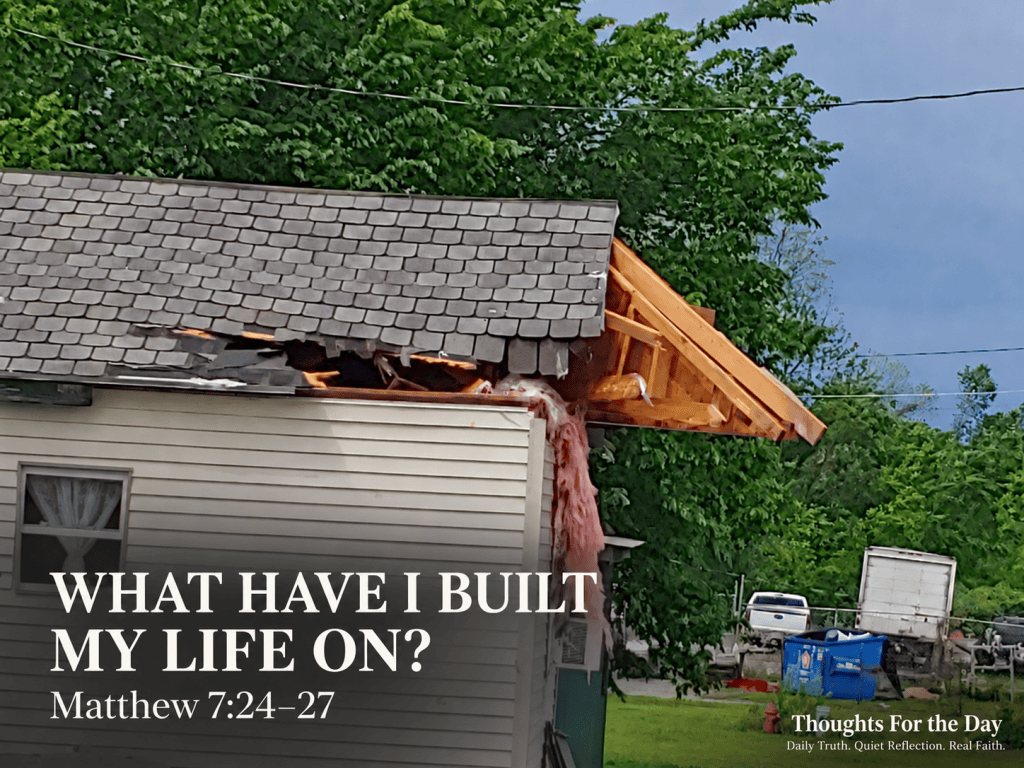
    Yesterday I wrote about photographs of the storm damage from the April 30, 2019 tornado that struck Haileyville, Oklahoma.

    Last night, as I looked back through those pictures, one photograph in particular held my attention.

    It showed a residence, much like an old shotgun house. Part of the roof framing had been pulled outward and was hanging beyond the back of the house. Roofing was torn open, insulation hung from the damaged corner, and the structure had been compromised.

    Yet the house remained standing.

    That picture brings a question close to home:

    What have I built my life on?

    In April 2004, I lost a job making nearly $36,000 a year through a series of events over which I had no control. After two months of searching, I accepted a minimum-wage job at Staples.

    During that same period, my Mums—the woman who had helped raise me—was hospitalized. We weren’t sure she would survive.

    Then, about two weeks after I started the new job, my wife stood in the doorway one Sunday evening and told me she wanted a divorce.

    When I asked why, she said, “I don’t want to be married to you anymore.”

    I asked her to clarify. Did she no longer want to be married, or did she no longer want to be married to me?

    Her answer was the same.

    It knocked the wind out of me. I felt as though I’d been hit in the stomach.

    Within a few weeks, I moved into a small duplex. Money was tight. My marriage was uncertain. Someone I loved dearly was fighting for her life.

    Most days, the routine was simple: get up, go to the hospital to check on Mums, go to work, go home.

    My relationship with God was tenuous. I won’t pretend otherwise. But I began journaling, and Bible study became my friend.

    The financial uncertainty remained. The questions about my marriage remained. Most days were a struggle.

    But during that season, I remained faithful to my vows and faithful to God.

    Jesus’ teaching about the two builders speaks into seasons like that:

    “Therefore whoever hears these sayings of Mine, and does them, I will liken him to a wise man who built his house on the rock.”
    —Matthew 7:24 NKJV

    Jesus described two builders. One built his house on rock; the other built on sand. Both houses faced rain, rising water, and beating winds. One stood. The other fell.

    The difference was in what they had been built on.

    Jesus used that picture to explain our response to His teaching. Hearing His words and putting them into practice is like building on rock. Hearing them without doing them is like building on sand.

    A dependable income matters. Our health matters. Our relationships matter deeply. And when those things become uncertain, the pain is real. Trusting God doesn’t mean we won’t feel the blow.

    But a paycheck, another person’s decisions, and our own ability to manage circumstances cannot provide an unshakable foundation.

    Looking back at that small duplex, I remember how little I could control. I couldn’t make my wife choose our marriage. I couldn’t guarantee Mums’ recovery. I couldn’t make an employer offer me the income I needed.

    But I still had choices about how I would live.

    That’s where Jesus’ teaching becomes practical for all of us.

    Will I tell the truth when honesty costs me something?

    Will I forgive when I’d rather keep rehearsing the offense?

    Will I accept correction when I want to defend myself?

    Will I obey what He has shown me while I’m still afraid?

    These are ordinary decisions through which we put His words into practice. We make them at work, at home, in difficult conversations, and in quiet moments when no one else sees.

    Looking at that photograph again, I see something that connects with my own experience. The displaced roof framing, torn roofing, and exposed corner show how much damage the house had sustained.

    Yet the house remained standing.

    I know something about feeling as though the supports have been pulled out of your life. A dependable income disappears. A loved one may not survive. A marriage you wanted to preserve becomes uncertain.

    You feel the damage. You struggle to find your footing. Some days, you wonder how much more you can take.

    That house brings me back to what Jesus taught: the foundation matters. What we build our lives on matters.

    The house built on rock still endured the storm. Following Jesus doesn’t mean we won’t experience grief, fear, or days when getting up takes everything we have.

    But His words give us something dependable to build on. As we put them into practice, we learn to remain faithful even when circumstances are beyond our control.

    That brings the question back to me. Knowing the right Scriptures matters. So does what I do with them.

    What is one thing Jesus has already shown me that I need to put into practice?

    That’s a place to begin building today.

  • Shaken, but Still Standing

    Shaken, but Still Standing

    Job 23:8–10; Matthew 7:24–27

    On the night of April 30, 2019, tornado sirens sounded in the small town of Haileyville, Oklahoma. An EF2 tornado swept through the area, damaging homes, vehicles, and businesses. The far northwestern corner of neighboring Hartshorne was also affected, but to a lesser degree.

    At the time, I was managing TH Rogers Lumber in Hartshorne. I’d heard reports as I was getting ready to leave the house the next morning, Wednesday, May 1, but what I heard hadn’t prepared me for what I saw as I approached Haileyville on my way to work.

    I drove slowly through town without stopping while emergency workers and first responders worked to ensure everyone was accounted for. Later that morning, I went out to survey the damage, assess what people needed, and determine what our store could provide.

    The devastation was mind-boggling.

    The roof had been torn off the back two-thirds of a secondhand resale store, leaving the front relatively undamaged. At another small shop, the front half was gone while the back portion appeared unscathed.

    A highway directional sign had been twisted nearly 270 degrees. The sign directing travelers toward Highway 270 East now pointed south-southwest.

    The post office roof was shredded. The roof and kitchen exhaust equipment from my favorite café were lying about a hundred yards away in someone’s backyard.

    At an auto body shop, the tornado had torn through the middle of the building, leaving damage that looked as though a semi had been driven straight through it.

    Dozens of homes were damaged, several beyond repair.

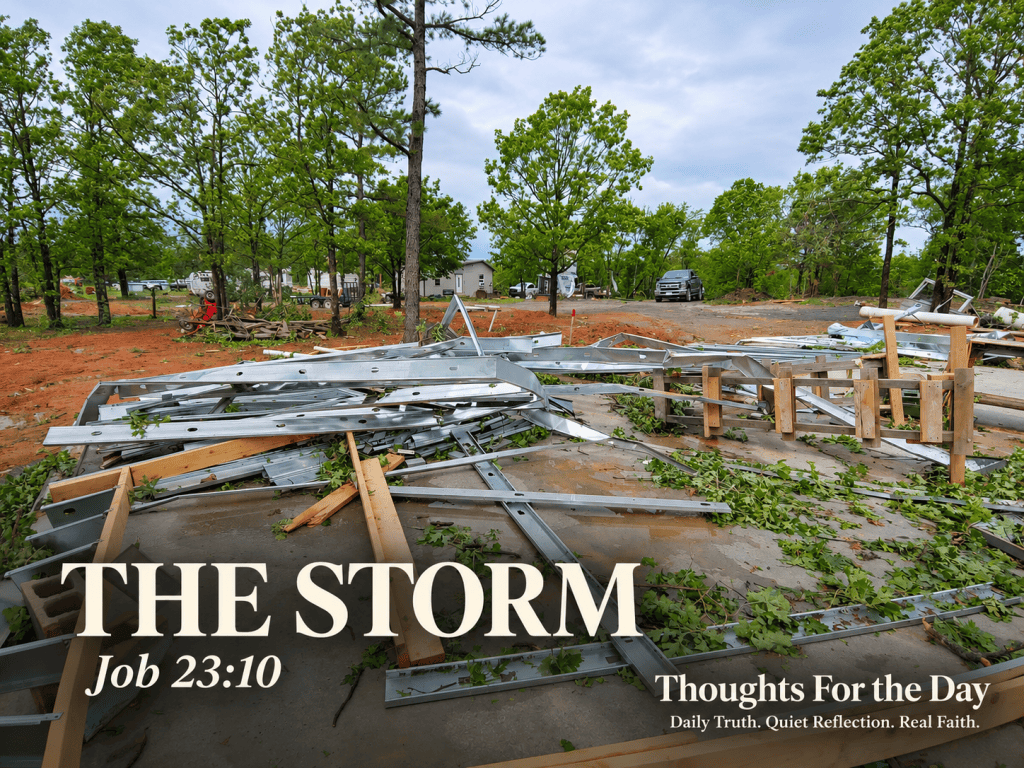
    One home was still under construction. It had been framed with metal studs, the metal siding was just going on, and the windows had been installed the Friday before the tornado. Now the framing lay bent and collapsed across the concrete slab, with window units scattered among the wreckage. Work completed only days earlier had been undone in a matter of moments.

    An antique store operating out of a repurposed home had been lifted from its foundation. The anchor bolts had ripped through the wooden sill plate as the structure was picked up nearly intact and deposited about fifteen feet behind its original location.

    For the people who lived and worked in Haileyville, those buildings held years of effort, memories, and plans. In a matter of moments, so much of what had seemed secure had been torn apart.

    I took photographs during that visit, with permission from the business owners and homeowners. At the time, I was focused on the work in front of me. People had immediate needs, and I was trying to figure out how we could help. I didn’t stop to draw a spiritual lesson from what I was seeing.

    That connection came more than seven years later.

    I’d discovered Adobe Premiere on my iPhone and started going through photographs to see what I could create. I added a picture, then some words, then looked for other photographs that fit the thought as it developed.

    As the images and words took shape, I began connecting the destruction I’d witnessed with the ways life can leave us shaken, disoriented, and wondering where God is.

    Some storms give us enough warning to hear the sirens and find shelter. Others arrive through a phone call, a difficult conversation, or news we never expected. They shake our confidence, disrupt our plans, and leave us struggling to understand what comes next.

    And sometimes, in the middle of it all, we struggle to find God.

    That thought brought me to Job 23.

    In the verses leading up to Job 23:10, Job describes searching for God and being unable to perceive Him. Yet even there, with his questions still unanswered in the wake of utter devastation, he says:

    “But He knows the way that I take;
    When He has tested me, I shall come forth as gold.”

    —Job 23:10, NKJV

    Job couldn’t see what God was doing, but he trusted that God knew where he was.

    We can find ourselves unable to perceive God in the middle of our circumstances and still trust that He knows the way we take.

    As I continued looking through the photographs, another image caught my attention differently.

    At least three rafters had been pulled from beneath the roof of a house. The wall was damaged, and the structure had been destabilized. Yet the house remained standing.

    Looking at that picture now, I think about what it means to endure the storms of life.

    We can suffer real damage. We can grieve, struggle, and find ourselves uncertain about how to move forward. Our lives may look very different from what we’d planned.

    And still, we can stand.

    In Matthew 7:24–27, Jesus describes a wise man who built his house on the rock. The rain fell, the floods came, and the winds beat against it. The house stood because of its foundation.

    Jesus also describes a house built on sand. The rain, floods, and wind came against that house, and it fell.

    Both houses faced the storm. The foundation they were built on mattered.

    Jesus connects building on the rock to hearing His words and putting them into practice. That brings the question close to home:

    What have I chosen to build my life on?

    It’s a question worth considering before the wind begins to blow—and one we may find ourselves answering again while standing among the pieces of what has been damaged.

    Building on Christ means learning to depend on Him and live by His words. That trust takes shape in the choices we make, the prayers we bring, and the steps of obedience we take while our questions remain unanswered.

    Sometimes that prayer comes through tears. Sometimes the next step feels small. Sometimes we need someone beside us to help us take it.

    Standing may look like praying again, accepting help, or taking one faithful step through a day we’re struggling to face.

    We may come through a storm carrying wounds. We may need time, help, and healing. We may have a great deal of rebuilding ahead of us.

    Through all of it, Christ remains worthy of our trust.

    That’s where these photographs bring me now: to Job’s assurance that God knows the way we take, and to Jesus’ invitation to build our lives on His words.

    You may be looking at circumstances you don’t understand. You may be grieving something you spent years building. You may be praying and wondering why the answers haven’t come.

    You can bring those questions to God. You can tell Him how much it hurts. And you can trust Him with the next step, even while the way ahead is unclear.

    When you can’t seem to find Him, He still knows exactly where you are.

    And when your life has been shaken, you can keep placing your trust in Christ—the foundation on whom you can stand.

  • How Long, O Lord

    How Long, O Lord

    Psalm 13:1–6; Luke 18:1 NKJV

    Some prayers remain tender long after we first prayed them. Even after we’ve been faithful, prayed earnestly, waited expectantly, and continued believing that God could intervene, we may still wake up to yet another morning with the need unresolved.

    We bring it to God again because it is still there.

    The relationship has not been restored. The diagnosis has not changed. The opportunity has not come. The grief still catches us off guard. The person we love is still struggling. The question remains unanswered.

    We have prayed about it before—perhaps more times than we can count—and we may no longer know what else to say.

    David knew the weariness of waiting. He began Psalm 13 with a question he repeated four times:

    “How long, O Lord? Will You forget me forever?
    How long will You hide Your face from me?
    How long shall I take counsel in my soul,
    Having sorrow in my heart daily?”

    — Psalm 13:1–2 NKJV

    David did not hide his distress behind carefully chosen religious language. He felt forgotten. He carried sorrow every day. He wanted to know how much longer he would have to live with what was hurting him.

    And Scripture does not condemn him for asking.

    “How long?” is not necessarily the question of someone who has stopped believing. It can be the cry of someone who still believes God hears, still believes He can intervene, and still cannot understand why He has not intervened.

    Lament is not the absence of faith. It is faith refusing to suffer in silence.

    Sometimes we think trusting God means we should no longer feel the ache of waiting. We may pressure ourselves to sound more confident than we feel or hurry toward words of celebration before we have had room to grieve.

    But David let the lament breathe. He told God that the waiting hurt.

    We can do the same.

    We can tell God that we are tired of carrying the same need into another day. We can admit that silence feels like absence. We can ask why help has not come and how much longer we must wait.

    Faith does not require us to pretend the question no longer hurts.

    Some answers never come in the way we hoped. Some questions remain even after life moves forward. We may receive something beautiful and still grieve what was lost. We may continue trusting God without ever receiving an explanation that makes the suffering understandable.

    Psalm 13 does not tell us that David’s circumstances changed while he was praying. Yet before the psalm ends, David turns toward what he knows about God:

    “But I have trusted in Your mercy;
    My heart shall rejoice in Your salvation.”

    — Psalm 13:5 NKJV

    That word “but” does not erase everything David said before it. His sorrow was still real. His questions were still unanswered. He had not suddenly discovered that the waiting did not matter.

    He remembered God’s mercy while he was still hurting.

    Sorrow and trust can exist in the same prayer. We can believe that God is faithful while admitting that we do not understand His ways. We can remember what He has done before while asking why He has not acted now.

    Jesus understood how easily prolonged waiting can discourage us. Luke tells us that He spoke a parable teaching that we “always ought to pray and not lose heart.”

    Persistent prayer does not force God’s hand, and it does not earn an answer through repetition. It keeps bringing our weary hearts into His presence when discouragement tells us to stop coming.

    Sometimes we pray again because the need is still real—and because, beneath all our questions, we still believe God is listening.

    We may come with fewer words than we once had. We may come with tears, disappointment, or questions we are afraid to say aloud. We may only be able to whisper, “How long, O Lord?”

    That is still prayer.

    God can be trusted with the question as well as the request. He can receive our weariness without turning us away. And when we do not have an answer, we can ask Him for enough strength to carry today’s portion of the waiting.

    Lord, I have brought this to You before, and I am bringing it again. You know how long I have waited and how deeply this still hurts. Hear me, sustain me, and help me not to lose heart.

  • Help My Unbelief

    Help My Unbelief

    Mark 9:17–27; Psalm 62:8 NKJV

    Have you ever felt that you needed to sound more confident in prayer than you actually felt?

    You believe God is able. You know He is faithful. Yet the situation in front of you leaves you wondering how things could possibly come together.

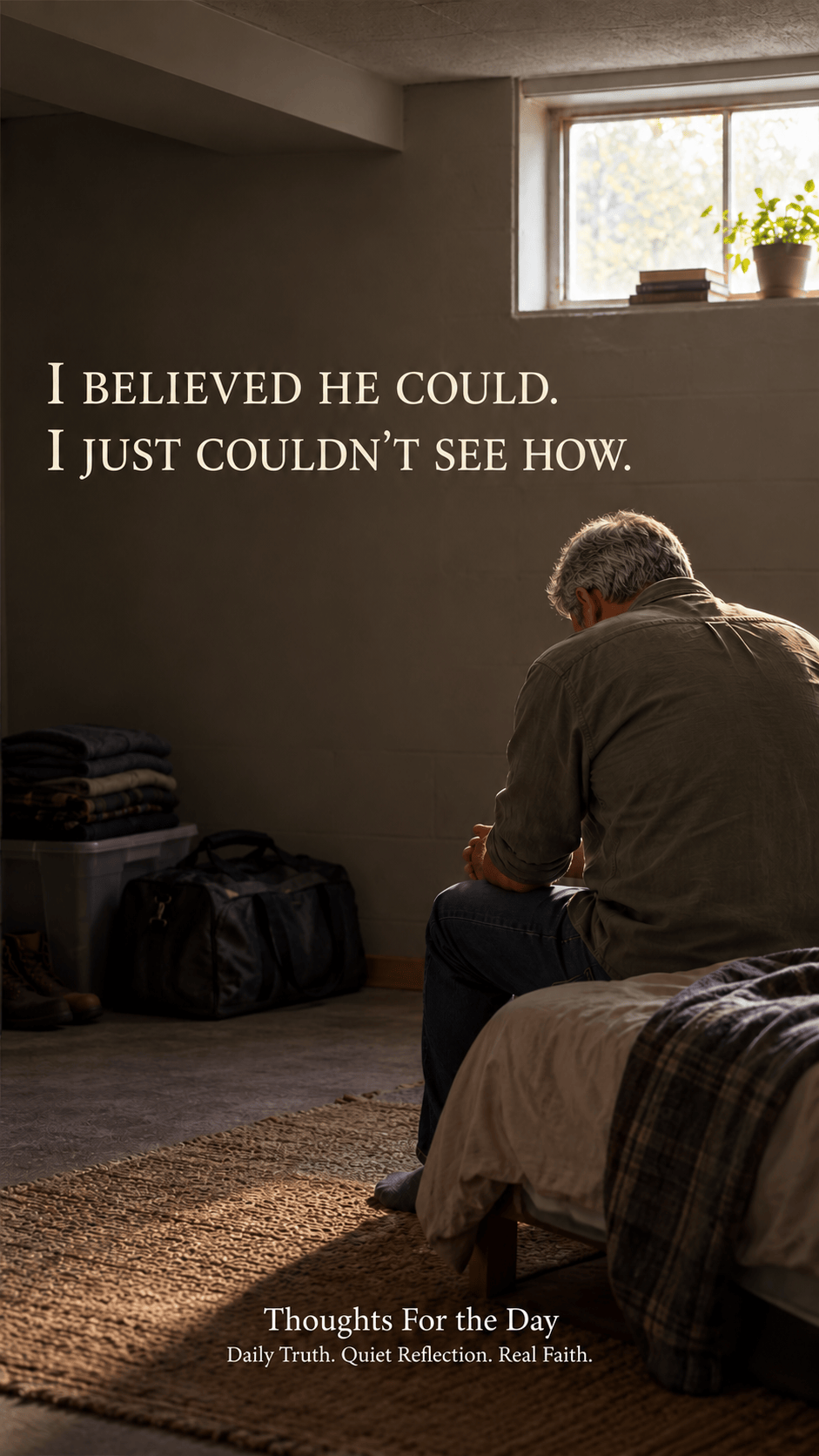
    A few years ago, I found myself at the end of my rope—the end of myself. I was living in my cousin’s basement, money was scarce, and I couldn’t see how I was going to get back on my feet.

    I was doing what I could to move forward, but even the immediate needs felt overwhelming. Could I afford enough gas to get to work? How would I pay my bills? When would I be able to find a place of my own?

    I believed God could and would direct my circumstances. I just couldn’t see how.

    I had hope. I also had worries that followed me through the day. The needs were immediate, and I couldn’t see how I was going to meet them.

    I reached a place where about all I could say was, “I believe; help my unbelief.”

    When I read the father’s plea in Mark 9, I recognize something of that struggle.

    He had watched his son suffer since childhood. He brought him to the disciples, but they had been unable to help. Now he stood before Jesus with his son’s need still unresolved.

    As Jesus called him to believe, the father cried out with tears:

    “Lord, I believe; help my unbelief!” — Mark 9:24 NKJV

    There is an expression of faith and an admission of need in the same prayer.

    He believed, and he recognized that he needed help believing. He brought Jesus his son’s suffering and his own struggling faith.

    That honesty speaks to me.

    Sometimes I know what I believe about God, but I struggle to trust Him with what I cannot see. I can speak confidently about His faithfulness and still become frightened when I think about tomorrow.

    That was where I found myself in that basement. I believed He could make a way. I needed His help while I was looking at needs I couldn’t meet and a future I couldn’t figure out.

    The father’s prayer gives us words for that place.

    We can tell God that we believe Him and ask Him to help us where trust is difficult. We can bring Him the fear we’re reluctant to admit, the disappointment we don’t know how to explain, and the questions we’re afraid might make us sound faithless.

    Psalm 62:8 invites us to:

    “Pour out your heart before Him.”

    The same verse calls us to trust Him at all times and reminds us that God is our refuge. We can come to Him with what is actually in our hearts.

    And we should keep reading the account in Mark. Jesus intervened in the boy’s suffering. He cast out the spirit that tormented him, took him by the hand, and lifted him up.

    The father had brought a real need to Jesus, and Jesus delivered his son.

    We can bring Him real needs, too. We can ask boldly for His help with the circumstances while also asking Him to strengthen our trust.

    Perhaps today you believe God is able, but you cannot see how things will come together. Perhaps hope and worry are sharing the same space.

    You can bring Him that struggle. You can keep coming while your voice shakes and your questions remain.

    Lord, I believe. Help me trust You with what I cannot yet see.

  • Until Prayer Changes Me

    Until Prayer Changes Me

    Philippians 4:6–7; Luke 22:41–42 NKJV

    How often have I worn myself out carrying something God had already invited me to bring Him?

    Sometimes I bring Him a problem I don’t understand, yet I convince myself that I know how He ought to resolve it. I’ve thought about what needs to happen, who needs to change, and how quickly everything ought to come together.

    Then I pray, asking God to help, while holding tightly to the outcome I’ve already chosen.

    The Kingdom Heirs song “Until Prayer Changes Me” has given me reason to examine that tendency in my own prayers.

    I can recognize that a situation is beyond my ability to fix and still struggle to entrust God with how it gets resolved. I want His help. I also want an answer that makes sense to me, a path I can understand, and an outcome I would have chosen.

    Trusting someone we know and can see is hard enough. They may be a close friend or family member who has proven trustworthy over the years. Even then, placing something that matters deeply to us in their hands can be difficult. We can have confidence in them and still struggle to release control.

    Trusting God, whom we cannot see, can make that struggle even more difficult. We naturally reach for something we can measure, anticipate, or influence. When circumstances become uncertain, our grip can tighten.

    Sometimes we keep carrying the weight until we reach the end of what we can figure out, arrange, or endure. Often, desperation reveals just how much we’ve still been trying to manage on our own.

    But God welcomes us long before we reach that point. We don’t have to exhaust ourselves before bringing Him the burden.

    Remembering whom we’re speaking to gives us reason to loosen our grip. The God who created us sees beyond the portion of the situation we can see. His wisdom reaches beyond our understanding. His faithfulness gives us reason to trust Him with what remains unknown.

    How much room have I left in my prayer for God to know something I don’t?

    In Gethsemane, Jesus expressed His desire openly:

    “Father, if it is Your will, take this cup away from Me; nevertheless not My will, but Yours, be done.” — Luke 22:42 NKJV

    There is room in prayer to ask honestly for relief. Jesus did. He also willingly submitted to the Father’s will in the midst of profound anguish.

    His surrender helps us understand how costly trust can be. Placing something in God’s hands may still hurt. We may surrender with tears. We may need to renew that surrender tomorrow when the fear rises again.

    In Philippians 4, Paul directs us to bring our requests to God through prayer and supplication, with thanksgiving. Then he gives this assurance:

    “and the peace of God, which surpasses all understanding, will guard your hearts and minds through Christ Jesus.” — Philippians 4:7 NKJV

    God’s peace can guard us while questions remain unanswered. We can be held by Him before we understand what He will do.

    We may still feel afraid. We may still grieve, struggle, or need help. Continued distress does not prove that our faith has failed.

    But as we keep coming to Him, we can become more willing to receive His direction. We can recognize expectations we’ve held too tightly. We can find enough steadiness to take the next faithful step.

    God can change the circumstances, and we can keep asking Him to do so. As we pray, we can also open our hearts to the work He wants to do within us.

    Lord, if the situation does not change today, continue changing me within it.

  • Come Aside For A While

    Come Aside For A While

    “Come aside by yourselves to a deserted place and rest a while.”
    — Mark 6:31, NKJV

    I’ve been silent this week. And that isn’t normal for me.

    Sharing God’s Word matters to me. So does being consistent. When a devotional remains unwritten, I find myself wondering whether I should have made more time.

    That question has followed me this week.

    And it has raised another: Have I given myself room to rest, or have I simply carried the pressure of an unfinished task into the time I spend doing something else?

    There have been health concerns, everyday responsibilities, decisions to make, and writing projects that mean a great deal to me. My mind has been full.

    One evening, I spent time with family and then sat down to pay bills. By bedtime, the devotional I had intended to write was still unwritten.

    I found myself wondering whether I hadn’t found the time—or simply hadn’t made it.

    That deserves an honest answer. So does another question:

    Had I considered everything else that needed my attention?

    Sometimes the things we care about most are the hardest things to step away from.

    We believe in the work. We recognize its value. We want to be faithful in doing it. And because it matters so much, we can have difficulty recognizing when we need to pause.

    In Mark 6, the apostles returned to Jesus and reported what they had done and taught. The activity around them was so demanding that they didn’t even have time to eat. Jesus responded by inviting them to withdraw and rest. (bible.com)

    Their work mattered. Their need for rest mattered to Him, too.

    That gives me something to consider when I examine my own priorities.

    I can measure a day by what I finished, what I wrote, or how far I moved a project forward. Yet there are other things that deserve a place in that examination: time with my wife, attention to my health, the care of my household, and quiet moments with God.

    Those things need room in my life.

    Sometimes making that room requires stepping back—even from work I love.

    A project may need to wait for an evening. A posting schedule may need adjusting. I may need to put down the phone, take a deep breath, and give my full attention to the person sitting beside me.

    And I need to recognize when fatigue, distraction, or a shorter temper are telling me to slow down and examine what I’m carrying.

    A pause gives us room to pray honestly:

    Lord, what needs my attention today? What can wait? Where have my priorities become crowded?

    We have a responsibility to consider those questions before exhaustion makes every decision feel urgent.

    If you’ve felt stretched thin this week, take a little time to examine your pace. Consider what your mind and body have been telling you. Bring your responsibilities—and your expectations of yourself—before the Lord.

    Then give yourself room to receive the rest you need.

    The people you love deserve your attention. Your health deserves care. Your walk with God deserves time.

    Don’t become so locked into a schedule that it squeezes the living out of your life.

    Let your schedule breathe…

    And make room for those things that matter most.

  • Sometimes You Hear Best In the Dark

    Sometimes You Hear Best In the Dark

    One evening in Puerto Rico, Lisa came in from sitting on the balcony with Ashlee.

    We were eight floors above the ocean, with a beautiful oceanfront view. During the day, you could see the water stretching toward the horizon.

    But at night, much of that view disappeared.

    Even with moonlight, there were still shadows. Dark places. Areas where the eye simply could not make out what was there.

    Lisa said something that stayed with me.

    “Sometimes you hear best when you’re in the dark.”

    She had been sitting outside listening.

    The wind.

    The surf.

    The insects.

    Even the sound of Ashlee breathing beside her.

    None of those sounds suddenly appeared because the sun went down.

    They had been there all along.

    The darkness simply made her more aware of them.

    Her words immediately took me back many years.

    As a young man, I went on a lot of late-night horseback rides. Sometimes the moon was bright enough to give me a general idea of where I was going, but there were always shadows where my eyes could not clearly make out the trail.

    There were times when I trusted the horse’s instincts more than my own eyesight.

    And something else happened in the darkness.

    I listened differently.

    I could hear twigs snapping.

    Leaves rustling as small animals moved through them.

    Sounds that might have gone unnoticed in daylight suddenly got my attention.

    The darkness did not mean I was on the wrong trail.

    It simply meant I could not see as much of it.

    I think we sometimes confuse those two things spiritually.

    There are seasons when we cannot see where God is leading us.

    We cannot see what He is doing.

    We cannot see how the situation is going to work out.

    And because we cannot see the road ahead, we begin to wonder whether we somehow missed God altogether.

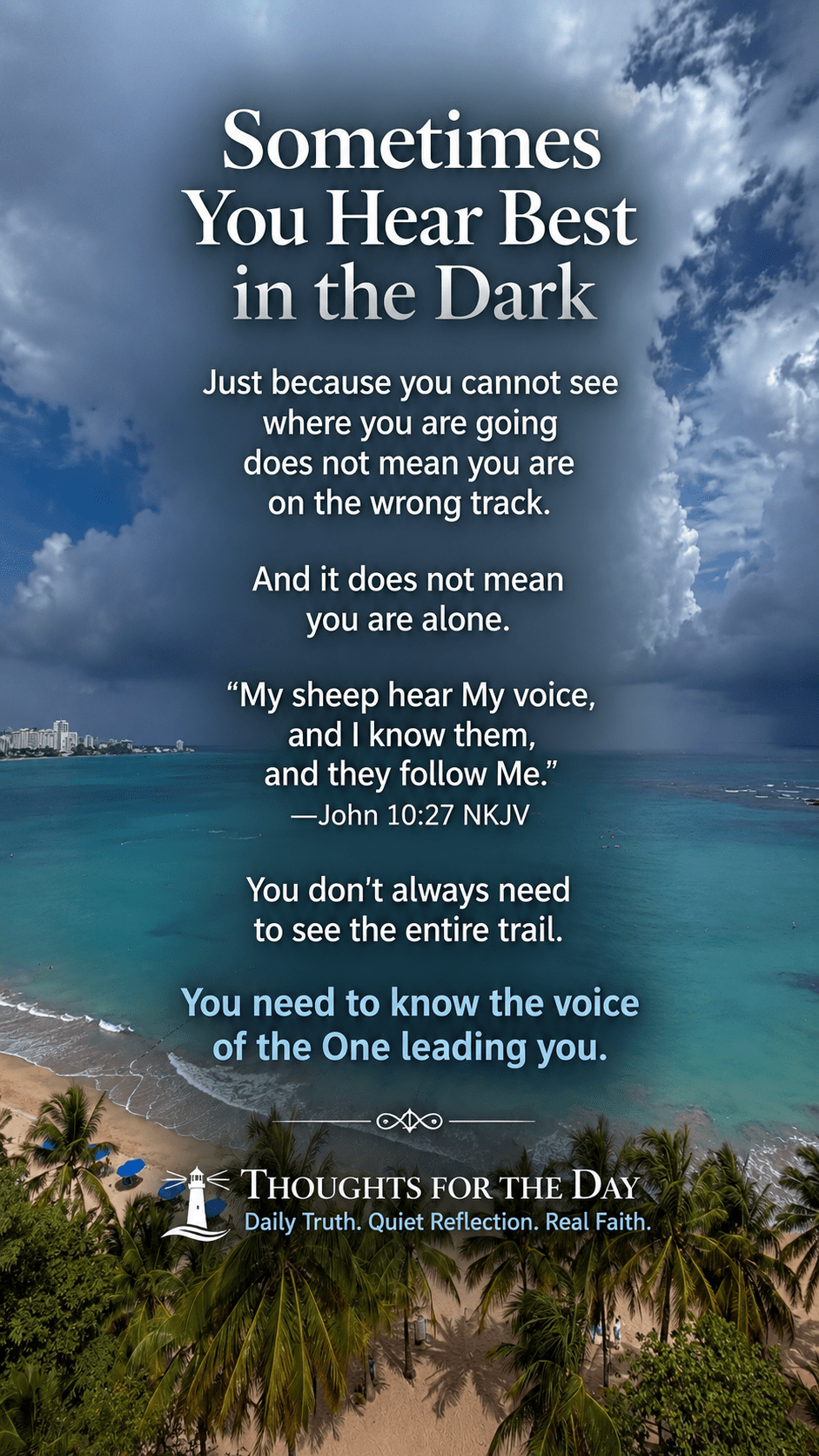
    But just because you cannot see where you are going does not mean you are on the wrong track.

    And it does not mean you are alone.

    Jesus said:

    “My sheep hear My voice, and I know them, and they follow Me.” ~ John 10:27, NKJV ~

    Notice what Jesus did not say.

    He did not say His sheep would always see the entire path.

    He said they would hear His voice.

    There is a difference.

    Sometimes we spend so much energy asking God to show us the road that we forget to listen for the One who is leading us down it.

    “Lord, show me what happens next.”

    “Show me how this is going to work.”

    “Show me where this is going.”

    “Show me what You are doing.”

    And sometimes the answer does not come as more light.

    Sometimes the answer comes as a voice in the darkness saying,

    “Follow Me.”

    David wrote:

    “Indeed, the darkness shall not hide from You,
    But the night shines as the day;
    The darkness and the light are both alike to You.”
    ~ Psalm 139:12 ~

    The darkness that limits my vision does not limit His.

    My darkness is not God’s darkness.

    I may not know what lies around the next bend.

    He does.

    I may not be able to see ten steps ahead.

    He can see the entire journey.

    Faith is not pretending the darkness is not real.

    Faith is not claiming we know where everything is going.

    Sometimes faith is simply saying:

    “I cannot see the trail very clearly right now, but I know the voice of the One I am following.”

    Maybe you have been asking God to turn the lights back on.

    Maybe you have been asking Him to show you the whole road.

    But perhaps this season is teaching you something else.

    To listen.

    To recognize His voice.

    To trust His leading.

    Because you do not always need to see the entire trail.

    You need to know the voice of the One leading you.

    And sometimes…

    you hear the Master best in the dark.

  • He Knows the Way

    He Knows the Way

    “Behold, I go forward, but he is not there; and backward, but I cannot perceive him: On the left hand, where he doth work, but I cannot behold him: he hideth himself on the right hand, that I cannot see him: But he knoweth the way that I take: when he hath tried me, I shall come forth as gold.” ~Job 23:8-10~

    At 35,000 feet, it is nearly impossible to sense how quickly an airplane is moving.

    On my return flight from San Juan, I sat in an aisle seat while nearly every window shade around me remained closed. I knew we were traveling generally north and northwest toward Atlanta, but I could not see the ocean beneath us. I could not watch the clouds pass. I could not identify a coastline, city, or landmark.

    There was no visible evidence of our speed, progress, or direction.

    From inside the darkened cabin, we could have been flying more than five hundred miles per hour or sitting completely still. Unless I looked at the flight tracker, I had no way of knowing where we were, how far we had traveled, or how much farther remained.

    Yet I was not empty-handed.

    I was returning with memories of people I love, photographs of places I had seen, roads I had walked, and lessons I did not want to forget. I carried mementos of where I had been and memories of those who had walked beside me.

    But none of them could show me the way ahead.

    There are seasons when faith feels much the same.

    We can remember what God has done before. We can look back at prayers He answered, doors He opened, and places where His hand was unmistakable. We carry photographs in our minds and testimonies in our hearts.

    But memories of yesterday do not always provide a map for tomorrow.

    Sometimes the shades are closed.

    We cannot see where we are going. We cannot sense progress. We may feel changes taking place without understanding where they are leading. Something shifts. The aircraft banks. A familiar season begins to turn, but we cannot identify the new direction.

    We know we are no longer where we were, but we have not yet arrived where we are going.

    Job understood that disorientation.

    He looked forward, but God did not appear to be there. He looked backward and could not perceive Him. He searched to the left, where he knew God was working, but could not behold Him. He looked to the right, and God remained hidden.

    Every direction Job searched seemed empty.

    Yet notice what Job said about the left hand:

    “Where he doth work.”

    Job could not see God, but he still acknowledged that God was working.

    That is faith in its most honest form. It does not pretend the window is open when it is closed. It does not deny the darkness, disguise the uncertainty, or claim to understand a route that remains hidden.

    Faith simply refuses to interpret limited visibility as divine absence.

    Job could not perceive God—but God had not lost sight of Job.

    “But he knoweth the way that I take.”

    Job did not know the way, but God did.

    Job could not see the route, but God could.

    Job could not identify his present location or understand the purpose of the journey, but heaven had not misplaced him.

    The same is true for us.

    There will be times when we cannot see what God is doing. We may not understand why a familiar path changed, why a door closed, why a season ended, or why the next destination has not yet appeared. We may feel the turn long before we understand the direction.

    But our inability to see the route never means the Pilot has lost it.

    God does not need us to understand the flight plan in order to complete it. He sees beyond the closed shade. He knows our present position, the conditions ahead, and the destination He has appointed.

    The silence does not mean He has left the cockpit.

    The darkness does not mean the aircraft has stopped moving.

    And the absence of visible landmarks does not mean we are lost.

    You may not know where this season is taking you. You may look forward, backward, left, and right without finding the answers you desperately want.

    But God knows the way that you take.

    For now, that may have to be enough.

    And faith says that it is.

    Final Word:

    When I cannot see the way ahead, I can still trust the One who already knows it.