Tag: Walk With Christ

  • The Verdict Has Already Been Rendered

    The Verdict Has Already Been Rendered

    One of the enemy’s greatest weapons isn’t temptation.

    It’s accusation.

    He reminds you who you were.

    He reminds you what you did.

    He reminds you of every failure, every regret, every moment you’d rather erase.

    Sometimes he doesn’t even have to speak.

    Our own hearts do it for him.

    We replay old chapters as though they are still being written.

    We introduce ourselves by our failures.

    We define ourselves by battles Christ has already won.

    But God tells a different story.

    When Jesus cried, “It is finished” (John 19:30), He wasn’t announcing that He had merely made forgiveness possible.

    He was declaring that the price had been paid.

    Completely.

    Fully.

    Forever.

    Three days later, the empty tomb became Heaven’s declaration that the sacrifice had been accepted.

    The resurrection wasn’t God changing His mind about Jesus.

    It was God announcing His verdict over everyone who would believe.

    Paul declares that verdict in one of the most powerful verses in all of Scripture:

    “There is therefore now no condemnation to those who are in Christ Jesus…”
    — Romans 8:1 (NKJV)

    Notice what Paul doesn’t say.

    He doesn’t say there is less condemnation.

    He doesn’t say there is future condemnation if God changes His mind.

    He says there is now no condemnation for those who are in Christ.

    That verdict changes more than your eternal destination.

    It changes your identity.

    “Therefore, if anyone is in Christ, he is a new creation; old things have passed away; behold, all things have become new.”
    — 2 Corinthians 5:17 (NKJV)

    God doesn’t simply clean up the old life.

    He creates a new one.

    That’s why Paul says:

    ”…even so we also should walk in newness of life.”
    — Romans 6:4 (NKJV)

    We don’t walk in newness of life to earn God’s acceptance.

    We walk in newness of life because, through Christ, we already have it.

    The church at Corinth understood what it meant to have a past.

    Some had lived in immorality.

    Some in idolatry.

    Some in drunkenness.

    Some in greed.

    Yet Paul reminds them:

    “And such were some of you. But you were washed, but you were sanctified, but you were justified in the name of the Lord Jesus and by the Spirit of our God.”
    — 1 Corinthians 6:11 (NKJV)

    Did you catch that?

    Such were some of you.

    Not, “Such still are you.”

    Were.

    The gospel never asks us to deny where we’ve been.

    It tells us we no longer have to live there.

    Now, does that mean Christians never struggle?

    Of course not.

    The New Testament calls us to daily repentance, continual growth, and lifelong sanctification.

    We still battle the flesh.

    But the flesh is no longer our identity.

    The enemy wants you to keep introducing yourself by your old record.

    God introduces you by His Son.

    The enemy calls you condemned.

    God says, “No condemnation.”

    The enemy calls you broken.

    God says, “A new creation.”

    The enemy calls you your past.

    God says, “Walk in newness of life.”

    The enemy says you’re still who you used to be.

    God says, “Such were some of you.”

    Whose voice are you going to believe?

    Final Word

    The enemy keeps reading from your old record.

    God has already written a new one.

    So don’t stop reading too soon.

    Don’t live like Friday has the final word.

    And don’t keep introducing yourself by a name that Christ has already buried.

    Because the empty tomb didn’t simply prove Jesus conquered death.

    It declared that everyone who is in Christ has received Heaven’s verdict.

    No condemnation.

    A new creation.

    A new life.

    A new name.

    The verdict has already been rendered.

    Now…

    Live like you believe it.

  • Learning To Lean

    Learning To Lean

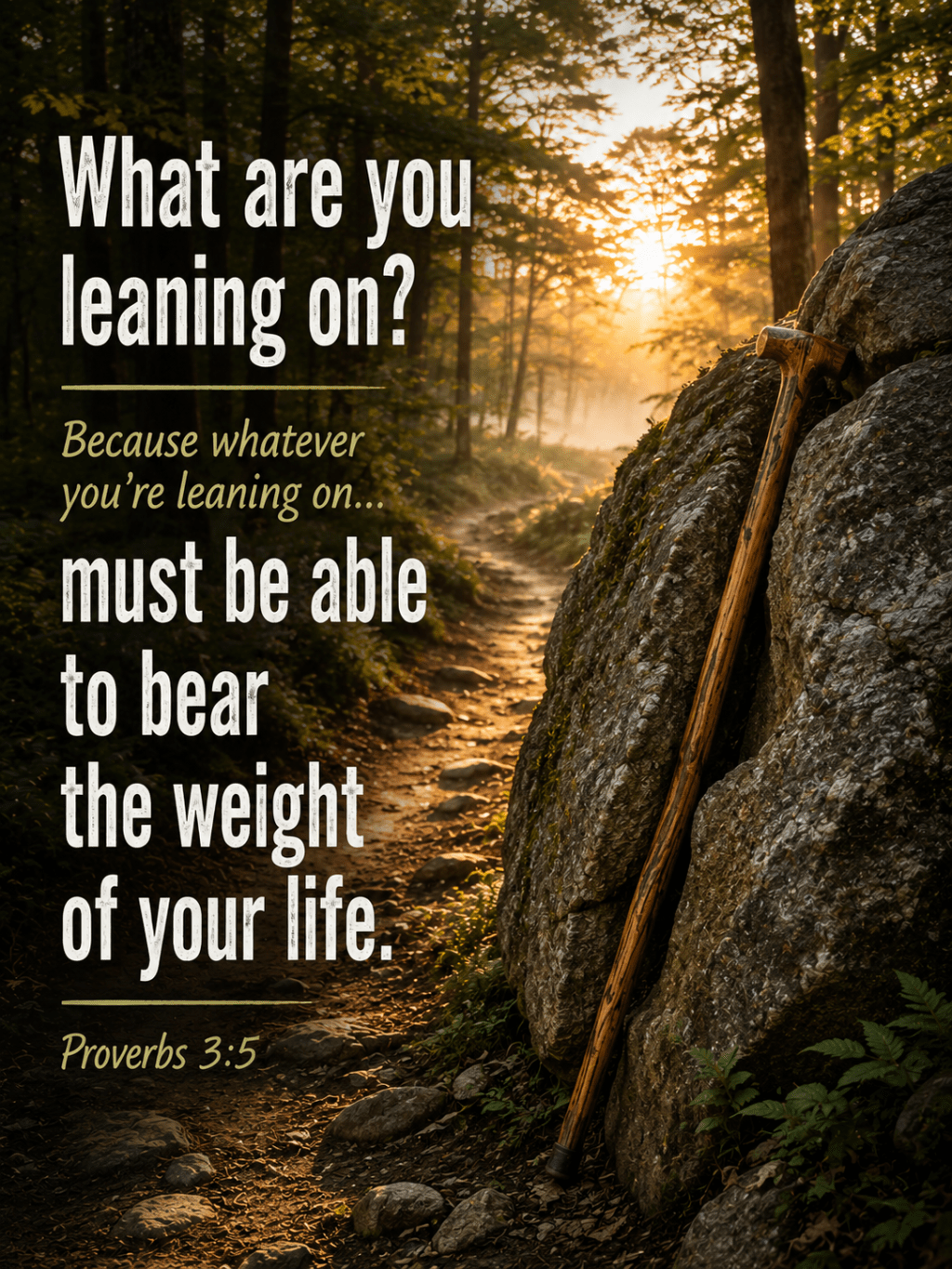
    “Trust in the LORD with all thine heart; and lean not unto thine own understanding.” — Proverbs 3:5

    I woke before sunrise with an old hymn running through my mind.

    Learning to lean…
    Learning to lean…
    I’m learning to lean on Jesus…

    At first, I thought it was simply an encouraging song.

    But as I spent time in Scripture, I realized it was asking me a deeper question.

    What am I leaning on?

    We all lean on something.

    Some lean on their own abilities.
    Some lean on financial security.
    Some lean on relationships, reputation, influence, or strength.
    Some lean on determination, believing that if they just try harder, they can make it through.

    Others lean on things that promise relief but never truly heal—addictions, distractions, habits, or anything else that numbs the weight they are carrying.

    But there is a second question we must ask.

    Why am I leaning on it?

    Because we do not lean on these things for no reason.

    We lean on money because we want security.
    We lean on people because we want acceptance.
    We lean on control because we want peace.
    We lean on success because we want significance.
    We lean on escape because we want relief.

    Every false support is promising something to the soul that only God can truly give.

    David faced that very test in a cave.

    King Saul, who had hunted him relentlessly, unknowingly walked in alone. David’s men saw the opportunity of a lifetime. One swing of the sword, and years of fear could be over.

    But David saw something else.

    He saw a promise that did not need his manipulation.

    He refused to take by force what God had promised by grace.

    David did not lean on his sword.
    He leaned on God.

    And because David was leaning on God, he did not need the throne to satisfy his soul.

    That is the difference.

    David still desired what God had promised.
    But he did not need to sin in order to obtain it.

    Perhaps that is why Solomon wrote,

    “Trust in the LORD with all thine heart; and lean not unto thine own understanding.”

    Those are not two separate commands.

    They are one.

    The first half tells us what God is calling us to do.

    The second half tells us how.

    We trust Him by refusing to lean on ourselves.

    Faith is not simply believing that God exists.

    Faith is transferring the weight of our confidence from our own understanding to His wisdom, and from our own strength to His faithfulness.

    And that brings us to the other hymn that came to mind today:

    Only Jesus can satisfy your soul…

    That is the full equation.

    What am I leaning on?

    And…

    What am I expecting it to give me?

    Because whatever we lean on must be able to bear the weight of our lives.

    And whatever we look to for satisfaction must be able to reach the deepest place in our souls.

    Only Christ can do both.

    He alone can carry the weight.
    He alone can satisfy the longing.

    So maybe the question today is not just whether we believe in Jesus.

    Maybe the question is more personal than that.

    Am I leaning on Him?

    And am I trusting Him to be enough?