Tag: Walk With God

  • Doing the Truth

    Doing the Truth

    A Facebook memory from seven years ago appeared in my feed this week. It was a simple image of a burning match with the words:

    “God is light, and in Him is no darkness at all.” (1 John 1:5)

    Years ago, that’s where I stopped reading.

    This week, I kept going.

    The very next verse says,

    “If we say that we have fellowship with Him, and walk in darkness, we lie and do not practice the truth.” (1 John 1:6, NKJV)

    Most English translations read “practice the truth,” but John’s wording is even more vivid. Literally, he says we do not “do the truth.”

    That stopped me.

    For a long time, I thought spiritual maturity was measured by how much I knew.

    I knew the doctrine.

    I knew the Scriptures.

    I knew the answers.

    But knowing the truth had not yet become doing the truth.

    Then I thought about James.

    “You believe that there is one God. You do well. Even the demons believe—and tremble!” (James 2:19)

    James reminds us that belief by itself is not the finish line. Even demons know who God is. They believe the truth about Him.

    What they do not do is submit to Him.

    Truth was never intended merely to fill our minds. It was meant to shape our lives.

    Jesus said,

    “If you know these things, blessed are you if you do them.” (John 13:17)

    Knowledge.

    Belief.

    Obedience.

    That’s the progression.

    The question isn’t simply, “Do I know the truth?”

    Or even, “Do I believe the truth?”

    The question John asks is far more personal:

    Am I doing the truth?

    Because the strongest testimony of what we believe isn’t found in what we say.

    It’s found in how we walk.

  • Sunday Studies: More Than Knowing About God

    Sunday Studies: More Than Knowing About God

    Primary Texts: Philippians 3:7–10; John 5:39; John 10:27; John 17:3


    Introduction

    July 12 is a special day for me.

    Had she lived, my Mums would have celebrated her 106th birthday today. And if you’ve followed me for any length of time, you’ll know that she was my rock.

    When I was six years old, she began a routine with me that would shape the rest of my life.

    She didn’t simply read the Bible stories to me.

    She taught me the value of reading them for myself.

    Every day, before I started my homework or went outside to play, she insisted that I spend five minutes reading my Bible.

    Five minutes became ten.

    Ten became twenty.

    Twenty became thirty.

    Before I knew it, reading God’s Word had become less of a requirement and more of a desire.

    Looking back now, I realize she wasn’t just teaching me to read the Bible.

    She was helping bring it to life.

    I don’t think she could have imagined that little boy would one day teach Sunday School, write daily devotionals, or spend countless hours studying Scripture.

    She was simply planting seeds.

    Today, I realize those seeds are still bearing fruit.

    And perhaps the greatest way I can honor her isn’t simply by remembering her…

    It’s by continuing what she started and building on that legacy.


    Have You Ever Noticed?

    Have you ever picked up a book, read a page or two, and immediately known who wrote it without having to look at the cover?

    Have you ever picked up a book, read a page or two, and immediately known who wrote it without having to look at the cover?

    For me, it’s authors like Max Lucado, C.S. Lewis, and John Grisham.

    Each has a distinct voice.

    A unique rhythm.

    A recognizable way of telling a story.

    The more time you spend reading an author, the more familiar you become with the way they think.

    Eventually…

    You recognize the author before you ever see the cover.

    That made me wonder…

    Isn’t that how Bible study is supposed to work?


    More Than Information

    I think we’ve stumbled onto something that explains why some Bible studies become dry while others become life-giving.

    If my goal is simply to know the Book…
    Eventually I’ll accumulate information.

    But if my goal is to know the Author…

    Every page…
    Every reading…
    Becomes another introduction.

    That’s a lifelong pursuit.

    The purpose of Bible study isn’t merely to know the Bible.
    It’s to know the God who gave it.

    The Bible doesn’t change…

    But we do as we walk with the Author.


    Paul

    If anyone could have claimed to know the Scriptures, it was the Apostle Paul.

    Long before he became a follower of Christ, Saul of Tarsus had devoted his life to studying God’s Word.

    He wasn’t simply religious.

    He was, in his own words, “an Hebrew of the Hebrews… as touching the law, a Pharisee” (Philippians 3:5).

    A Pharisee among the Pharisees.

    Trained under Gamaliel.

    He had spent his entire life studying the Torah and the Prophets.

    He knew the Law.

    He knew the promises.

    He knew the history.

    He knew the Scriptures better than almost anyone alive.

    Yet before the Damascus Road…

    He knew the Word…

    But he did not know the Savior to whom the Word pointed.

    Everything changed that day.

    Not because Paul received a different Bible.

    But because he finally met the Author.

    Years later…

    After churches has been planted.

    After miracles had been witnessed – and experienced.

    After beatings had been endured.

    After several prison sentences.

    After writing much of what would become the New Testament…

    Paul still writes,

    «“That I may know Him…” — Philippians 3:10»

    Notice what he doesn’t say.

    He doesn’t say,

    “That I may know more.”

    He says,

    “That I may know Him.”

    Relationship had become greater than information.


    The Difference

    This may be one of the most important truths I’ve ever learned.

    You can know the Scriptures…
    without knowing the Savior.

    But once you know the Savior…
    you begin reading the Scriptures differently.

    Suddenly…

    Joseph isn’t merely a story about forgiveness.

    He’s a picture of God’s providence.

    David isn’t merely a shepherd who became king.

    He’s another glimpse of God’s faithful heart.

    The Psalms aren’t simply beautiful poetry.

    They’re invitations into a relationship.

    Everything changes because you’ve come to know the Author.


    Jesus Said the Same Thing

    Jesus confronted the religious leaders with these words:

    «”Search the scriptures; for in them ye think ye have eternal life: and they are they which testify of me.”
    — John 5:39»

    They knew the text.

    They missed the Person.

    The tragedy wasn’t that they studied too much.

    The tragedy was that they stopped at the study.


    His Sheep Know His Voice

    Jesus also said,

    «”My sheep hear my voice…”
    — John 10:27»

    I’ve often thought of that as something mysterious.

    Now I think it’s something deeply relational.

    Why do sheep recognize the shepherd’s voice?

    Not because they studied acoustics.

    Because they’ve walked with him.

    They’ve heard him call.

    They’ve learned his character.

    They know him.


    Recognizing the Author

    When you’ve walked with the Author long enough…

    You begin to recognize His heart before you’ve finished reading the story.

    Have you ever noticed that certain composers have a signature style?

    You can hear just a few measures and immediately know who wrote the music.

    Not because every song sounds the same.

    But because the composer’s fingerprints are woven throughout the melody, harmony, rhythm, and cadence.

    I think Scripture is much the same.

    Genesis doesn’t sound like Psalms.

    Psalms doesn’t sound like Isaiah.

    Isaiah doesn’t sound like John.

    John doesn’t sound like Romans.

    Different human authors.

    Different audiences.

    Different centuries.

    Yet the more time you spend with God…

    The more you begin recognizing His fingerprints.

    Mercy.

    Grace.

    Patience.

    Holiness.

    Justice.

    Truth.

    Faithfulness.

    Love.

    Those themes keep appearing throughout Scripture.

    Not because God keeps repeating Himself…

    But because His character is beautifully, consistently recognizable.

    Different movements.

    Same Composer.


    Eternal Life

    Then Jesus says something that has completely changed the way I think about salvation.

    Praying to the Father, He says:

    «“And this is life eternal, that they might know thee the only true God, and Jesus Christ, whom thou hast sent.” ~ John 17:3»

    I’ve read that verse countless times.

    For years, if someone had asked me, “What is eternal life?” I probably would have answered, “Living forever in heaven.”

    Jesus gives a different answer.

    He doesn’t begin with a place.

    He begins with a Person.

    “This is life eternal… that they might know Thee.”

    Not simply know about Him.

    Know Him.

    That one statement changes the entire purpose of Scripture.

    The Bible isn’t merely preparing us for heaven.

    It’s introducing us to the God with whom we’ll spend eternity.

    Every page reveals another glimpse of His heart.

    Every promise reveals another aspect of His faithfulness.

    Every command reveals His holiness.

    Every act of mercy reveals His love.

    Every story reveals His character.

    And every time we open His Word, we’re invited to know Him a little more than we did yesterday.

    That’s why Bible study never becomes obsolete.

    The Bible doesn’t change…

    But we do as we walk with the Author.

    The longer we walk with Him, the more familiar His voice becomes.

    The more recognizable His heart becomes.

    Until one day we find ourselves reading a passage we’ve read dozens of times before…

    And suddenly we see Him in a way we never have before.

    Not because the passage changed.

    Because we did.

    That’s the journey.

    Not merely accumulating information about God…

    But growing in a relationship with Him that will continue for all eternity.


    Closing

    As I think about my Mums today, I realize she gave me a gift far greater than I understood as a little boy.

    She taught me to open the Bible expecting to meet God.

    Not merely to learn facts.

    But to know the One who inspired every page.

    That’s the legacy she left me.

    And it’s the legacy I hope to leave others.

    Because the goal isn’t simply to know the Bible.

    The goal is to know the God who gave it.

    The Bible was never given merely so we could learn God’s works.

    It was given so that, through His works, we would come to know His heart.

    If Lessons From Samuel & the Psalms accomplishes that…

    Then we’ve done far more than study David’s life.

    We’ve introduced people to the Author who has been patiently revealing Himself from Genesis to Revelation all along.

  • Turning The Page

    Turning The Page

    Some chapters close quietly.

    Not because the story is over…
    But because it’s time to turn the page.

    We may not understand why one season ends or what the next one will hold. But God sees the whole story, while we only see the page in front of us.

    So when something familiar begins to fade, don’t assume God is finished.

    Trust the Author.

    He’s still writing.

    “Being confident of this very thing, that he which hath begun a good work in you will perform it…”
    — Philippians 1:6

  • Create In Me A Clean Heart

    Create In Me A Clean Heart

    Scripture: Psalm 51

    Yesterday we looked at one of the most uncomfortable moments in all of Scripture.

    Nathan stood before King David and uttered four unforgettable words:

    “Thou art the man.”

    David’s response was immediate.

    “I have sinned against the LORD.” (2 Samuel 12:13)

    For most of us, that’s where the story ends.

    But Scripture doesn’t leave us standing in the throne room with Nathan.

    It invites us into David’s prayer closet.

    Psalm 51 is that prayer.

    If 2 Samuel 12 records David’s confession…

    Psalm 51 reveals David’s heart.

    I’ve read Psalm 51 countless times over the years, and it has long been one of my favorite chapters in the Bible.

    But through the years I’ve discovered something.

    There are certain passages of Scripture that become more meaningful the longer you live.

    When I was younger, I admired David’s poetry.

    Today…

    I understand his tears.

    David doesn’t spend this Psalm trying to explain himself.

    He doesn’t minimize his sin.

    He doesn’t compare himself to someone worse.

    He doesn’t bargain with God.

    No… he simply throws himself entirely upon the mercy of God.

    The opening words set the tone for everything that follows.

    “Have mercy upon me, O God, according to thy lovingkindness…”

    David doesn’t appeal to his past victories.

    He doesn’t remind God that he killed Goliath.

    He doesn’t mention the years he faithfully served as king.

    He simply pleads for mercy.

    That is where genuine repentance always begins.

    The more I read this Psalm, the more one truth stands out.

    David never asks God to change his circumstances.

    Instead…

    He asks God to change him.

    That may be the clearest evidence that his repentance was genuine.

    “Wash me thoroughly from mine iniquity…”

    “Cleanse me from my sin.”

    “Purge me with hyssop…”

    “Create in me a clean heart…”

    “Renew a right spirit within me.”

    Notice the pattern.

    Wash me.

    Cleanse me.

    Purge me.

    Create in me.

    Renew me.

    Restore me.

    Those aren’t the prayers of a man trying to escape consequences.

    They’re the prayers of a man who longs to be different.

    David understood something that we sometimes forget.

    Forgiveness isn’t merely about removing guilt.

    It’s about restoring fellowship with God.

    In this chapter, there is one verse that has always stopped me in my tracks.

    “Cast me not away from thy presence; and take not thy holy spirit from me.” (Psalm 51:11)

    David had already lost peace.

    He had already lost joy.

    His family would experience heartbreaking consequences because of his choices.

    But above everything else…

    He feared losing the presence of God.

    That tells me David finally understood what mattered most.

    One word in particular has fascinated me for years.

    “Create in me a clean heart, O God…”

    David didn’t ask God to repair his heart.

    He didn’t ask Him to polish it.

    Or improve it.

    The Hebrew word translated “create” is the same word used in Genesis 1.

    It describes something only God can do.

    David wasn’t asking for self-improvement.

    He was asking for a new creation.

    Isn’t that the hope of the Gospel?

    God doesn’t simply make bad people a little better.

    He makes dead things live again.

    He gives new hearts.

    New spirits.

    New beginnings.

    As I’ve reflected on my own life over the past sixteen years, these words have taken on a depth they never had before.

    Not because I’ve learned more Hebrew.

    Not because I’ve become a better Bible student.

    But because I’ve experienced the painful reality of living with the consequences of my own failures.

    I’ve learned that repentance isn’t just feeling sorry for what I’ve done.

    It’s longing to become someone different through the grace of God.

    That’s why Psalm 51 continues to speak to me.

    David never asked God to erase the past.

    He asked Him to transform the man who would live tomorrow.

    There is a profound difference.

    Repentance isn’t trying to convince God we’re better than we are.

    It’s agreeing with God about who we really are…

    and trusting Him to make us new.

    That is the beauty of grace.

    Not that God overlooks our sin.

    But that He cleanses the sinner who comes to Him with a broken and contrite heart.

    Final Word

    David wasn’t remembered because he was the king who never failed.

    He was remembered because he was the king who knew where to go when he did.

    Every one of us will fail.

    Every one of us will need mercy.

    The question isn’t whether we’ll ever have our own Psalm 51 moment.

    The question is whether we’ll come to God with excuses…

    or with surrender.

    May our prayer never become,

    “Lord, protect my reputation.”

    May it always be,

    “Create in me a clean heart, O God; and renew a right spirit within me.”

    Because God specializes in doing what only He can do.

    He doesn’t merely forgive repentant hearts.

    He creates new ones.

  • When Conviction Loses Compassion

    When Conviction Loses Compassion

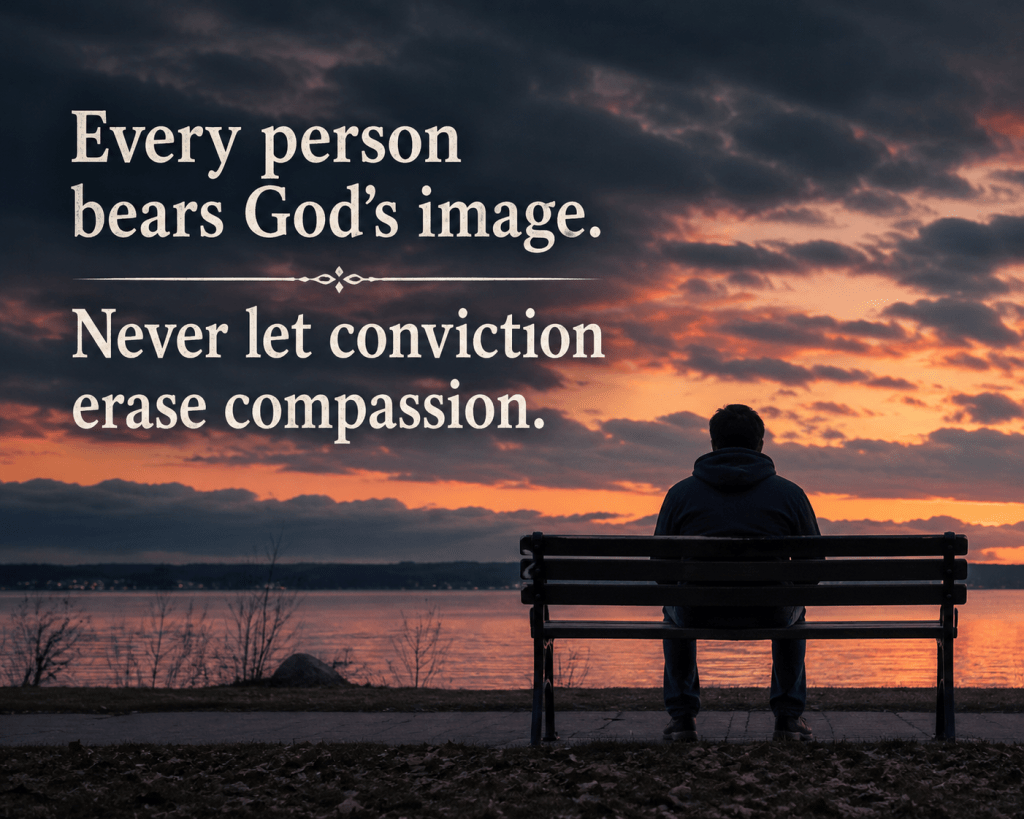
    One of the saddest realities of our culture is that we have become convinced we must choose between truth and compassion.

    We’re told that if we stand for biblical truth, we cannot truly love people.

    Or, if we genuinely love people, we must eventually surrender biblical truth.

    Jesus accepted neither option.

    He never compromised truth.

    He never withheld compassion.

    And somehow, two thousand years later, many of us have managed to separate what He perfectly united.

    Before we go any further, let me be equally clear about where I stand. I believe God’s design for marriage and sexuality is revealed in Scripture, and I do not have the authority to redefine what God has already spoken. At the same time, I believe every person—regardless of their beliefs, identity, choices, or lifestyle—is created in the image of God and is therefore worthy of dignity, compassion, and respect. These convictions are not in conflict. In fact, they belong together.

    I recently came across a simple quote that has lingered in my mind:

    “When you hold a belief so tightly you cannot see another’s humanity, it will eventually obscure your own.”

    Whether the author intended it or not, I immediately thought of Jesus.

    Not because He abandoned truth…

    But because He never allowed truth to become an excuse for forgetting the value of the person standing in front of Him.

    Think about His ministry.

    The woman caught in adultery.

    The Samaritan woman at the well.

    Matthew, the tax collector.

    Zacchaeus.

    The lepers everyone else avoided.

    The demoniac living among the tombs.

    People whom society had already categorized, condemned, dismissed, or avoided.

    Jesus never ignored their sin.

    But neither did He ignore their humanity.

    He saw people before He addressed their problems.

    Genesis tells us something remarkable.

    Every human being is created in the image of God.

    Not just Christians.

    Not just people who agree with us.

    Not just those living according to Scripture.

    Every person.

    Sin has marred that image, but it has not erased it.

    That truth should forever change the way followers of Christ see people.

    The person addicted to drugs.

    The man sitting in prison.

    The woman who has had multiple abortions.

    The atheist.

    The Muslim.

    The political activist.

    The LGBTQ+ individual.

    The person who hurt you.

    The family member who rejected your values.

    The coworker who mocks your faith.

    Every one of them still bears the imprint of the Creator.

    If God saw enough value in them to create them…

    And enough value in them to send His Son to die for them…

    Who am I to pretend they are beneath my compassion?

    James writes something that should stop every Christian in their tracks.

    With our mouths we bless God…

    And with those same mouths we curse people who have been made in the likeness of God.

    James says these things should not be.

    Think about that.

    When I insult, mock, dehumanize, or rejoice in another person’s humiliation, I am doing so against someone who still carries the fingerprints of God.

    That doesn’t excuse sin.

    It simply reminds me that sinners are still people.

    Sometimes I wonder if we’ve become so busy defending biblical positions that we’ve forgotten why God gave us those truths in the first place.

    The purpose of truth is not to win arguments.

    The purpose of truth is to lead people to Christ.

    Jesus never confused acceptance with approval.

    He welcomed people without affirming everything they did.

    He loved them enough to meet them where they were.

    He also loved them too much to leave them there.

    To the woman caught in adultery He extended mercy…

    Then He called her to leave her sin.

    Those are not contradictory actions.

    They are the very definition of biblical love.

    Love without truth leaves people lost.

    Truth without love leaves people hopeless.

    The Gospel has always been both.

    During the past month, as conversations surrounding Pride once again filled social media, I noticed something that deeply grieved me.

    Not the disagreements.

    Disagreement is inevitable.

    Christians and our culture have very different understandings of sexuality, marriage, and identity.

    Those conversations matter.

    But what disturbed me wasn’t disagreement.

    It was the hatred.

    The mocking.

    The cruel jokes.

    The celebration of another person’s pain.

    The comments that seemed to delight in making someone feel less than human.

    I couldn’t help but wonder…

    When did we decide that cruelty became a fruit of the Spirit?

    There is nothing Christlike about humiliating someone.

    There is nothing holy about ridicule.

    There is nothing righteous about treating another image-bearer of God as though they have no value.

    If we believe someone is living apart from God’s design, shouldn’t that move us toward compassion instead of contempt?

    After all…

    That’s exactly how Jesus treated us.

    The Apostle Paul wrote words that every believer should remember:

    “Such were some of you.”

    Those words level the ground beneath the cross.

    Every Christian has a past.

    Every Christian has needed grace.

    Every Christian has stood in desperate need of mercy.

    The only difference between us and anyone still trapped in sin is not our goodness.

    It’s God’s grace.

    That realization should produce humility instead of arrogance.

    Compassion instead of contempt.

    Tears instead of insults.

    Perhaps the greatest danger isn’t abandoning biblical convictions.

    It’s allowing those convictions to harden our hearts.

    The Pharisees knew Scripture better than almost anyone.

    Yet they looked into the eyes of the Son of God and could not recognize Him because their hearts had become so consumed with being right that they no longer loved the people they were supposed to shepherd.

    Knowledge had replaced mercy.

    Religion had replaced relationship.

    Truth had lost compassion.

    May that never be true of us.

    As followers of Christ, we should never apologize for what Scripture teaches.

    But neither should we apologize for loving the people Christ died to save.

    Those are not opposing commitments.

    They are inseparable.

    If my convictions cause me to look down on people…

    Something is wrong with my heart.

    If my theology allows me to despise those Christ willingly died for…

    Something is wrong with my theology.

    Because every person I meet is someone Jesus considered worth stretching out His hands for.

    And if He could love them enough to die for them…

    Surely I can love them enough to treat them with dignity.

    Final Word

    The world often tells us we must choose between conviction and compassion.

    Jesus chose neither.

    He embodied both.

    He never compromised truth.

    He never forgot a person’s worth.

    As His followers, neither should we.

    Because biblical conviction should never make us less compassionate.

    It should remind us just how much compassion God first showed us.