Tag: Worship

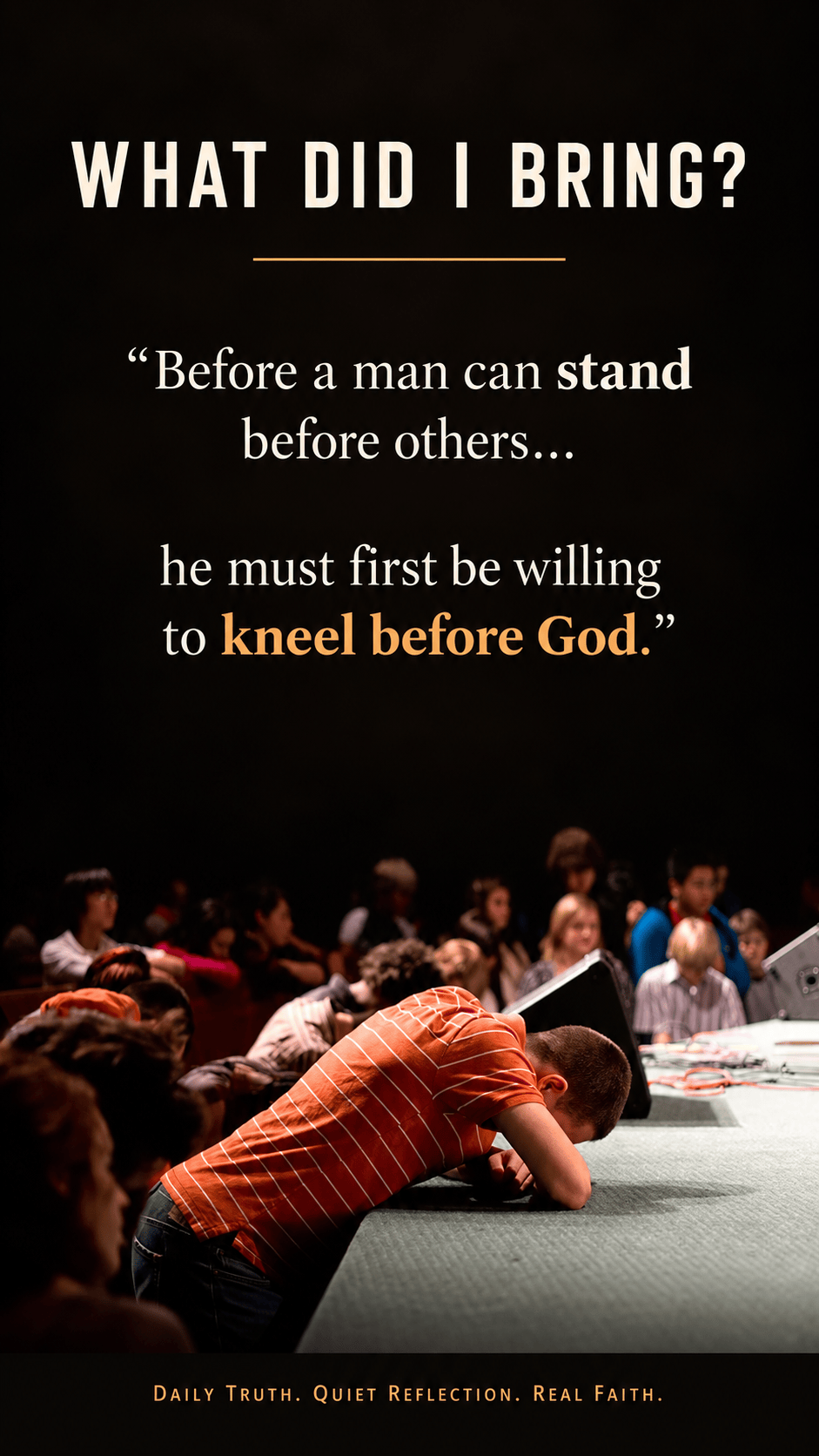
  • What Did I Bring?

    What Did I Bring?

    A couple of days ago, my friend Christi Rogers shared a post about someone standing in a quiet sanctuary before service began. The instruments were waiting. The microphones were silent. The pews had not yet filled.

    At the heart of the reflection was one penetrating question:

    What did I bring?

    As someone who has taught Sunday School and served in worship ministry, I know something about what happens before a service begins.

    Someone arrives early.

    Someone rehearses while others are still getting ready at home. Someone studies a lesson no one will see them preparing. Someone prays over the sanctuary, the musicians, the preacher, and the people who will soon occupy the empty seats. Someone carries a burden for what God may want to accomplish.

    By the time the congregation arrives, there has already been a pouring out.

    It is easy to enter that prepared place and become a consumer without realizing it. We listen to the musicians, receive the teaching, respond to the preaching, and enjoy an atmosphere shaped by someone else’s preparation.

    Then we evaluate what we received.

    Did I like the music?

    Did the sermon speak to me?

    Did I feel anything today?

    But worship was never intended to be something performed by a few people while everyone else waits to be moved. The musicians may lead us, but they cannot worship for us. The preacher may feed us, but he cannot bring our surrender to the altar. Someone else may help prepare the room, but no one else can bring our offering.

    So perhaps, before asking what we received from the service, we should ask:

    What did I bring into the presence of God?

    When Getting There Is the Offering

    Before that question becomes a source of condemnation, it must be covered with grace.

    There are Sundays when we arrive ready to pour ourselves out in worship. There are other Sundays when simply making it through the doors requires nearly everything we have.

    Grief may have emptied us.

    Depression may have followed us into the sanctuary.

    Exhaustion may have taken our voice.

    Private devastation may be hiding behind the smile we managed to put on before leaving the car.

    Coming needy does not make us less spiritual. The church is a body, and we will not all be strong on the same Sunday. Sometimes we help carry someone else. Sometimes we are the ones who need to be carried.

    Hannah entered the house of the Lord as a woman overwhelmed by sorrow. She did not arrive with a triumphant song. She could not even form an audible prayer.

    Scripture says:

    “Now Hannah spoke in her heart; only her lips moved, but her voice was not heard.”
    —1 Samuel 1:13, NKJV

    Eli saw her lips moving and mistakenly assumed she was drunk. Hannah explained that she was a woman of sorrowful spirit who had “poured out” her soul before the Lord.

    To the person watching, it may have appeared that Hannah brought nothing. There was no song, no shout, and no eloquent prayer.

    But she had not come empty-handed.

    She brought her broken heart and poured it out before God.

    Romans 8:26 tells us that when we do not know how to pray, the Spirit helps us in our weakness and intercedes for us “with groanings which cannot be uttered.”

    God does not mistake silence for emptiness.

    Sometimes the only offering we can bring is trembling lips, falling tears, and a prayer too painful to speak. God understands every word we cannot find.

    The Sacrifice of Praise

    There are seasons when we desperately need to receive. But there are also seasons when God calls us out of a settled posture of spiritual consumption and asks us to pour.

    Hebrews 13:15 says:

    “Therefore by Him let us continually offer the sacrifice of praise to God, that is, the fruit of our lips, giving thanks to His name.”
    —Hebrews 13:15, NKJV

    Two words stand out:

    Continually. Sacrifice.

    Praise is not meant to depend upon the music being right, the song being familiar, the week having gone well, or our emotions cooperating.

    If praise is offered continually, there will be times when it flows freely—and times when it costs us something.

    A sacrifice of effort.

    We turn our attention toward God. We quiet the distractions, engage our minds, open our mouths, and participate. We do not wait passively for the musicians to produce a feeling before we respond.

    A sacrifice of pride.

    We stop managing how we appear to everyone around us. We acknowledge that we are not self-sufficient—that we need God, depend upon God, and owe everything to God.

    A sacrifice of self.

    We surrender our preferences, expectations, comfort, and desire to be served. Worship is not about whether they sang our favorite song in our preferred style at the volume we wanted.

    The sacrifice is not being offered to us.

    We are offering it to Him.

    Sometimes the sacrifice is not the song. It is the self we must lay down in order to sing it.

    The Pride We Were Taught to Protect

    The sacrifice of pride is deeply personal for me.

    Many of us—especially men of my generation—were taught that real men do not cry. They do not lose control of their emotions. They keep everything together so they can remain strong for everyone else.

    That teaching can produce dependable men.

    It can also produce isolated men.

    We become so accustomed to carrying the burden that we no longer know how to admit when it has become too heavy. We become so committed to appearing strong that we struggle to be honest about our need.

    Then we carry the same armor into worship.

    We feel something stirring within us, but immediately become aware of who may be watching. Our voice tightens. Our hands remain at our sides. The tears begin to rise, and we force them back—not because God has not touched us, but because we have been trained to protect the image of the man who always has himself under control.

    Self-control is biblical. Emotional suppression is not.

    Surrendering to God is not the same as being governed by our emotions. Tears are not necessarily evidence that a man has lost control. Sometimes they are evidence that he has finally stopped pretending he does not need God.

    Jesus wept openly.

    David poured his anguish into the Psalms.

    Peter wept bitterly after denying the Lord.

    Hebrews tells us that Jesus prayed with vehement cries and tears.

    Their tears did not diminish their strength.

    We were taught that we must be the rock for everyone else. But we are not the Rock.

    Jesus is.

    “It Was Before the LORD”

    When the Ark of the Covenant was brought into Jerusalem, David danced before the Lord with all his might.

    Michal watched from a window and despised him.

    She was concerned with how the king appeared. David was concerned with the One before whom the king was worshiping.

    When she mocked what she considered his undignified behavior, David answered:

    “It was before the LORD… And I will be even more undignified than this, and will be humble in my own sight.”
    —2 Samuel 6:21–22, NKJV

    David was not manufacturing an emotional spectacle. He had decided that his title, reputation, and another person’s opinion would not determine his response to God.

    Before the Lord, the king was simply another worshiper.

    That was David’s sacrifice of pride.

    Sometimes our sacrifice may be allowing the tear to fall instead of immediately wiping it away. It may be lifting our hands without first surveying the room. It may be kneeling when pride tells us to remain standing. It may be walking forward for prayer or telling someone, “I am not doing well, and I need you to pray for me.”

    Before I can lift my hands in worship, I may first have to lay down my pride.

    And there may always be a Michal watching from the window.

    But my worship was never for the Michal’s.

    It was before the Lord.

    One Danced. One Wept.

    There is a beautiful contrast between David and Hannah.

    David’s worship was expressive, and Michal considered it undignified.

    Hannah’s prayer was nearly silent, and Eli misunderstood it entirely.

    David was judged because people could see too much.

    Hannah was judged because people could understand too little.

    One danced. One wept. Both were misunderstood. And God saw the heart of each.

    Not everyone must worship like David. Not every sacrifice of praise will be loud, exuberant, or outwardly expressive. Sometimes worship dances. Sometimes worship weeps. Sometimes it shouts. Sometimes it can only whisper.

    The common thread is not the outward expression.

    It is the inward surrender.

    David once declared:

    “Nor will I offer burnt offerings to the LORD my God with that which costs me nothing.”
    —2 Samuel 24:24, NKJV

    So, what did I bring?

    Perhaps I brought thanksgiving.

    Perhaps I brought praise.

    Perhaps I brought a burden for someone sitting near me.

    Perhaps I brought a broken heart, trembling lips, and a prayer I could not speak.

    Perhaps I brought the willingness to admit that I needed someone else to help carry me.

    Or perhaps the most costly thing I brought was the self I had worked so hard to protect.

    I will not always enter His presence feeling strong. I will not always bring the same offering.

    Some days I may bring a shout.

    Some days I may bring a whisper.

    Some days I may bring nothing but tears.

    But I do not want to come merely asking what someone else has prepared for me. I want to enter His presence with an honest and surrendered heart.

    Before I ask, “What am I going to receive today?” perhaps I should stop and ask:

    Jesus, what am I bringing to You?

  • The Plastic Chair Was Never the Problem

    Key Scripture:
    “And you shall know the truth, and the truth shall make you free.” — John 8:32 (NKJV)
    “Be transformed by the renewing of your mind.” — Romans 12:2b (NKJV)


    I came across an image recently that caught me off guard—and convicted me more than I’d like to admit.

    It was a horse. Big, strong, muscular. But it was standing still, tied by a rope to a flimsy plastic lawn chair. That horse could’ve broken free without even trying. But it didn’t. Not because it couldn’t—but because it believed it was bound.

    And right then, I saw myself.

    For the past month, I’ve allowed distractions to pull me away from the very disciplines that gave me life—prayer, time in the Word, pouring truth into others through every platform God gave me. One small excuse turned into a week. One neglected moment of prayer turned into silence. Then came the guilt. The disappointment. The rope.

    Not one of those things—distraction, laziness, or even failure—was stronger than my calling or the presence of God in my life. But somewhere in my head, I gave them that power. I started believing that I had to feel on fire to be faithful. I told myself I needed to wait until I was inspired, until life calmed down, until I “got it together.”

    But that was the rope talking. That was the plastic chair.

    Jesus didn’t die and rise again to set us halfway free. The bondage we face now isn’t always external. Sometimes, it’s just a lie we’ve believed for too long.

    And that’s where the real battle is won: not just by cutting the rope—but by renewing the mind that believed it held us.

    Romans 12:2 doesn’t say we’re transformed by doing better. It says we’re transformed by the renewing of our mind. That’s where it starts. That’s where the chair loses its grip.

    So here I am—coming back to the things I’ve neglected. Not because I feel worthy, but because I now see the truth. The enemy will try to convince us we’re too far gone. That God’s disappointed. That we’re disqualified.

    But listen to me: that chair has no power.

    The truth is that God is waiting—not with condemnation, but with open arms.
    The truth is that freedom isn’t earned, it’s claimed.
    The truth is that your calling doesn’t evaporate when you get distracted.
    It waits—right where you left it.


    Reflection Questions:

    1. What lies have I believed about myself that are keeping me tied down?
    2. Where have I allowed distractions to become spiritual chains?
    3. What truth do I need to replace those lies with today?

    Closing Prayer:
    Father, I confess that I’ve allowed myself to become entangled in lies and distractions. I’ve believed the rope was real, even when You’ve already given me freedom. Help me today to renew my mind—to replace the lies with truth. I want to walk in the freedom Jesus died to give me. Pull me back into the disciplines I’ve neglected, and meet me in that place. I’m coming home. In Jesus’ name, amen.

  • Nearer Than You’ve Ever Dreamed

    Fifteen years ago, I received a phone call from a friend in what I can only describe as a full-blown spiritual crisis. Through tears and strained silence, she confessed things she thought disqualified her from God’s presence: sexual sin, rebellion, alcohol abuse, and a string of regrets. Her voice cracked as she asked, “Does God even see me anymore? Can He still hear me?”

    Truth be told, I didn’t have the right words in that moment. So I did what I always do when I feel helpless—I prayed, then turned to Scripture. The story of the prodigal son in Luke 15:11-32 brought comfort. That image of a father running to his broken, returning son never fails to bring me to tears.

    Later, I picked up Max Lucado’s Come Thirsty, and this fictional yet spiritually potent scene caught my eye. Jesse, a Christ-figure, finds Meagan in a cafe. She’s exhausted, emotionally wrecked, and burdened by shame. She spills out her story—a series of poor choices that left her feeling used and discarded. Then she asks: “Where’s God in all this?”

    Jesse leans in and replies, “Nearer than you’ve ever dreamed.”

    This is the heart of the gospel.

    Psalm 34:18 (NKJV) declares,

    “The Lord is near to those who have a broken heart, and saves such as have a contrite spirit.”

    And Isaiah 55:6-7 (NKJV) urges,

    “Seek the Lord while He may be found, call upon Him while He is near. Let the wicked forsake his way… and He will have mercy… for He will abundantly pardon.”

    We serve a God who draws near to the broken.

    Not just the polished or the cleaned-up.

    Not just the Sunday best version.

    But the tear-streaked, regret-heavy, “I’m barely holding it together” version.

    Maybe this is you today. Maybe you’re wondering, like my friend once did, if God still sees you. If He’s still listening. Let me remind you: He is. He always has been.

    He is nearer than you’ve ever dreamed.

    When have you felt far from God? What reminded you of His nearness?

    Share your story below. Someone else might need your honesty today.

  • When Obedience Makes No Sense: Marching Through the Impossible

    Scripture focus: “You will not need to fight in this battle. Position yourselves, stand still and see the salvation of the Lord…” (2 Chronicles 20:17, NKJV)

    The Bible is packed with stories that, if we’re being honest, sound like they should’ve ended in disaster. People facing impossible odds, following battle plans that would never fly in a military strategy room—and somehow walking away victorious. Why? Because God was the one calling the shots.

    Let’s start at the Red Sea. The children of Israel—more than 600,000 men, plus women and children—had finally escaped Egypt. But they were trapped between the uncrossable Red Sea and Pharaoh’s pursuing army. No weapons. No escape route. No time. But instead of rallying the people to arms, Moses said something crazy: “Stand still, and see the salvation of the Lord” (Exodus 14:13). Then God parted the waters. The people walked through on dry land. And when Pharaoh’s army followed, the sea closed in behind them.

    That’s not strategy. That’s sovereignty.

    And then there’s Jericho. A fortified city with high walls and strong defenses. Any human general would’ve planned a siege. But God gave Joshua a blueprint that sounded like a children’s game: walk around the city once a day for six days in total silence. Then on the seventh day, march around seven times. Blow the trumpets. Shout. That’s 13 total laps around the city.

    Now pause for a second. The number 13 has a bad reputation. The world calls it unlucky. Some elevators skip the 13th floor. People talk about Friday the 13th like it’s cursed. But let this sink in: God used 13 laps—that “unlucky” number—to bring down the walls of one of the strongest cities in the Promised Land.

    Let the world call it bad luck. We call it divine design.

    It doesn’t stop there. Gideon started with 32,000 men to fight the Midianites. But God trimmed it down to 10,000… then just 300 men—armed not with swords, but with trumpets, torches, and clay pitchers. Judges 7:12 says the enemy was “as numerous as locusts; and their camels… as the sand by the seashore.” That’s not just outnumbered. That’s outmatched, overwhelmed, and underqualified. Yet by God’s hand, victory came anyway.

    Over and over we see it:

    • Hezekiah and the Assyrian army (2 Kings 19)
    • Jehoshaphat against the armies of Moab and Ammon (2 Chronicles 20)
    • Daniel in the lion’s den (Daniel 6)
    • Shadrach, Meshach, and Abed-Nego in the fiery furnace (Daniel 3)

    These aren’t just Bible stories—they’re testimonies. Reminders that when obedience seems foolish, God’s power is often just moments away.

    I don’t know what kind of battle you’re facing today. Maybe you’re on lap 11 or 12, and nothing’s changed. The walls are still there. The enemy still looms. The fear is still whispering in your ear. But let me say this:

    Don’t quit before lap 13.

    Don’t let the world define your “unlucky” situation. Let God redeem it for His glory. Maybe you feel like the underdog—like Gideon. Or maybe you’ve been marching silently like Joshua, wondering if your obedience even matters. It does. It always does.

    And when you’re tired? When quitting seems easier than continuing? Remember the words of Jehaziel in 2 Chronicles 20:17, “Stand still and see the salvation of the Lord.” Or David’s bold declaration to Goliath in 1 Samuel 17:47, “The battle is the Lord’s.” Or the simple, powerful invitation from Psalm 46:10: “Be still, and know that I am God.”

    There’s a song from the Imperials—recorded back in 1979—that still speaks:

    Praise the Lord, for the chains that seem to bind you
    Serve only to remind you
    That they drop powerless behind you
    When you praise Him.

    Chains look real. Walls feel permanent. But God? He specializes in things that don’t make sense.


    Reflection Questions:

    1. Have you ever obeyed God when it didn’t make sense? What happened?
    2. Are you on a “lap” right now where quitting feels easier than trusting?
    3. What walls are you facing today that need a God-sized breakthrough?

    Final Encouragement:
    Obedience may not feel powerful—but it positions us to see God’s power clearly. Don’t stop short. Don’t buy the world’s definition of what’s “lucky” or “logical.” If He brought you to it, He’s more than able to bring you through it.

    Keep marching. Lap 13 is coming.

  • When Broken Becomes Beautiful

    Scripture: “The Lord is near to those who have a broken heart, and saves such as have a contrite spirit.” – Psalm 34:18 (NKJV)

    Some endings hit so hard, the air gets knocked clean out of your lungs. That’s what last night felt like. The weight of a failing marriage… the kind of grief that doesn’t come with a clean break, just a slow unraveling. I thought I’d already cried the hard tears—but somehow, there were more.

    In that place, I heard a song that spoke truth straight to the rawest part of me. “The bright side of being broken is a heart that’s busted open.”

    At first, I didn’t want to hear it. I didn’t want to look for silver linings—I wanted restoration. Reconciliation. But the more I listened, the more I realized something powerful: broken doesn’t mean abandoned. In fact, it might be where God does His most beautiful work.

    God doesn’t avoid our mess. He meets us in it.

    Psalm 34:18 isn’t just comfort—it’s a promise. Jesus draws near to the brokenhearted. That means He’s not waiting for us to fix ourselves up. He moves into the ruins and begins to build something new—not from polished perfection, but from broken pieces.

    So if your life feels shattered, you’re not disqualified from grace—you’re a prime candidate. If everything feels like it’s ending, maybe that’s the very place God begins something eternal.

    Reflection Questions:

    • What part of your life feels broken right now?
    • Can you invite Jesus into that space instead of hiding it?
    • What could “the bright side of broken” look like for you?

    Prayer:
    Lord, I don’t like feeling broken. I’d rather be healed, restored, and whole. But if broken is the door You walk through to reach me, then here I am—wide open. Step into the wreckage, Lord, and do what only You can. Amen.

  • When I’m Not in Control

    “And He said to me, ‘My grace is sufficient for you, for My strength is made perfect in weakness.’ Therefore most gladly I will rather boast in my infirmities, that the power of Christ may rest upon me… For when I am weak, then I am strong.” II Corinthians 12:9–10 (NKJV)

    I don’t like not being in control.

    If I’m in the car, I’d rather be the one driving. At work, I want to be the guy coordinating the chaos, managing the details, keeping the wheels turning. At home, I like being the one with the answers—the calm in the storm. The strong one.

    But sometimes, life makes it painfully clear that I’m not meant to run the show.

    There are moments when I have to admit someone else should take the lead. Times I don’t have the answers. Days I can’t fix what’s broken. And those moments sting. They make me feel exposed and unsteady—like I’m failing somehow.

    But here’s the truth I’m learning: That space—where I feel powerless and uncomfortable—is often exactly where God wants me. Not because He delights in my weakness, but because it’s there that I’m finally available.

    When I stop relying on my own strength, God can show up with His.

    Paul understood this. He didn’t pretend weakness was easy or desirable—but he recognized its purpose. He came to see his limitations not as obstacles, but as opportunities for Christ to move through him.

    We can’t experience God’s sufficiency until we admit our own lack. When we insist on staying in control, we leave little room for the Spirit to work. But when we surrender, when we confess, “Lord, I can’t do this alone”—that’s when grace rushes in.

    You may be in a season where you feel like you’re supposed to have it all figured out. Maybe you’re leading others, managing a household, carrying emotional burdens you don’t talk about. You’re worn out, but still gripping the wheel, because it feels safer than letting go.

    Can I lovingly challenge you today? Let go.

    God isn’t asking you to be invincible. He’s asking you to be available.

    And that starts with vulnerability. With honesty. With that simple but powerful prayer: “God, I need You.”

    Letting go of control doesn’t mean you’re giving up. It means you’re giving it over—to the One who never loses His grip.


    Reflection Questions:

    • What areas of your life are you struggling to release control over?
    • What would it look like to surrender those to God today?
    • Can you think of a time when your weakness became a platform for God’s strength?

    Prayer:
    Father, I confess that I like being in control. I like feeling strong, capable, and in charge. But I know that real strength comes from You—not from me. Help me to release the areas I’ve been gripping too tightly. Teach me to trust You more than I trust myself. Use my weakness for Your glory. In Jesus’ name, amen.

  • The Blessing of the Unworthy

    It’s a quiet lie most Christians carry: “I know God blesses… but I’m not really worthy of it.”

    We’ve stumbled. We’ve failed. And some days, the weight of our past makes us believe God’s goodness is for other people—the strong, the clean, the spiritual. But not for us.

    Yet the truth is clear: He blesses the unworthy because He loves us.

    Scripture doesn’t hide the flaws of God’s people:

    • Noah got drunk after surviving the flood (Genesis 9:21).
    • Abraham lied about Sarah twice to save his own skin (Genesis 12 & 20).
    • Jacob schemed and tricked his own brother (Genesis 27).
    • David, a man after God’s own heart, committed adultery and murder (2 Samuel 11).
    • Elijah—after calling down fire from heaven—wanted to die (1 Kings 19:4).
    • Peter tried to stop Christ’s arrest with a sword (John 18:10), then denied Him three times (Luke 22:61).

    They weren’t strong. They weren’t clean. They weren’t perfect.

    But they were chosen.

    Because God doesn’t call the worthy. He makes the called worthy through Christ.

    “Not by works of righteousness which we have done, but according to His mercy He saved us…” – Titus 3:5 (NKJV)

    “My grace is sufficient for you, for My strength is made perfect in weakness.” – 2 Corinthians 12:9 (NKJV)

    Friend, if you’ve fallen, you’re not disqualified—you’re a candidate for grace. If you’ve failed, you’re in the company of every great hero of faith. If you feel unworthy… you’re exactly where His love can reach you.

    Reflection question: What lie has the enemy whispered that keeps you from accepting God’s blessing? What part of your past still makes you feel disqualified?

    You may feel unworthy. But He blesses you anyway—because of who He is, not because of what you’ve done.

  • Letting Go of Everything—Except Faith

    Scripture Focus: [17] Though the fig tree may not blossom, Nor fruit be on the vines; Though the labor of the olive may fail, And the fields yield no food; Though the flock may be cut off from the fold, And there be no herd in the stalls— [18] Yet I will rejoice in the Lord, I will joy in the God of my salvation. [19] The Lord God is my strength; He will make my feet like deer’s feet, And He will make me walk on my high hills. Habakkuk 3:17–19 (NKJV)

    Life has a way of stripping you bare. Of peeling away the layers until all you’re left with is the core of who you are and what you believe.

    I wrote this reflection in one of the hardest seasons of my life—during the first separation from my wife. My world had come crashing down around me. And while praying one night, God reminded me that everything in this world is temporary:

    • Homes
    • Jobs
    • Health
    • Even the people we love

    It can all change in a moment. A diagnosis, an accident, a broken vow. And I found myself praying, “Lord, give me the heart of Job. Teach me to say, ‘Blessed be Your name,’ even when I lose what I love.”

    That prayer led me back to a memory from college. A class called Philosophy of Life, where we studied great thinkers—Plato, Aristotle, Descartes, Kant, and others—against the backdrop of Scripture. But it was an assignment called The Process of Dying that shook me.

    We had to imagine we had just six months to live and slowly let go of what mattered most. I remember my last four:

    1. Family
    2. My wife
    3. My Bible
    4. My faith

    In the end, I let go of everything but my faith. I couldn’t let it go. Because when your body is failing, when your mind is clouded by grief, when the pages of your Bible feel too heavy to turn—faith remains.

    That exercise taught me something I never forgot:
    Stuff doesn’t last. Faith does.

    “Though the fig tree may not blossom…yet I will rejoice in the Lord.”
    “The Lord God is my strength.”

    Faith doesn’t ignore the pain. It transcends it.

    So, here’s my question for you today:
    If you had to let go of everything—what would remain?
    Would your faith be enough to sustain you in your darkest hour?

    Because when all is stripped away, that’s when you find out what you really believe.

    And if your faith is in Christ, I promise you—it will be enough.


  • Untangling the Mess: Peace in the Middle of Chaos

    “I ask You to smooth out the tangled up places in my life…”

    That’s how I began a journal entry dated August 23, 2023. And truthfully? I could’ve written that line yesterday.

    Because life—real, raw, day-in-day-out life—is full of tangled-up places. Plans fall through. People disappoint. Communication breaks down. You try to do what’s right, but your efforts get twisted by someone else’s perspective, or worse—by silence. One situation leads to another, and before you know it, you’re stuck in a web of misunderstandings, emotional debris, and spiritual fatigue.

    We don’t talk about that part enough. We rush to fix. We mask it with positivity. But the truth is: life is messy, and the longer we pretend it’s not, the further we drift from the only One who can do something with the mess.

    God doesn’t need your situation to be neat and tidy before He can work. He specializes in taking what’s tangled and making it whole.

    1 Chronicles 16:11 (NKJV) says,

    “Seek the Lord and His strength; Seek His face evermore!”

    That’s not a one-time action—it’s a lifestyle. We don’t just run to God in crisis. We learn to seek His face—His presence, His character, His will—continually. Especially when life looks like a mess of string we can’t sort out.

    And here’s the shift: Peace doesn’t come from getting answers. It comes from getting God.

    “The Lord is my portion,” says my soul, “Therefore I hope in Him!”
    (Lamentations 3:24, NKJV)

    If the Lord is your portion, then it means you don’t need to see the outcome to find rest. You don’t need resolution to find peace. Because He is enough—even in the uncertainty.

    Let’s be real: sometimes we keep ourselves tied up in knots trying to understand everything, fix everyone, or manage every angle. But Isaiah 26:3 offers a better way:

    “You will keep him in perfect peace, whose mind is stayed on You, because he trusts in You.”

    God’s peace doesn’t come after the storm. It comes in the middle of it—when our mind is stayed (anchored, fixed) on Him.

    Philippians 4:6–7 (NKJV) ties it all together:

    “Be anxious for nothing, but in everything by prayer and supplication, with thanksgiving, let your requests be made known to God; and the peace of God… will guard your hearts and minds through Christ Jesus.”

    That’s the process. We bring Him the mess—not once, but daily. We lay it down in prayer, thank Him for who He is, and then trust Him to guard our hearts with a peace that doesn’t always make sense—but always holds firm.

    So if you’re in a tangled season, don’t pull away from God. Press in. Stop rehearsing the mess and start releasing it. The Lord is your portion. Not clarity. Not closure. Him.

    And He’s never failed to untangle what we surrender into His hands.


    Reflection Questions:

    • What tangled area of your life needs God’s peace right now?
    • Have you been seeking His face or just His hand?
    • What’s one thing you need to release to Him today?

  • What if Trusting God Means Letting Go of the Plan?

    “Trust in the Lord with all your heart, and lean not on your own understanding; in all your ways acknowledge Him, and He shall direct your paths.” — Proverbs 3:5–6 (NKJV)

    This verse is popular, sure. But lived out? It’s a battleground.

    Let’s start here: Your heart wants control.
    You want clarity. You want steps A through Z laid out before you say yes. But God rarely works that way. Why? Because He’s not trying to grow your comfort. He’s trying to grow your faith.

    And faith, by definition, means trusting what you cannot see (Hebrews 11:1). That’s why the command starts with: “Trust in the Lord with all your heart.” No back-up plans. No “if this doesn’t work out” safety nets. This kind of trust says, “Even if it doesn’t make sense—I’m in.”

    “Lean not on your own understanding.”
    This is where we struggle the most. Your understanding might be based on trauma, pride, or fear. God doesn’t ask us to discard wisdom, but He warns us not to rely on it above His Word. In fact, Jeremiah 17:9 reminds us just how deceived we can be:

    “The heart is deceitful above all things, and desperately wicked; who can know it?”

    So why would we trust our own thoughts more than His?

    “In all your ways acknowledge Him.”
    This is about submission. Invite God into the process. Not just when it’s urgent—but in everything. Invite Him into the budget, the relationship, the business, the parenting, the daily grind. This is how He becomes Lord of your life—not just Savior of your soul.

    “And He shall direct your paths.”
    God’s direction isn’t always obvious. But it is always intentional. Sometimes He redirects through delay. Sometimes He leads through loss. But if He’s leading, it’s never aimless. The path may not be easy, but it’s right.

    🧠 Reflect:

    • Where are you leaning on your own understanding instead of God’s Word?
    • Are there areas in your life where you’ve stopped acknowledging Him?
    • What would it look like for you to trust God with all your heart—no reservations?

    🙏 Prayer:
    Lord, I confess that I like control. I confess I often lean on what I understand instead of who You are. Teach me to trust You fully. Help me surrender the outcome and walk in faith. I believe You will direct my steps—even when I don’t know where they’re going. In Jesus’ name, amen.