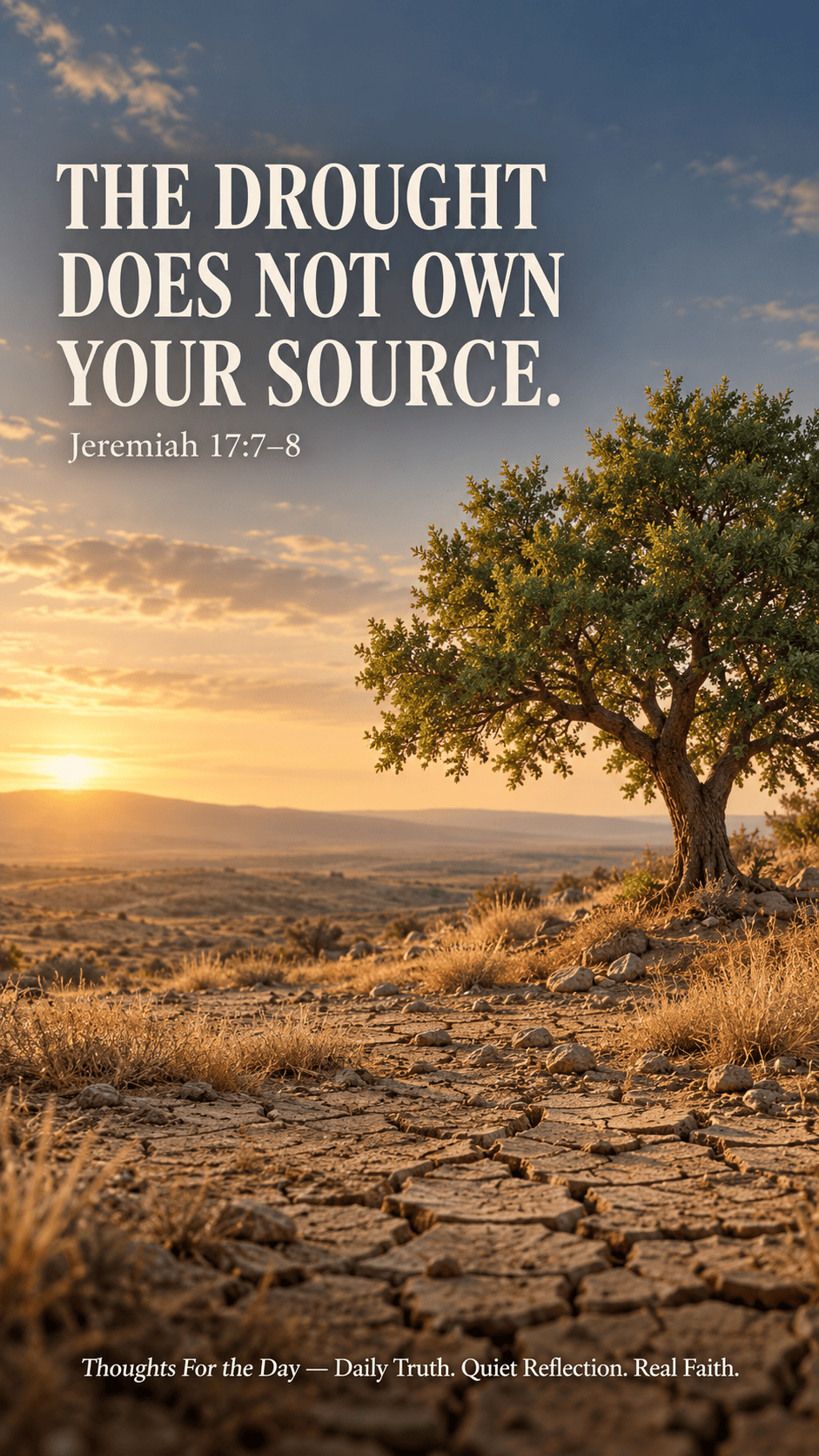
Jeremiah 17:5–8 NKJV
Some trials arrive like storms.
The sky darkens. The wind rises. Something destructive enters our lives with little warning, and everything that appeared secure is suddenly tested.
A storm attacks quickly.
A drought takes its time.
There is no thunder, no violent impact, and no single moment we can identify as the beginning.
The rain simply stops.
The days remain hot.
The ground gradually hardens.
Streams become shallower, and what was once green begins to wither.
What a storm attempts in hours…
a drought seeks to accomplish by degrees.
A storm tests whether something can remain standing.
A drought tests whether it can remain living.
There are spiritual droughts, too.
They are the seasons in which the answer does not come, the door does not open, the burden does not lift, and tomorrow begins to look remarkably similar to today.
Prayer may feel unanswered.
Worship may feel empty.
Scripture remains true, but the words may not bring the comfort we once felt when reading them.
We continue waiting for some indication that the season is changing, but the horizon remains clear and the ground around us keeps getting drier.
Prolonged adversity carries a particular weariness. We may endure the first blow with courage, only to become exhausted by the repetition of it. The drought does not demand that we abandon our trust in one dramatic moment. It simply invites us to loosen our grip a little more each day.
Jeremiah understood what it meant to live through a prolonged season of deterioration. In the middle of it, God gave him a picture of two lives:
Thus says the LORD:
“Cursed is the man who trusts in man
And makes flesh his strength,
Whose heart departs from the LORD.
For he shall be like a shrub in the desert,
And shall not see when good comes,
But shall inhabit the parched places in the wilderness,
In a salt land which is not inhabited.
“Blessed is the man who trusts in the LORD,
And whose hope is the LORD.
For he shall be like a tree planted by the waters,
Which spreads out its roots by the river,
And will not fear when heat comes;
But its leaf will be green,
And will not be anxious in the year of drought,
Nor will cease from yielding fruit.”
— Jeremiah 17:5–8 NKJV
The contrast is not between one person who experiences hardship and another who does not.
There is heat.
There are parched places.
There is a year of drought.
The difference is not the condition surrounding them.
The difference is the source sustaining them.
One life places the weight of its confidence upon human strength. The other trusts in the Lord and becomes like a tree planted beside water.
Jeremiah was not teaching that people are useless or that accepting help is evidence of weak faith. Scripture repeatedly commends wise counsel, faithful friendship, shared burdens, and care within the community of believers.
The warning concerns our ultimate dependence.
Human resources can be helpful without becoming the foundation of our hope. We can seek medical care while trusting God. We can receive counsel while trusting God. We can prepare, plan, save, work, and act responsibly while trusting God.
But every human resource has a limit.
The strongest person can become weak. The wisest adviser can misunderstand. The best institution can fail. The most carefully constructed plan can be overtaken by circumstances no one anticipated.
Eventually, every life reaches a place where human strength is not enough.
The year of drought exposes where our confidence truly rests.
Jeremiah does not say that the tree survives because it becomes tough enough to live without water. The tree survives because its roots reach the river.
That distinction matters.
The rooted life is not the self-sufficient life. It is the life that has learned where its strength comes from.
People see the green leaf and the continuing fruit. What they cannot see is the hidden reach of the roots beneath the surface.
Roots push through resistant soil. They work their way around stones. They reach beyond the dry ground toward water that cannot be seen from above.
Faith often grows the same way.
Its deepest work happens where no one else can see it—in prayers offered without an audience, Scripture held in the heart before it is urgently needed, worship given when no emotion supports it, and repeated returns to God when discouragement tells us there is no reason to keep reaching.
Those practices do not earn the river.
They are how our roots continue reaching toward it.
Prayer does not prove how strong we are. It acknowledges where our strength comes from.
Scripture does not congratulate us for possessing all the answers. It roots us in the truth of the One who does.
Worship does not deny the drought. It refuses to allow the drought to become greater in our vision than God.
There may be seasons when we cannot feel the river.
We pray, but cannot recognize God’s answer. We worship, but do not sense His presence. We search for evidence that something is changing, yet everything visible appears as dry as it was yesterday.
But the inability to feel the river does not mean the river has failed.
Silence is not absence.
Dryness is not abandonment.
Faith is how we continue reaching toward the God we cannot presently sense.
Sometimes rooted faith sounds less like triumphant certainty and more like a quiet refusal to walk away.
We keep praying.
We keep worshiping.
We keep opening the Word.
We keep sending our roots toward God.
The tree in Jeremiah 17 is not green because the heat never came.
It is green because its life comes from somewhere deeper than the heat can reach.
It does not continue bearing fruit because the drought ends quickly.
It bears fruit because the drought does not possess its source.
The year of drought may affect what surrounds us. It may alter our plans, reduce our resources, expose our limitations, and leave the landscape looking very different from the one we once knew.
But it cannot exhaust God.
The world around the tree may determine what falls from the sky.
It does not determine what rises through the roots.
The drought does not own your Source.
Keep reaching toward the river.
Twist


Leave a Reply