Tag: Daniel 3

  • Long Before the Furnace Was Lit

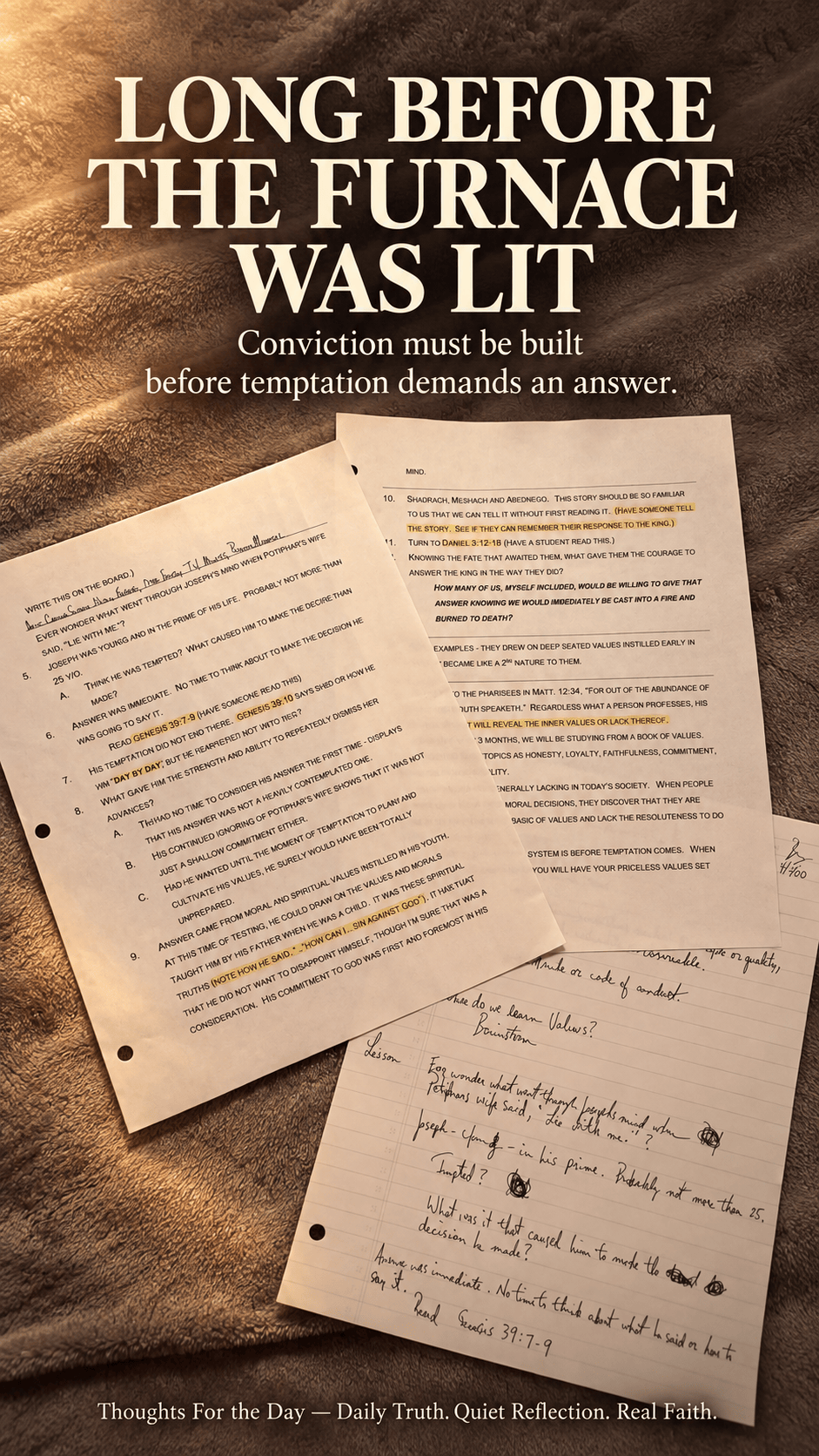
    Long Before the Furnace Was Lit

    Genesis 39:7–10; Daniel 1:8; Daniel 3:16–18; Luke 16:10 NKJV

    Everyone remembers the furnace.

    We remember Shadrach, Meshach, and Abed-Nego standing while everyone around them bowed. We remember their answer to Nebuchadnezzar:

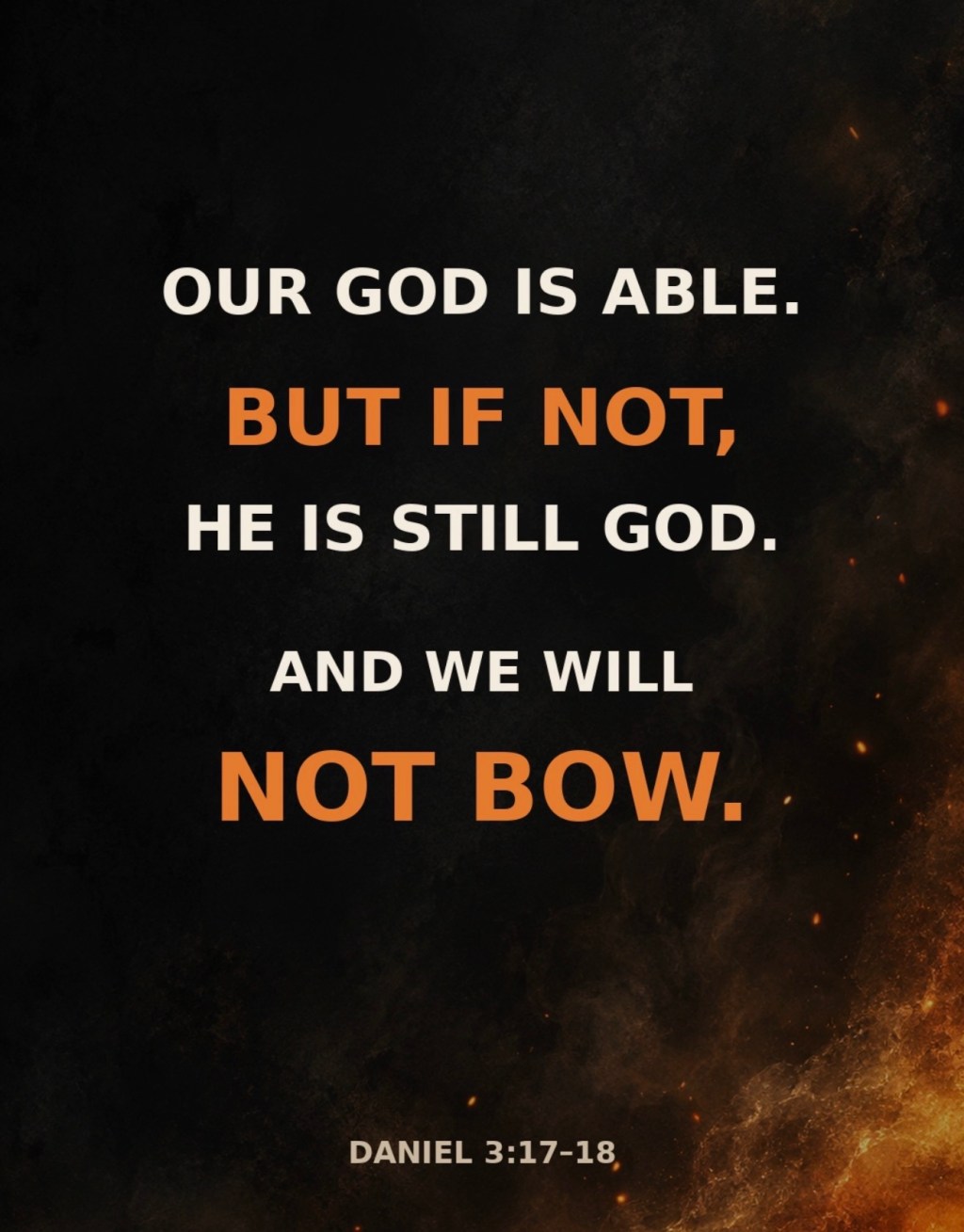
    Our God is able.

    But if not.

    We will not bow.

    What we may not consider is how long it took to form the faith behind that answer.

    The three Hebrews did not begin building their convictions while the furnace was being heated. That was no place to begin deciding whom they would worship. The pressure was too great, the cost was too high, and the moment demanded an immediate answer.

    Their decision had been made long before the music began.

    Years ago, I taught a Sunday-school series called Values That Last. One of those lessons centered on another young man far from home: Joseph.

    Joseph had been betrayed by his brothers, carried into Egypt, and sold as a slave. He was separated from his father, his family, and everything familiar. Then Potiphar’s wife repeatedly attempted to draw him into sin.

    Joseph did not need time to decide whether her offer was wrong. His response was immediate:

    “How then can I do this great wickedness, and sin against God?”
    — Genesis 39:9 NKJV

    Joseph did not merely refuse once. Scripture says she spoke to him day by day, and he continued to refuse.

    Potiphar’s house was not where Joseph began developing his convictions.

    The temptation revealed his integrity.

    It did not create it.

    Joseph’s response came from truth that had been instilled in his youth, buried deeply within his heart, and made personal before the temptation arrived. He was no longer standing beside his father. There was no teacher in the room reminding him what was right. As far as Joseph knew, no one who loved him would ever learn what he chose to do.

    But Joseph knew that God would know.

    When I taught that lesson, I told those young people that they might someday find themselves a thousand miles from home, surrounded by people who did not know them and apparently accountable to no one. If they waited until that moment to decide what they believed and how they intended to live, it would be too late.

    Conviction must be built before temptation demands an answer.

    The same truth appears in the lives of Daniel, Shadrach, Meshach, and Abed-Nego.

    The Bible does not record the lessons they heard as children. It does not tell us the names of the parents, teachers, or spiritual leaders who helped form them. But Daniel 1 shows us the convictions they carried into captivity.

    Babylon changed their location. It changed their names. It began teaching them a new language, a new literature, and a new way of life.

    But Babylon encountered something already present within them.

    “But Daniel purposed in his heart that he would not defile himself with the portion of the king’s delicacies, nor with the wine which he drank.”
    — Daniel 1:8 NKJV

    Daniel spoke, and the four young men stood together in that decision.

    Even that was not the beginning of their faith. It was the first recorded evidence of a faith already being lived. Before they refused to bow before the king’s image, they had refused to compromise at the king’s table.

    The table prepared them for the furnace.

    The private decision prepared them for the public stand.

    Jesus said:

    “He who is faithful in what is least is faithful also in much.”
    — Luke 16:10 NKJV

    Faithfulness in smaller matters may not feel dramatic. Prayer when no crisis is present does not attract much attention. Reading Scripture when no immediate answer is required may appear ordinary. Obeying God when compromise would be easy and invisible may never become a story anyone else tells.

    But those quiet acts are forming something within us.

    They teach the heart where to turn.

    They settle questions before pressure asks them.

    They establish whom we serve before another voice demands our allegiance.

    This is why parents, teachers, and churches must plant truth early. Convictions do not pass automatically from one generation to the next. They must be taught, modeled, repeated, and lived.

    But there also comes a moment when inherited instruction must become personal conviction.

    Joseph could not rely upon Jacob’s presence in Potiphar’s house.

    The four Hebrew youths could not rely upon Jerusalem while living in Babylon.

    The truth they had received had to become the truth by which they lived.

    None of us knows exactly what test may come tomorrow. Most of us will never stand before a literal fiery furnace. But we will encounter moments when compromise offers an easier road, when obedience carries a cost, or when no one appears to be watching.

    That moment is not the time to begin building faith.

    Crisis does not usually give us time to develop convictions. It calls upon the convictions we have already developed.

    The furnace revealed the faith of Shadrach, Meshach, and Abed-Nego.

    It did not create it.

    The stand you may need tomorrow is being formed by the truth you receive, the convictions you settle, and the choices you make with God today.

  • But If Not

    But If Not

    Daniel 3:16–18 NKJV

    They knew God was able.

    But they did not know what God would do.

    That is the tension at the center of Daniel 3.

    Shadrach, Meshach, and Abed-Nego stood before an enraged king with a furnace burning nearby. Nebuchadnezzar had given them one more opportunity to bow before the image he had made. If they complied, they could return to their positions and continue their lives in Babylon. If they refused, they would be thrown into the fire.

    The fire had not touched them… yet.

    They could still avoid it.

    All they had to do was bow.

    Instead, they answered:

    “O Nebuchadnezzar, we have no need to answer you in this matter. If that is the case, our God whom we serve is able to deliver us from the burning fiery furnace, and He will deliver us from your hand, O king. But if not, let it be known to you, O king, that we do not serve your gods, nor will we worship the gold image which you have set up.”
    — Daniel 3:16–18 NKJV

    The King James says, “O Nebuchadnezzar, we are not careful to answer thee…”

    Their answer moved through three declarations:

    Our God is able.

    But if not.

    We will not bow.

    The first declaration was faith.

    They did not minimize the danger.
    They did not pretend the flames were harmless or that Nebuchadnezzar lacked the power to carry out his threat.
    And their confidence was not in their position, their influence, or their ability to survive.

    Their confidence was in God.

    The furnace was real, but it was not greater than Him. The king had authority, but he did not have final authority. God was able to deliver them from the fire and from the hand of Nebuchadnezzar.

    Faith still begins there.

    God is able to heal. He is able to restore. He is able to provide. He is able to open the door, change the heart, reverse the decision, and make a way where we cannot see one.

    We should pray boldly. We should bring our needs to God and believe in His power. Surrender is not unbelief, and it is not wrong to ask God for the outcome we desperately desire.

    But confidence in God’s ability is not the same as certainty about His decision.

    The three Hebrews knew what God could do.

    They did not presume to tell Him what He must do.

    That is where their second declaration becomes so important:

    But if not.

    Those words did not weaken their faith. They completed it.

    Without “our God is able”, “but if not” could sound like hopeless resignation.

    Without “but if not”, “our God is able” can become an attempt to control God through religious certainty.

    Together, the two declarations reveal mature trust.

    Faith says God is able.

    Surrender says He will still be God if He does not do what I am asking.

    I have discovered how easy it is to call something trust while quietly attaching conditions to it.

    I will trust God if He heals.

    I will keep serving if the door eventually opens.

    I will remain faithful if the sacrifice produces something I can see.

    I will obey if He protects me from the consequences.

    I will trust Him if the story ends the way I believe it should.

    But that is not complete surrender. It says, “God, I will trust You only if You give me the outcome I want.” Instead of surrendering our will to Him, we are asking Him to surrender His will to ours.

    Shadrach, Meshach, and Abed-Nego refused to make that bargain.

    They would not worship the golden image Nebuchadnezzar had erected. Neither would they turn deliverance into an idol of their own.

    They did not know whether they would walk out of the furnace. They were not promised that the flames would leave them untouched. What they knew was that God’s worthiness did not depend upon their survival.

    He was worthy before the answer.

    He would remain worthy within the fire.

    He would still be worthy if their story ended in a way they would never have chosen.

    That brought them to the third declaration:

    We will not bow.

    They could not control Nebuchadnezzar.

    They could not control the furnace.

    They could not control whether God would rescue them.

    They could decide whom they would worship.

    There is freedom in recognizing that difference.

    We spend enormous amounts of strength trying to control decisions that belong to God, responses that belong to other people, and outcomes no human being can guarantee. We want to determine how quickly the answer comes, how the story develops, and what obedience will cost.

    But the outcome belongs to God.

    Faithfulness belongs to us.

    Trust does not mean we stop caring about the outcome. The three Hebrews were not eager to burn. Their willingness to die did not mean they had no desire to live. Surrender does not require us to become detached, emotionless, or indifferent.

    It means the outcome will not become our master.

    It means we can ask God for deliverance without demanding it as the price of our devotion.

    It means we can place the request before Him while leaving the throne occupied by Him.

    Most of us will never stand before a literal furnace. But every believer eventually reaches a place where God’s ability is unquestioned and His decision remains unknown.

    We know He can intervene.

    We do not know whether He will intervene in the way we desire.

    That is when “but if not” stops being a phrase from an ancient story and becomes the language of personal surrender.

    If the answer is no, does God retain my worship?

    If the door remains closed, does He retain my obedience?

    If the healing does not come, does He retain my trust?

    If the story takes a road I would never choose, does He remain worthy?

    The answer cannot be grounded in our ability to predict the ending. It must be grounded in the character of the God to whom we have entrusted it.

    God’s goodness is not established by our comfort.

    His faithfulness is not measured by the ease of our lives.

    His worthiness does not rise and fall with the outcome of our prayers.

    The three Hebrews stood before the king without knowing what would happen next. Their obedience was complete before deliverance became visible.

    Perhaps that is the deepest meaning of “but if not.”

    It is not faith giving way to doubt.

    It is faith releasing its demand for control.

    It is worship that no longer belongs to an answer, an outcome, or an explanation.

    Our God is able.

    But if not,

    He is still God.

    And we will not bow.

  • When Obedience Makes No Sense: Marching Through the Impossible

    Scripture focus: “You will not need to fight in this battle. Position yourselves, stand still and see the salvation of the Lord…” (2 Chronicles 20:17, NKJV)

    The Bible is packed with stories that, if we’re being honest, sound like they should’ve ended in disaster. People facing impossible odds, following battle plans that would never fly in a military strategy room—and somehow walking away victorious. Why? Because God was the one calling the shots.

    Let’s start at the Red Sea. The children of Israel—more than 600,000 men, plus women and children—had finally escaped Egypt. But they were trapped between the uncrossable Red Sea and Pharaoh’s pursuing army. No weapons. No escape route. No time. But instead of rallying the people to arms, Moses said something crazy: “Stand still, and see the salvation of the Lord” (Exodus 14:13). Then God parted the waters. The people walked through on dry land. And when Pharaoh’s army followed, the sea closed in behind them.

    That’s not strategy. That’s sovereignty.

    And then there’s Jericho. A fortified city with high walls and strong defenses. Any human general would’ve planned a siege. But God gave Joshua a blueprint that sounded like a children’s game: walk around the city once a day for six days in total silence. Then on the seventh day, march around seven times. Blow the trumpets. Shout. That’s 13 total laps around the city.

    Now pause for a second. The number 13 has a bad reputation. The world calls it unlucky. Some elevators skip the 13th floor. People talk about Friday the 13th like it’s cursed. But let this sink in: God used 13 laps—that “unlucky” number—to bring down the walls of one of the strongest cities in the Promised Land.

    Let the world call it bad luck. We call it divine design.

    It doesn’t stop there. Gideon started with 32,000 men to fight the Midianites. But God trimmed it down to 10,000… then just 300 men—armed not with swords, but with trumpets, torches, and clay pitchers. Judges 7:12 says the enemy was “as numerous as locusts; and their camels… as the sand by the seashore.” That’s not just outnumbered. That’s outmatched, overwhelmed, and underqualified. Yet by God’s hand, victory came anyway.

    Over and over we see it:

    • Hezekiah and the Assyrian army (2 Kings 19)
    • Jehoshaphat against the armies of Moab and Ammon (2 Chronicles 20)
    • Daniel in the lion’s den (Daniel 6)
    • Shadrach, Meshach, and Abed-Nego in the fiery furnace (Daniel 3)

    These aren’t just Bible stories—they’re testimonies. Reminders that when obedience seems foolish, God’s power is often just moments away.

    I don’t know what kind of battle you’re facing today. Maybe you’re on lap 11 or 12, and nothing’s changed. The walls are still there. The enemy still looms. The fear is still whispering in your ear. But let me say this:

    Don’t quit before lap 13.

    Don’t let the world define your “unlucky” situation. Let God redeem it for His glory. Maybe you feel like the underdog—like Gideon. Or maybe you’ve been marching silently like Joshua, wondering if your obedience even matters. It does. It always does.

    And when you’re tired? When quitting seems easier than continuing? Remember the words of Jehaziel in 2 Chronicles 20:17, “Stand still and see the salvation of the Lord.” Or David’s bold declaration to Goliath in 1 Samuel 17:47, “The battle is the Lord’s.” Or the simple, powerful invitation from Psalm 46:10: “Be still, and know that I am God.”

    There’s a song from the Imperials—recorded back in 1979—that still speaks:

    Praise the Lord, for the chains that seem to bind you
    Serve only to remind you
    That they drop powerless behind you
    When you praise Him.

    Chains look real. Walls feel permanent. But God? He specializes in things that don’t make sense.


    Reflection Questions:

    1. Have you ever obeyed God when it didn’t make sense? What happened?
    2. Are you on a “lap” right now where quitting feels easier than trusting?
    3. What walls are you facing today that need a God-sized breakthrough?

    Final Encouragement:
    Obedience may not feel powerful—but it positions us to see God’s power clearly. Don’t stop short. Don’t buy the world’s definition of what’s “lucky” or “logical.” If He brought you to it, He’s more than able to bring you through it.

    Keep marching. Lap 13 is coming.