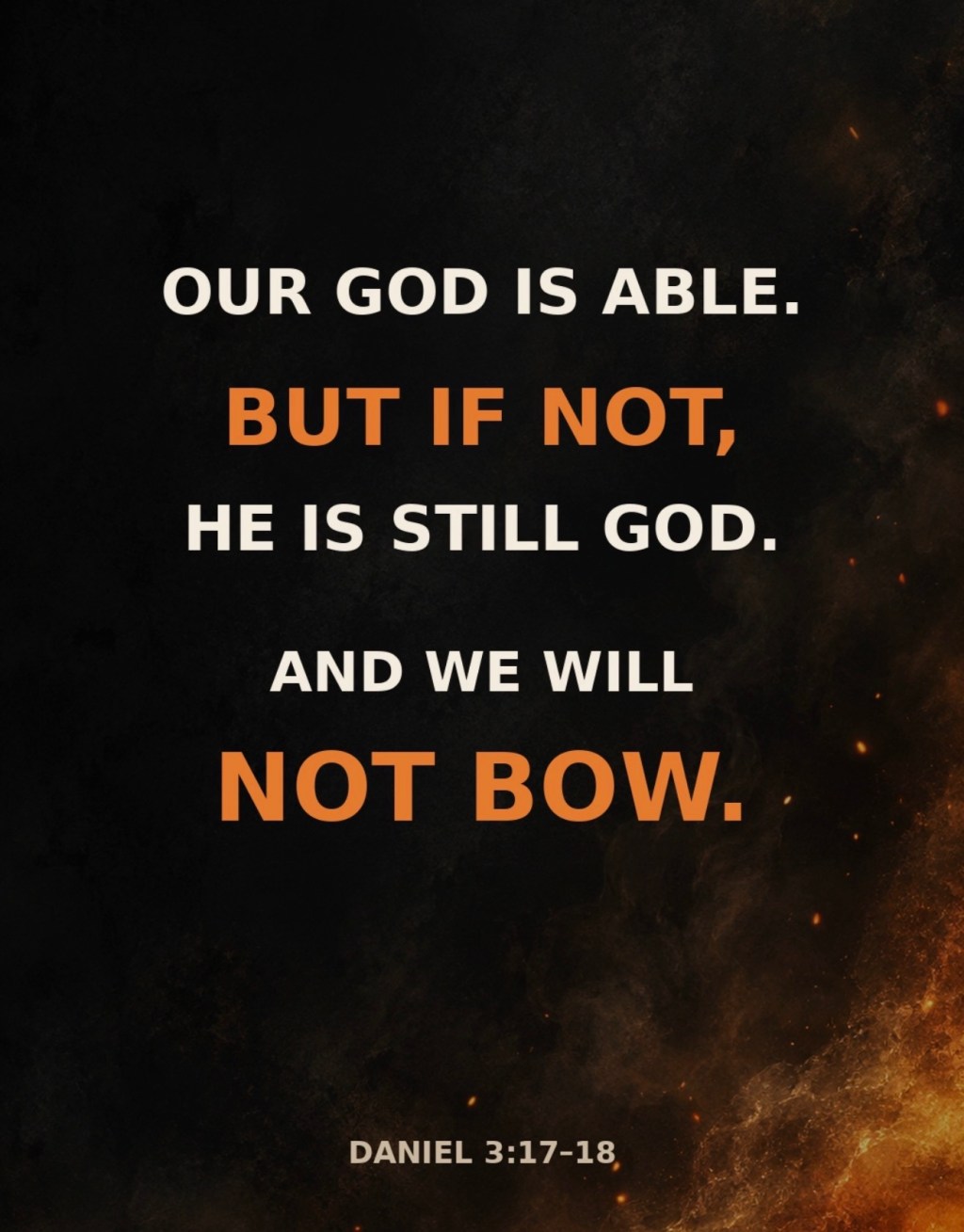
Daniel 3:16–18 NKJV
They knew God was able.
But they did not know what God would do.
That is the tension at the center of Daniel 3.
Shadrach, Meshach, and Abed-Nego stood before an enraged king with a furnace burning nearby. Nebuchadnezzar had given them one more opportunity to bow before the image he had made. If they complied, they could return to their positions and continue their lives in Babylon. If they refused, they would be thrown into the fire.
The fire had not touched them… yet.
They could still avoid it.
All they had to do was bow.
Instead, they answered:
“O Nebuchadnezzar, we have no need to answer you in this matter. If that is the case, our God whom we serve is able to deliver us from the burning fiery furnace, and He will deliver us from your hand, O king. But if not, let it be known to you, O king, that we do not serve your gods, nor will we worship the gold image which you have set up.”
— Daniel 3:16–18 NKJV
The King James says, “O Nebuchadnezzar, we are not careful to answer thee…”
Their answer moved through three declarations:
Our God is able.
But if not.
We will not bow.
The first declaration was faith.
They did not minimize the danger.
They did not pretend the flames were harmless or that Nebuchadnezzar lacked the power to carry out his threat.
And their confidence was not in their position, their influence, or their ability to survive.
Their confidence was in God.
The furnace was real, but it was not greater than Him. The king had authority, but he did not have final authority. God was able to deliver them from the fire and from the hand of Nebuchadnezzar.
Faith still begins there.
God is able to heal. He is able to restore. He is able to provide. He is able to open the door, change the heart, reverse the decision, and make a way where we cannot see one.
We should pray boldly. We should bring our needs to God and believe in His power. Surrender is not unbelief, and it is not wrong to ask God for the outcome we desperately desire.
But confidence in God’s ability is not the same as certainty about His decision.
The three Hebrews knew what God could do.
They did not presume to tell Him what He must do.
That is where their second declaration becomes so important:
But if not.
Those words did not weaken their faith. They completed it.
Without “our God is able”, “but if not” could sound like hopeless resignation.
Without “but if not”, “our God is able” can become an attempt to control God through religious certainty.
Together, the two declarations reveal mature trust.
Faith says God is able.
Surrender says He will still be God if He does not do what I am asking.
I have discovered how easy it is to call something trust while quietly attaching conditions to it.
I will trust God if He heals.
I will keep serving if the door eventually opens.
I will remain faithful if the sacrifice produces something I can see.
I will obey if He protects me from the consequences.
I will trust Him if the story ends the way I believe it should.
But that is not complete surrender. It says, “God, I will trust You only if You give me the outcome I want.” Instead of surrendering our will to Him, we are asking Him to surrender His will to ours.
Shadrach, Meshach, and Abed-Nego refused to make that bargain.
They would not worship the golden image Nebuchadnezzar had erected. Neither would they turn deliverance into an idol of their own.
They did not know whether they would walk out of the furnace. They were not promised that the flames would leave them untouched. What they knew was that God’s worthiness did not depend upon their survival.
He was worthy before the answer.
He would remain worthy within the fire.
He would still be worthy if their story ended in a way they would never have chosen.
That brought them to the third declaration:
We will not bow.
They could not control Nebuchadnezzar.
They could not control the furnace.
They could not control whether God would rescue them.
They could decide whom they would worship.
There is freedom in recognizing that difference.
We spend enormous amounts of strength trying to control decisions that belong to God, responses that belong to other people, and outcomes no human being can guarantee. We want to determine how quickly the answer comes, how the story develops, and what obedience will cost.
But the outcome belongs to God.
Faithfulness belongs to us.
Trust does not mean we stop caring about the outcome. The three Hebrews were not eager to burn. Their willingness to die did not mean they had no desire to live. Surrender does not require us to become detached, emotionless, or indifferent.
It means the outcome will not become our master.
It means we can ask God for deliverance without demanding it as the price of our devotion.
It means we can place the request before Him while leaving the throne occupied by Him.
Most of us will never stand before a literal furnace. But every believer eventually reaches a place where God’s ability is unquestioned and His decision remains unknown.
We know He can intervene.
We do not know whether He will intervene in the way we desire.
That is when “but if not” stops being a phrase from an ancient story and becomes the language of personal surrender.
If the answer is no, does God retain my worship?
If the door remains closed, does He retain my obedience?
If the healing does not come, does He retain my trust?
If the story takes a road I would never choose, does He remain worthy?
The answer cannot be grounded in our ability to predict the ending. It must be grounded in the character of the God to whom we have entrusted it.
God’s goodness is not established by our comfort.
His faithfulness is not measured by the ease of our lives.
His worthiness does not rise and fall with the outcome of our prayers.
The three Hebrews stood before the king without knowing what would happen next. Their obedience was complete before deliverance became visible.
Perhaps that is the deepest meaning of “but if not.”
It is not faith giving way to doubt.
It is faith releasing its demand for control.
It is worship that no longer belongs to an answer, an outcome, or an explanation.
Our God is able.
But if not,
He is still God.
And we will not bow.


Leave a Reply