Tag: Discipleship

  • Don’t Stop Reading Too Soon

    Don’t Stop Reading Too Soon

    “If you’re going to tell my story… tell it all. Don’t tell me about David and Goliath if you don’t tell me about Bathsheba. Don’t tell me about Peter walking on the water if you don’t tell me about him denying Christ. Don’t tell me about Saul becoming Paul if you don’t tell me about him persecuting the Church.”
    — Rev. Ronald LaCombe

    Those words have stayed with me since I first read them.

    Not because they excuse sin.

    Not because they diminish failure.

    But because they remind us of something we often forget.

    A single chapter is not the whole story.

    Imagine if the Bible had ended at some of its darkest moments.

    Moses standing over the body of an Egyptian.

    Gideon hiding in a winepress, fearful of the Midianites.

    Samson, blind and broken, grinding grain for the Philistines.

    David standing on a rooftop instead of a battlefield.

    Peter warming himself beside the fire as he denied even knowing Jesus.

    Saul of Tarsus breathing threats against the Church.

    Manasseh filling Jerusalem with idolatry and innocent blood.

    If the story stopped there, history would remember each of them very differently.

    But God didn’t stop writing.

    That’s one of the things I love most about Scripture.

    It doesn’t sanitize its heroes.

    If the Bible were merely a collection of inspiring legends, those chapters would have quietly disappeared. Noah’s drunkenness would have been omitted. Abraham’s fear would have been edited out. David’s adultery would have remained unmentioned. Peter’s denial would have been forgotten.

    Instead, God left every one of those stories in the pages of His Word.

    Why?

    Because the Bible has never been a book about flawless people.

    It is a book about a faithful God.

    Moses became the deliverer of Israel.

    Gideon led three hundred men against an army that couldn’t be counted.

    Samson’s greatest victory came after his greatest failure.

    David became known as a man after God’s own heart—not because he never sinned, but because he genuinely repented.

    Peter stood on the Day of Pentecost and boldly preached the very Christ he had once denied.

    Saul became Paul, carrying the gospel farther than he ever carried persecution.

    Even Manasseh—the most wicked king Judah had ever known—humbled himself before God, and God heard his prayer.

    Grace did not erase what they had done.

    Moses still never entered the Promised Land.

    David still endured painful consequences.

    Samson still died in Gaza.

    Peter never forgot that night around the fire.

    God doesn’t rewrite history.

    He redeems it.

    I wonder how many people have already decided your story is finished.

    Perhaps they know about the divorce, but not the healing.

    The addiction, but not the freedom.

    The rebellion, but not the repentance.

    The failure, but not the restoration.

    Maybe you’ve done the same thing to yourself.

    Maybe you’ve convinced yourself that one painful chapter has become the title of your entire life.

    Friend, don’t stop reading too soon.

    The same God who continued writing Moses’ story…

    continued writing David’s.

    Continued writing Peter’s.

    Continued writing Paul’s.

    Continued writing Manasseh’s.

    And if you’ve placed your life in His hands…

    He’s still writing yours.

    The world is quick to place a period where God places a comma.

    People often decide the ending while God is still turning the page.

    So if you’re going to tell my story…

    Tell it all.

    Tell them where I failed.

    Tell them where I fell.

    Tell them where I doubted.

    But don’t stop there.

    Tell them about the God whose mercy proved greater than my worst chapter.

    Because the greatest part of my story was never my failure.

    It was the grace of God that refused to let my failure become the end.

    Final Word

    The enemy wants you to believe your worst moment is your defining moment.

    God declares that, through repentance and His grace, your worst moment can become the place where His mercy shines the brightest.

    So don’t stop reading too soon.

    God isn’t finished writing.

  • Create In Me A Clean Heart

    Create In Me A Clean Heart

    Scripture: Psalm 51

    Yesterday we looked at one of the most uncomfortable moments in all of Scripture.

    Nathan stood before King David and uttered four unforgettable words:

    “Thou art the man.”

    David’s response was immediate.

    “I have sinned against the LORD.” (2 Samuel 12:13)

    For most of us, that’s where the story ends.

    But Scripture doesn’t leave us standing in the throne room with Nathan.

    It invites us into David’s prayer closet.

    Psalm 51 is that prayer.

    If 2 Samuel 12 records David’s confession…

    Psalm 51 reveals David’s heart.

    I’ve read Psalm 51 countless times over the years, and it has long been one of my favorite chapters in the Bible.

    But through the years I’ve discovered something.

    There are certain passages of Scripture that become more meaningful the longer you live.

    When I was younger, I admired David’s poetry.

    Today…

    I understand his tears.

    David doesn’t spend this Psalm trying to explain himself.

    He doesn’t minimize his sin.

    He doesn’t compare himself to someone worse.

    He doesn’t bargain with God.

    No… he simply throws himself entirely upon the mercy of God.

    The opening words set the tone for everything that follows.

    “Have mercy upon me, O God, according to thy lovingkindness…”

    David doesn’t appeal to his past victories.

    He doesn’t remind God that he killed Goliath.

    He doesn’t mention the years he faithfully served as king.

    He simply pleads for mercy.

    That is where genuine repentance always begins.

    The more I read this Psalm, the more one truth stands out.

    David never asks God to change his circumstances.

    Instead…

    He asks God to change him.

    That may be the clearest evidence that his repentance was genuine.

    “Wash me thoroughly from mine iniquity…”

    “Cleanse me from my sin.”

    “Purge me with hyssop…”

    “Create in me a clean heart…”

    “Renew a right spirit within me.”

    Notice the pattern.

    Wash me.

    Cleanse me.

    Purge me.

    Create in me.

    Renew me.

    Restore me.

    Those aren’t the prayers of a man trying to escape consequences.

    They’re the prayers of a man who longs to be different.

    David understood something that we sometimes forget.

    Forgiveness isn’t merely about removing guilt.

    It’s about restoring fellowship with God.

    In this chapter, there is one verse that has always stopped me in my tracks.

    “Cast me not away from thy presence; and take not thy holy spirit from me.” (Psalm 51:11)

    David had already lost peace.

    He had already lost joy.

    His family would experience heartbreaking consequences because of his choices.

    But above everything else…

    He feared losing the presence of God.

    That tells me David finally understood what mattered most.

    One word in particular has fascinated me for years.

    “Create in me a clean heart, O God…”

    David didn’t ask God to repair his heart.

    He didn’t ask Him to polish it.

    Or improve it.

    The Hebrew word translated “create” is the same word used in Genesis 1.

    It describes something only God can do.

    David wasn’t asking for self-improvement.

    He was asking for a new creation.

    Isn’t that the hope of the Gospel?

    God doesn’t simply make bad people a little better.

    He makes dead things live again.

    He gives new hearts.

    New spirits.

    New beginnings.

    As I’ve reflected on my own life over the past sixteen years, these words have taken on a depth they never had before.

    Not because I’ve learned more Hebrew.

    Not because I’ve become a better Bible student.

    But because I’ve experienced the painful reality of living with the consequences of my own failures.

    I’ve learned that repentance isn’t just feeling sorry for what I’ve done.

    It’s longing to become someone different through the grace of God.

    That’s why Psalm 51 continues to speak to me.

    David never asked God to erase the past.

    He asked Him to transform the man who would live tomorrow.

    There is a profound difference.

    Repentance isn’t trying to convince God we’re better than we are.

    It’s agreeing with God about who we really are…

    and trusting Him to make us new.

    That is the beauty of grace.

    Not that God overlooks our sin.

    But that He cleanses the sinner who comes to Him with a broken and contrite heart.

    Final Word

    David wasn’t remembered because he was the king who never failed.

    He was remembered because he was the king who knew where to go when he did.

    Every one of us will fail.

    Every one of us will need mercy.

    The question isn’t whether we’ll ever have our own Psalm 51 moment.

    The question is whether we’ll come to God with excuses…

    or with surrender.

    May our prayer never become,

    “Lord, protect my reputation.”

    May it always be,

    “Create in me a clean heart, O God; and renew a right spirit within me.”

    Because God specializes in doing what only He can do.

    He doesn’t merely forgive repentant hearts.

    He creates new ones.

  • Two Kings. Two Prophets. Two Hearts.

    Two Kings. Two Prophets. Two Hearts.

    Last weekend, Lisa and I had the opportunity to see David at Sight & Sound in Branson.

    The production was outstanding.

    Like most people, I expected to leave thinking about Goliath.

    Instead, I couldn’t stop thinking about Nathan.

    As I watched the prophet confront David over his sin with Bathsheba and Uriah, I found myself comparing that scene with another confrontation recorded in Scripture.

    Two kings.

    Two prophets.

    Two sins.

    Two completely different responses.

    King Saul was confronted by Samuel after sparing King Agag and keeping the best of the Amalekite livestock, despite God’s clear command to destroy everything.

    King David was confronted by Nathan after committing adultery with Bathsheba and arranging for Uriah to be killed in battle.

    Neither man sought out correction.

    God sent a prophet to them.

    Both men had sinned.

    Both men were confronted.

    But that’s where the similarities end.

    When Samuel confronted Saul, his first response wasn’t confession.

    It was self-defense.

    “I have obeyed…”

    “The people took of the spoil…”

    “It was to sacrifice unto the Lord…”

    Excuse followed excuse.

    Responsibility was shifted.

    Blame was shared.

    Even after finally saying, “I have sinned,” Saul immediately added another request:

    “Honor me now, I pray thee, before the elders of my people.”

    Even in repentance, he was still concerned about preserving his image.

    Then Nathan stood before David.

    He didn’t begin with an accusation.

    He told a story.

    A rich man stole the only lamb a poor man possessed.

    David was furious.

    “The man that hath done this thing shall surely die!”

    Then Nathan spoke four words that have echoed through history.

    “Thou art the man.”

    At that moment, David could have done exactly what Saul had done.

    He could have blamed Bathsheba.

    He could have blamed loneliness.

    He could have blamed the pressures of leadership.

    He could have blamed anyone but himself.

    Instead, David uttered one of the shortest—and most powerful—confessions in all of Scripture.

    “I have sinned against the LORD.”

    No excuses.

    No blame shifting.

    No attempts to justify himself.

    Just honest repentance.

    David’s sin was enormous.

    Adultery.

    Deception.

    Murder.

    None of it was minimized.

    The consequences were real, painful, and far-reaching.

    His family suffered.

    His kingdom suffered.

    David himself suffered.

    Repentance does not erase earthly consequences.

    But it does restore fellowship with God.

    I’ve often wondered why preachers spend far more time talking about David and Goliath than David and Nathan.

    Perhaps it’s because Goliath is easier.

    We all like sermons that ask,

    “What giant are you facing?”

    Nathan asks a far more uncomfortable question.

    “Where are you refusing God’s correction?”

    One sermon inspires us.

    The other examines us.

    One points to battles around us.

    The other exposes battles within us.

    As I reflected on the production afterward, another thought settled into my heart.

    The greatest difference between Saul and David wasn’t that one sinned and the other didn’t.

    Both failed.

    Both needed mercy.

    The difference was what happened after God confronted them.

    Saul defended himself.

    David humbled himself.

    One protected his reputation.

    The other surrendered his heart.

    I don’t believe God is looking for people who never fail.

    If He were, none of us would qualify.

    I believe He’s looking for people who remain teachable.

    People who are willing to hear hard truth.

    People who care more about holiness than appearance.

    People who, when confronted by the Spirit of God, are willing to say,

    “Lord… You’re right.”

    Because every one of us will eventually have a “Thou art the man” moment.

    The question isn’t whether correction will come.

    The question is what kind of heart it will find.

    Final Word

    David wasn’t called “a man after God’s own heart” because he never sinned.

    He was called that because when God exposed his sin, he didn’t harden his heart.

    He humbled it.

    The difference between Saul and David wasn’t the seriousness of their failures.

    It was the condition of their hearts after they were confronted.

    May we never become so concerned with protecting our reputation that we stop listening to God’s correction.

    Because the path to restoration doesn’t begin with defending ourselves.

    It begins with four simple words…

    “I have sinned, Lord.”

  • When Conviction Loses Compassion

    When Conviction Loses Compassion

    One of the saddest realities of our culture is that we have become convinced we must choose between truth and compassion.

    We’re told that if we stand for biblical truth, we cannot truly love people.

    Or, if we genuinely love people, we must eventually surrender biblical truth.

    Jesus accepted neither option.

    He never compromised truth.

    He never withheld compassion.

    And somehow, two thousand years later, many of us have managed to separate what He perfectly united.

    Before we go any further, let me be equally clear about where I stand. I believe God’s design for marriage and sexuality is revealed in Scripture, and I do not have the authority to redefine what God has already spoken. At the same time, I believe every person—regardless of their beliefs, identity, choices, or lifestyle—is created in the image of God and is therefore worthy of dignity, compassion, and respect. These convictions are not in conflict. In fact, they belong together.

    I recently came across a simple quote that has lingered in my mind:

    “When you hold a belief so tightly you cannot see another’s humanity, it will eventually obscure your own.”

    Whether the author intended it or not, I immediately thought of Jesus.

    Not because He abandoned truth…

    But because He never allowed truth to become an excuse for forgetting the value of the person standing in front of Him.

    Think about His ministry.

    The woman caught in adultery.

    The Samaritan woman at the well.

    Matthew, the tax collector.

    Zacchaeus.

    The lepers everyone else avoided.

    The demoniac living among the tombs.

    People whom society had already categorized, condemned, dismissed, or avoided.

    Jesus never ignored their sin.

    But neither did He ignore their humanity.

    He saw people before He addressed their problems.

    Genesis tells us something remarkable.

    Every human being is created in the image of God.

    Not just Christians.

    Not just people who agree with us.

    Not just those living according to Scripture.

    Every person.

    Sin has marred that image, but it has not erased it.

    That truth should forever change the way followers of Christ see people.

    The person addicted to drugs.

    The man sitting in prison.

    The woman who has had multiple abortions.

    The atheist.

    The Muslim.

    The political activist.

    The LGBTQ+ individual.

    The person who hurt you.

    The family member who rejected your values.

    The coworker who mocks your faith.

    Every one of them still bears the imprint of the Creator.

    If God saw enough value in them to create them…

    And enough value in them to send His Son to die for them…

    Who am I to pretend they are beneath my compassion?

    James writes something that should stop every Christian in their tracks.

    With our mouths we bless God…

    And with those same mouths we curse people who have been made in the likeness of God.

    James says these things should not be.

    Think about that.

    When I insult, mock, dehumanize, or rejoice in another person’s humiliation, I am doing so against someone who still carries the fingerprints of God.

    That doesn’t excuse sin.

    It simply reminds me that sinners are still people.

    Sometimes I wonder if we’ve become so busy defending biblical positions that we’ve forgotten why God gave us those truths in the first place.

    The purpose of truth is not to win arguments.

    The purpose of truth is to lead people to Christ.

    Jesus never confused acceptance with approval.

    He welcomed people without affirming everything they did.

    He loved them enough to meet them where they were.

    He also loved them too much to leave them there.

    To the woman caught in adultery He extended mercy…

    Then He called her to leave her sin.

    Those are not contradictory actions.

    They are the very definition of biblical love.

    Love without truth leaves people lost.

    Truth without love leaves people hopeless.

    The Gospel has always been both.

    During the past month, as conversations surrounding Pride once again filled social media, I noticed something that deeply grieved me.

    Not the disagreements.

    Disagreement is inevitable.

    Christians and our culture have very different understandings of sexuality, marriage, and identity.

    Those conversations matter.

    But what disturbed me wasn’t disagreement.

    It was the hatred.

    The mocking.

    The cruel jokes.

    The celebration of another person’s pain.

    The comments that seemed to delight in making someone feel less than human.

    I couldn’t help but wonder…

    When did we decide that cruelty became a fruit of the Spirit?

    There is nothing Christlike about humiliating someone.

    There is nothing holy about ridicule.

    There is nothing righteous about treating another image-bearer of God as though they have no value.

    If we believe someone is living apart from God’s design, shouldn’t that move us toward compassion instead of contempt?

    After all…

    That’s exactly how Jesus treated us.

    The Apostle Paul wrote words that every believer should remember:

    “Such were some of you.”

    Those words level the ground beneath the cross.

    Every Christian has a past.

    Every Christian has needed grace.

    Every Christian has stood in desperate need of mercy.

    The only difference between us and anyone still trapped in sin is not our goodness.

    It’s God’s grace.

    That realization should produce humility instead of arrogance.

    Compassion instead of contempt.

    Tears instead of insults.

    Perhaps the greatest danger isn’t abandoning biblical convictions.

    It’s allowing those convictions to harden our hearts.

    The Pharisees knew Scripture better than almost anyone.

    Yet they looked into the eyes of the Son of God and could not recognize Him because their hearts had become so consumed with being right that they no longer loved the people they were supposed to shepherd.

    Knowledge had replaced mercy.

    Religion had replaced relationship.

    Truth had lost compassion.

    May that never be true of us.

    As followers of Christ, we should never apologize for what Scripture teaches.

    But neither should we apologize for loving the people Christ died to save.

    Those are not opposing commitments.

    They are inseparable.

    If my convictions cause me to look down on people…

    Something is wrong with my heart.

    If my theology allows me to despise those Christ willingly died for…

    Something is wrong with my theology.

    Because every person I meet is someone Jesus considered worth stretching out His hands for.

    And if He could love them enough to die for them…

    Surely I can love them enough to treat them with dignity.

    Final Word

    The world often tells us we must choose between conviction and compassion.

    Jesus chose neither.

    He embodied both.

    He never compromised truth.

    He never forgot a person’s worth.

    As His followers, neither should we.

    Because biblical conviction should never make us less compassionate.

    It should remind us just how much compassion God first showed us.
  • The Blessing You Didn’t Pray For

    The Blessing You Didn’t Pray For

    “Every good gift and every perfect gift is from above…” — James 1:17

    A song came to mind this week that asks a series of thought-provoking questions.

    What if the things we call hardships are sometimes the very means by which God accomplishes His greatest work in our lives?

    It isn’t asking whether pain is enjoyable.
    It isn’t suggesting that loss somehow becomes pleasant.

    Instead, it challenges us to consider a difficult possibility:

    What if some of God’s greatest blessings arrive in packages we would never choose to open?

    That thought immediately took me back through Scripture.

    Joseph certainly wouldn’t have chosen betrayal by his brothers.
    He wouldn’t have chosen slavery.
    He wouldn’t have chosen prison.

    Yet years later, he could look back and see that God had been working through every painful chapter.

    David probably wouldn’t have chosen years of hiding in caves while running for his life.

    Moses likely wouldn’t have volunteered for forty years in the wilderness.

    Naomi certainly wouldn’t have chosen famine, widowhood, and the loss of her sons.

    None of those experiences felt like blessings when they were happening.

    Yet every one of them became part of God’s greater purpose.

    I wonder how many blessings I’ve almost missed because I was looking for the wrong wrapping paper.

    We naturally think blessings look like answered prayers.

    Open doors.
    Good health.
    Financial provision.
    Restored relationships.

    There is no question those things can be tremendous gifts from God.

    But sometimes His greatest gifts are quieter.

    A disappointment that redirected our lives.
    A closed door that protected us from walking somewhere we shouldn’t.
    A season of waiting that taught us patience.
    A trial that stripped away our self-reliance and taught us complete dependence upon Him.

    None of us pray for those things.

    Yet many of us would honestly say they became turning points in our walk with Christ.

    I’ve noticed something else.

    We usually recognize those blessings only by looking backward.

    Very few people say in the middle of suffering,

    “I can already see why God allowed this.”

    Perspective often comes long after the pain.

    Perhaps that’s why faith is so essential.

    Faith trusts that God is good before we can understand what He is doing.

    Only later do we begin to see how He was weaving together circumstances we never could have imagined.

    Romans 8:28 isn’t a promise that everything is good.

    It’s a promise that God is working through everything for the good of those who love Him and are called according to His purpose.

    That doesn’t minimize grief.
    It doesn’t erase loss.
    It doesn’t pretend suffering isn’t real.

    It simply reminds us that God never wastes any of it.

    One day, I believe we’ll look back and discover that some of the moments we would have erased from our story became the very chapters God used to shape us most into the image of Christ.

    Final Word

    We spend much of our lives asking God to change our circumstances.

    Sometimes He does.

    But often, His greater miracle is using those circumstances to change us.

    Perhaps the greatest blessings aren’t always the ones that make life easier.

    Perhaps they’re the ones that make us more like Jesus.

  • Sunday Studies – Mercy Offends: Lessons from Jonah 4

    Sunday Studies – Mercy Offends: Lessons from Jonah 4

    Most of us know the story of Jonah.

    We remember the storm.

    The great fish.

    The reluctant prophet finally walking through the streets of Nineveh proclaiming God’s coming judgment.

    What often surprises people is that the real climax of the book doesn’t happen when Jonah is swallowed by the fish.

    It happens after Nineveh repents.

    The greatest revival recorded in the Old Testament had just taken place.

    From the king to the common citizen, the people humbled themselves before God. They fasted, repented, and turned from their violence. In response, God withheld the judgment He had promised.

    If we were writing the story, this would be the perfect ending.

    The prophet preached.

    The people repented.

    God showed mercy.

    Everyone celebrates.

    Instead, Jonah chapter 4 opens with these startling words:

    “But it displeased Jonah exceedingly, and he became angry.” (Jonah 4:1)

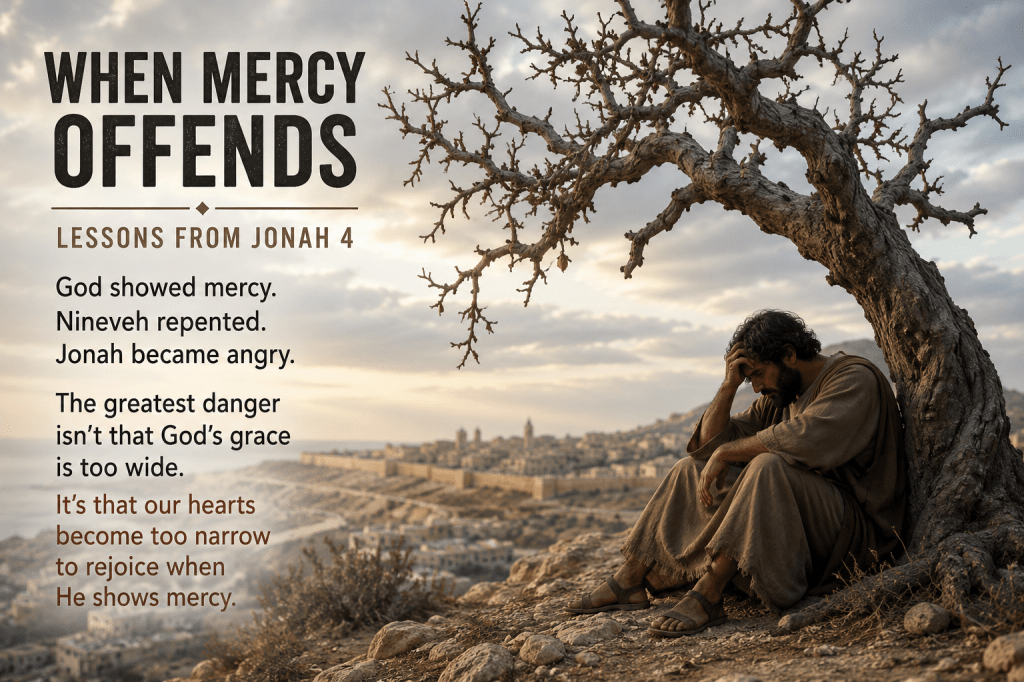
    Jonah wasn’t angry because his message failed.

    He was angry because it succeeded.

    He had witnessed exactly what every prophet should long to see—repentance, mercy, and revival.

    And he hated it.

    That should stop every one of us in our tracks.

    Why Was Jonah Angry?

    Jonah explains it himself.

    “I knew that You are a gracious and merciful God, slow to anger and abundant in lovingkindness…” (Jonah 4:2)

    Notice what Jonah is saying.

    He isn’t questioning God’s character.

    He knew God’s character perfectly.

    He simply didn’t want God’s mercy extended to those people.

    The Assyrians weren’t misunderstood.

    They were notoriously cruel. They conquered nations through terror, torture, and brutality. Humanly speaking, Jonah’s hatred made sense.

    What didn’t make sense to Jonah was that God’s mercy could be greater than Nineveh’s wickedness.

    Our Jonah Moments

    Before we’re too hard on Jonah, we should ask ourselves a difficult question.

    Who is our Nineveh?

    Who do we quietly believe has crossed the line beyond God’s mercy?

    Maybe it’s a murderer.

    A rapist.

    A child molester.

    An abusive spouse.

    A corrupt politician.

    Someone who destroyed your family.

    Someone who betrayed your trust.

    Most of us have someone.

    We may never say it aloud, but somewhere deep inside we think,

    “Lord… surely not them.”

    That’s where Jonah meets us.

    Justice and Mercy

    This is where many people struggle.

    If God forgives someone guilty of terrible crimes, does that mean justice no longer matters?

    Not at all.

    Scripture never teaches that forgiveness removes earthly consequences.

    David was forgiven, but still lived with painful consequences.

    Moses was forgiven, yet never entered the Promised Land.

    The thief on the cross received mercy, but still died under Roman execution.

    A murderer who genuinely repents may still spend the rest of his life in prison.

    A child molester who truly comes to Christ should still face every legal consequence and every necessary safeguard to protect others.

    Grace does not erase justice.

    It restores a sinner’s relationship with God.

    Those are not the same thing.

    What Forgiveness Looks Like

    Perhaps you’re thinking,

    “That’s easy to say until it’s your child.”

    For one Oklahoma father, it was.

    In 2006, ten-year-old Lindsay Wagoner was raped and murdered. For thirteen years, her father, Bill Wagoner, carried the crushing weight of hatred toward the man who had taken his daughter’s life.

    Eventually, Bill came to a painful realization.

    The man who murdered Lindsay had already stolen enough from his family.

    He wasn’t going to allow him to steal the rest of his life as well.

    In 2019, Bill chose to meet face-to-face with the man who murdered his daughter. He forgave him and shared with him the message of Jesus Christ and the forgiveness that had first been extended to him.

    That meeting didn’t change what had happened.

    It didn’t erase the murder.

    It didn’t remove the prison sentence.

    It didn’t make evil good.

    But it did break the chains that hatred had wrapped around a grieving father’s heart.

    Bill’s story reminds us that forgiveness is never declaring evil to be acceptable.

    It is refusing to allow evil to have the final word.

    Jonah could preach repentance to Nineveh.

    Bill Wagoner lived it.

    One wanted judgment to have the final word.

    The other chose to let mercy have it.

    That is the crossroads every follower of Christ eventually reaches.

    The Foot of the Cross Is Level

    The uncomfortable truth is this:

    The ground at the foot of the cross is perfectly level.

    The respectable church member and the violent criminal are both saved exactly the same way.

    Neither earns forgiveness.

    Neither deserves forgiveness.

    Both stand before God entirely because of grace.

    That doesn’t make their sins equally destructive in this life.

    But it does remind us that salvation has never been based upon the size of our sin.

    It has always been based upon the greatness of our Savior.

    Jonah, the Older Brother… and Us

    Jonah wasn’t the only one to struggle with this.

    Jesus told the story of the prodigal son.

    Most of us celebrate the younger brother coming home.

    But the older brother became angry because someone he believed deserved judgment received mercy instead.

    The Pharisees struggled with tax collectors.

    Peter struggled with Gentiles receiving the Holy Ghost.

    The workers in Jesus’ vineyard parable struggled when those who worked only one hour received the same wage.

    Again and again, Scripture exposes the same temptation.

    We love mercy…

    …until it’s given to someone we don’t think deserves it.

    Looking Into the Mirror

    The Book of Jonah ends strangely.

    There’s no neat conclusion.

    No record of Jonah changing his heart.

    Instead, God simply asks,

    “Is it right for you to be angry?” (Jonah 4:4)

    Then the book ends.

    Almost as though God intentionally leaves the final chapter unfinished.

    Because the last chapter isn’t really about Jonah.

    It’s about us.

    Will we rejoice only when God’s mercy reaches people like us?

    Or will we celebrate whenever another sinner finds forgiveness—even someone we believed was beyond redemption?

    The measure of our understanding of grace isn’t how thankful we are that God forgave us.

    It’s whether we can rejoice when He forgives someone we never thought deserved it.

    Final Word

    The real miracle in Jonah isn’t that God spared Nineveh.

    It’s that God patiently pursued Jonah while his heart was resisting mercy.

    The greatest danger isn’t that God’s grace is too wide.

    It’s that our hearts become too narrow to rejoice when His grace reaches someone we never thought it should.

    If God had drawn the line where we often wish He would…

    none of us would be invited to the Marriage Supper of the Lamb.

  • When Was the Last Time Discipleship Cost You Something?

    “…To be a disciple of Jesus is going to cost you something…”

    That quote hit me square between the eyes. Because when I held it up to my own life, I had to admit something uncomfortable: I don’t know that I’ve ever truly lived that kind of discipleship. Not consistently. Not fully.

    Jesus didn’t mince words. The call to follow Him was direct, costly, and repeated.

    Matthew 16:24. Mark 8:34. Mark 10:21. Luke 9:23

    That phrase—“take up your cross and follow Me”—isn’t some poetic metaphor for mild inconvenience. It was a death sentence. A surrender of will. And the fact that all three Synoptic Gospels include it—Mark more than once—tells us just how central it is to the Christian life.

    Discipleship isn’t a suggestion. It’s a command.

    And we’ve spent far too much time reshaping that command into something manageable.

    Comfortable.

    Instagrammable.

    We’ve turned “take up your cross” into a cozy quote rather than a call to daily death to self.

    Let’s be brutally honest: when was the last time following Jesus actually cost you something?

    Not just time.

    Not just a tithe.

    But real, personal sacrifice.

    Something that forced you to change your plans, stretch your faith, or confront your pride?

    We love the verses about being blessed. We highlight the promises of peace and provision. But we skip over the ones about obedience, sacrifice, and suffering. We love the idea of being “called,” but wrestle when that calling demands discomfort.

    That’s not legalism. That’s lordship.

    And Jesus made it crystal clear:

    “If anyone desires to come after Me, let him deny himself, and take up his cross daily, and follow Me.” (Luke 9:23)

    He didn’t say, “Take up your dreams.”

    He said, “Take up your cross.”

    That cross is not a religious accessory.

    It’s a declaration of surrender. It means laying down your rights.

    It means serving people you don’t like, giving when it hurts, forgiving when it’s undeserved, and going where you’d rather not go.

    Jesus said in Matthew 25:35–40 that whatever we do for “the least of these,” we do for Him. That means giving a sandwich to the hungry, a drink to the thirsty, a warm welcome to the outcast, and our time to those who can’t repay it.

    Discipleship means getting out of our comfort zones.

    Rolling up our sleeves.

    Doing the hard, often thankless work of loving people well in Jesus’ name.

    It’s not flashy. It’s not always fun. But it’s faithful.

    So here’s the challenge:

    What has your faith cost you lately?

    What have you surrendered—not just out of guilt, but out of obedience?

    May we be found faithful—not just in belief, but in obedience.

    Not just in words, but in sacrifice.

    Not just on Sunday—but every single day.

  • If This Life I Lose, I Will Follow

    “For whoever desires to save his life will lose it, but whoever loses his life for My sake will find it.” – Matthew 16:25 (NKJV)

    Following Jesus is easy when it costs us nothing. It’s easy when the blessings flow, when the path is smooth, when faith fits neatly into our routines. But what happens when following Christ demands something more?

    Jesus never sugarcoated the cost of discipleship. He didn’t say, “Follow Me, and your life will be comfortable.” He said, “Take up your cross.” He didn’t promise safety—He promised suffering. And yet, He also promised that losing our lives for His sake is the only way to truly find life.

    Modern Christianity struggles with this truth. We’ve been conditioned to think faith should be convenient, that God’s primary concern is our comfort. But the reality of discipleship is surrender. It’s laying down our desires, our plans, and even our reputations for the sake of Christ. It’s like the modem church thinks of submission as a dirty word, but James is very clear when he tells us to “Submit yourselves therefore to God…” (James 4:7 NKJV)

    The question is: What are we still holding onto? Is it control? The approval of others? A dream we’re unwilling to release? If Jesus asked us to walk away from everything, would we?

    The world tells us to live for ourselves, to chase after success, to prioritize ease over endurance. But Jesus tells us to live for Him. To stand firm, even when it costs us. To be bold, even when it makes us unpopular. To trust Him, even when surrender feels like loss.

    But here’s the promise—surrender is never truly loss. Because when we give up everything for Christ, we gain something far greater: eternal life, unshakable joy, and a purpose that outlasts this world.

    Think about the following questions and consider whether you’re more committed to comfort or to Christ. You just might be surprised.

    What is one thing you’ve been hesitant to surrender to Christ?

    Are you following Jesus only when it’s easy, or even when it costs you?

    How can you take a bold step of faith today, trusting that Jesus is worth it?

    Lord, I don’t want a faith of convenience. I want a faith of commitment. Give me the courage to surrender everything for You, knowing that true life is found in following You. Strengthen me to stand firm, even when it costs me, because You are worth it all. Amen.