Tag: Grace

  • If My Story Can Save Someone Else’s

    If My Story Can Save Someone Else’s

    There comes a point in life when you stop worrying about what people will remember about you…

    And you start wondering what your life will point them toward.

    I’ve made decisions I wish I could take back.

    I’ve hurt people I loved.

    I’ve failed in ways that still grieve me.

    If I could rewrite those chapters, I would.

    But I can’t.

    And maybe that’s exactly where God’s grace becomes most visible.

    Because grace isn’t proven by the lives of people who never needed it.

    Grace is proven by what God does with people who did.

    The Apostle Paul never hid the fact that he persecuted the church.

    Peter never pretended he hadn’t denied Jesus.

    David never removed Psalm 51 from the Bible.

    Their failures weren’t recorded to glorify sin.

    They were preserved to magnify God’s mercy.

    I don’t tell parts of my story because I’m proud of them.

    I’m not.

    I tell them because somewhere, someone else is standing where I once stood.

    Someone is one decision away from destroying a marriage.

    Someone is trapped in secret sin.

    Someone is convinced they’ve gone too far for God to forgive.

    If my failures can persuade one person to turn around before making the same mistake…

    If my scars can convince someone that God’s grace is still greater than their shame…

    If one person finds hope because they realized God never gave up on me…

    Then every painful chapter will have served a purpose.

    When this life is over, I don’t want people talking about my accomplishments.

    I don’t want to be remembered for clever words, popular posts, or even a ministry.

    I want them to remember a faithful God…

    Who refused to stop pursuing an unfaithful man.

    Like the song says:

    “I don’t want to leave a legacy.

    I don’t care if they remember me.

    Only Jesus.”

    Because if my life points even one person toward Him…

    Then every chapter—

    The joyful ones.

    The painful ones.

    The victories.

    The failures.

    The mountains.

    The valleys.

    Will all have been worth it.

    Final Word

    One day, every one of us will leave something behind.

    The question isn’t whether we’ll leave a legacy.

    The question is what that legacy will point to.

    May people never look at our lives and say, “What an extraordinary person.”

    May they instead say,

    “What an extraordinary Savior.”

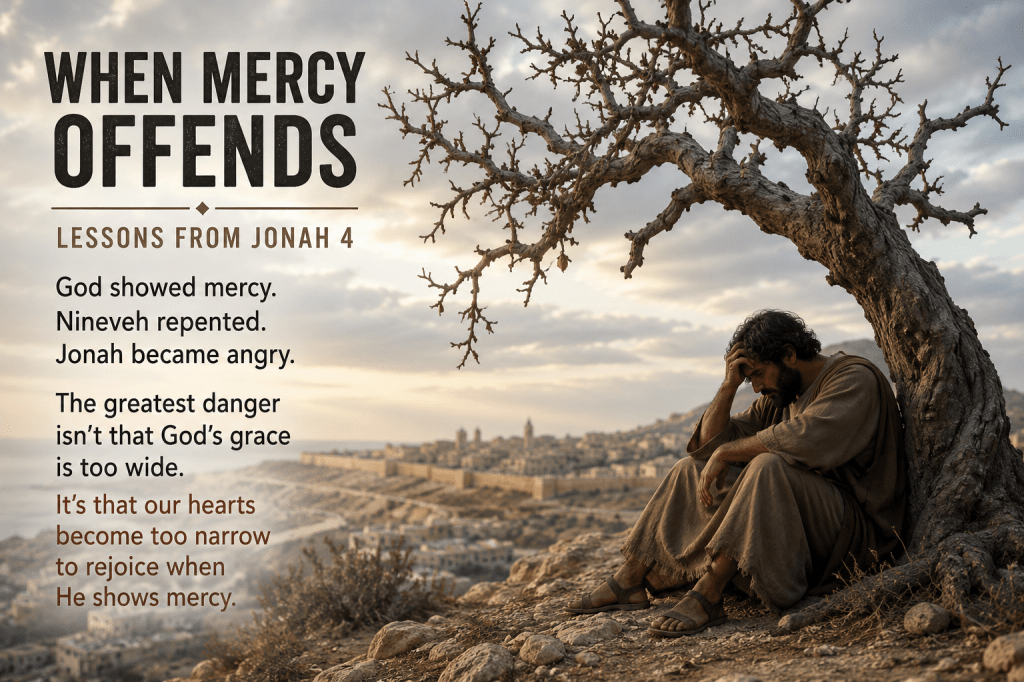
  • Sunday Studies – Mercy Offends: Lessons from Jonah 4

    Sunday Studies – Mercy Offends: Lessons from Jonah 4

    Most of us know the story of Jonah.

    We remember the storm.

    The great fish.

    The reluctant prophet finally walking through the streets of Nineveh proclaiming God’s coming judgment.

    What often surprises people is that the real climax of the book doesn’t happen when Jonah is swallowed by the fish.

    It happens after Nineveh repents.

    The greatest revival recorded in the Old Testament had just taken place.

    From the king to the common citizen, the people humbled themselves before God. They fasted, repented, and turned from their violence. In response, God withheld the judgment He had promised.

    If we were writing the story, this would be the perfect ending.

    The prophet preached.

    The people repented.

    God showed mercy.

    Everyone celebrates.

    Instead, Jonah chapter 4 opens with these startling words:

    “But it displeased Jonah exceedingly, and he became angry.” (Jonah 4:1)

    Jonah wasn’t angry because his message failed.

    He was angry because it succeeded.

    He had witnessed exactly what every prophet should long to see—repentance, mercy, and revival.

    And he hated it.

    That should stop every one of us in our tracks.

    Why Was Jonah Angry?

    Jonah explains it himself.

    “I knew that You are a gracious and merciful God, slow to anger and abundant in lovingkindness…” (Jonah 4:2)

    Notice what Jonah is saying.

    He isn’t questioning God’s character.

    He knew God’s character perfectly.

    He simply didn’t want God’s mercy extended to those people.

    The Assyrians weren’t misunderstood.

    They were notoriously cruel. They conquered nations through terror, torture, and brutality. Humanly speaking, Jonah’s hatred made sense.

    What didn’t make sense to Jonah was that God’s mercy could be greater than Nineveh’s wickedness.

    Our Jonah Moments

    Before we’re too hard on Jonah, we should ask ourselves a difficult question.

    Who is our Nineveh?

    Who do we quietly believe has crossed the line beyond God’s mercy?

    Maybe it’s a murderer.

    A rapist.

    A child molester.

    An abusive spouse.

    A corrupt politician.

    Someone who destroyed your family.

    Someone who betrayed your trust.

    Most of us have someone.

    We may never say it aloud, but somewhere deep inside we think,

    “Lord… surely not them.”

    That’s where Jonah meets us.

    Justice and Mercy

    This is where many people struggle.

    If God forgives someone guilty of terrible crimes, does that mean justice no longer matters?

    Not at all.

    Scripture never teaches that forgiveness removes earthly consequences.

    David was forgiven, but still lived with painful consequences.

    Moses was forgiven, yet never entered the Promised Land.

    The thief on the cross received mercy, but still died under Roman execution.

    A murderer who genuinely repents may still spend the rest of his life in prison.

    A child molester who truly comes to Christ should still face every legal consequence and every necessary safeguard to protect others.

    Grace does not erase justice.

    It restores a sinner’s relationship with God.

    Those are not the same thing.

    What Forgiveness Looks Like

    Perhaps you’re thinking,

    “That’s easy to say until it’s your child.”

    For one Oklahoma father, it was.

    In 2006, ten-year-old Lindsay Wagoner was raped and murdered. For thirteen years, her father, Bill Wagoner, carried the crushing weight of hatred toward the man who had taken his daughter’s life.

    Eventually, Bill came to a painful realization.

    The man who murdered Lindsay had already stolen enough from his family.

    He wasn’t going to allow him to steal the rest of his life as well.

    In 2019, Bill chose to meet face-to-face with the man who murdered his daughter. He forgave him and shared with him the message of Jesus Christ and the forgiveness that had first been extended to him.

    That meeting didn’t change what had happened.

    It didn’t erase the murder.

    It didn’t remove the prison sentence.

    It didn’t make evil good.

    But it did break the chains that hatred had wrapped around a grieving father’s heart.

    Bill’s story reminds us that forgiveness is never declaring evil to be acceptable.

    It is refusing to allow evil to have the final word.

    Jonah could preach repentance to Nineveh.

    Bill Wagoner lived it.

    One wanted judgment to have the final word.

    The other chose to let mercy have it.

    That is the crossroads every follower of Christ eventually reaches.

    The Foot of the Cross Is Level

    The uncomfortable truth is this:

    The ground at the foot of the cross is perfectly level.

    The respectable church member and the violent criminal are both saved exactly the same way.

    Neither earns forgiveness.

    Neither deserves forgiveness.

    Both stand before God entirely because of grace.

    That doesn’t make their sins equally destructive in this life.

    But it does remind us that salvation has never been based upon the size of our sin.

    It has always been based upon the greatness of our Savior.

    Jonah, the Older Brother… and Us

    Jonah wasn’t the only one to struggle with this.

    Jesus told the story of the prodigal son.

    Most of us celebrate the younger brother coming home.

    But the older brother became angry because someone he believed deserved judgment received mercy instead.

    The Pharisees struggled with tax collectors.

    Peter struggled with Gentiles receiving the Holy Ghost.

    The workers in Jesus’ vineyard parable struggled when those who worked only one hour received the same wage.

    Again and again, Scripture exposes the same temptation.

    We love mercy…

    …until it’s given to someone we don’t think deserves it.

    Looking Into the Mirror

    The Book of Jonah ends strangely.

    There’s no neat conclusion.

    No record of Jonah changing his heart.

    Instead, God simply asks,

    “Is it right for you to be angry?” (Jonah 4:4)

    Then the book ends.

    Almost as though God intentionally leaves the final chapter unfinished.

    Because the last chapter isn’t really about Jonah.

    It’s about us.

    Will we rejoice only when God’s mercy reaches people like us?

    Or will we celebrate whenever another sinner finds forgiveness—even someone we believed was beyond redemption?

    The measure of our understanding of grace isn’t how thankful we are that God forgave us.

    It’s whether we can rejoice when He forgives someone we never thought deserved it.

    Final Word

    The real miracle in Jonah isn’t that God spared Nineveh.

    It’s that God patiently pursued Jonah while his heart was resisting mercy.

    The greatest danger isn’t that God’s grace is too wide.

    It’s that our hearts become too narrow to rejoice when His grace reaches someone we never thought it should.

    If God had drawn the line where we often wish He would…

    none of us would be invited to the Marriage Supper of the Lamb.

  • Grace Is Free—So Why Do We Struggle to Accept It?

    Some people struggle to believe in grace. Not because they don’t want to, but because they’ve spent their whole lives hearing that they don’t deserve it.

    Maybe you were raised in a home where love was conditional. Maybe church felt more like a courtroom than a refuge. Maybe every time you messed up, someone was quick to remind you just how much you had failed. Over time, you started believing the lie: I have to earn grace. I have to prove I’m worthy of forgiveness.

    Even those raised in the church aren’t immune. The mind resists what the heart knows to be true. You can read about grace, hear sermons on grace, even sing about grace… and still struggle to accept it for yourself.

    But here’s the truth: Grace is free. It always has been.

    Ephesians 2:8-9 says, “For by grace you have been saved through faith, and that not of yourselves; it is the gift of God, not of works, lest anyone should boast.”

    A gift. Not a wage. Not a reward. A gift.

    But the enemy doesn’t want you to believe that. He wants to keep you trapped in shame, in doubt, in fear. That’s why I love Zack Williams’ song Fear Is a Liar. Because fear is a liar. It whispers, You’re not enough. You’ll never change. You don’t deserve forgiveness. But God says, There is therefore now no condemnation to those who are in Christ Jesus (Romans 8:1).

    If you’ve been carrying the weight of trying to earn God’s love, it’s time to lay it down. His grace is enough. For you.

    And if you know someone who struggles with this, be patient. Be kind. Sometimes, climbing out of that pit takes time. Sometimes, people need to see grace lived out before they can fully accept it.

    So let’s be a reflection of the grace we’ve received.

    Watch Fear Is a Liar by Zack Williams

  • The Other Prodigal Son

    “But he was angry and would not go in. Therefore his father came out and pleaded with him.” – Luke 15:28 (NKJV)

    Most of us focus on the younger son in Jesus’ parable—the one who ran away, wasted everything, and came home to a forgiving father. But let’s talk about the other prodigal son.

    The older brother never left home. He never rebelled. He did everything right. But when his lost brother was welcomed back, he refused to celebrate. Instead of joy, he felt resentment.

    He saw his brother’s redemption as an insult to his own obedience. “I never left, I never wasted anything, I did everything right—and where’s my feast?” He wasn’t just angry at his brother. He was angry at his father.

    How often do we do the same?

    When God forgives someone we think doesn’t deserve it.

    When we secretly want people to earn grace, instead of freely receive it.

    When we think our goodness makes us more deserving than someone else.

    But here’s the truth—the older son needed grace just as much as the younger one. He had stayed home, but his heart was just as lost.

    And yet, look at what the father does. He doesn’t rebuke him. He comes out to him. Just as he ran to the younger son, he reaches out to the older one. Because grace isn’t just for the obviously broken. It’s for the self-righteous, too.

    The question is—will we accept it? Or will we stay outside, arms crossed, missing the beauty of the Father’s mercy?

    Because at the end of the day, it’s not about who deserves grace. None of us do. That’s the point. And the Father’s invitation is the same for both sons: Come inside. Join the celebration. You belong here.

  • The Hound of Heaven vs. The Hounds of Hell

    I first heard a sermon over 45 years ago titled “The Hounds of Hell.” Bro. Bass, a hunter, described how his trained dogs would track their prey relentlessly—up mountains, through valleys, across rivers—never stopping until their target was cornered, exhausted, and alone. He compared it to how Satan and his demons track us, waiting for us to stumble.

    1 Peter 5:8 (NKJV) warns us: “Be sober, be vigilant; because your adversary the devil walks about like a roaring lion, seeking whom he may devour.” The enemy is relentless. He will chase us through every twist and turn, pressing in until we feel trapped with no escape.

    But yesterday morning, I was reminded of a different pursuit—one not of destruction, but of love.

    I pulled a book from my shelf titled A Gentle Thunder and saw the title of chapter two: “The Hound of Heaven: The God Who Pursues.”

    Francis Thompson’s poem describes God as “that tremendous Lover, pursuing me with His love.” Unlike the enemy, who seeks to destroy, Jesus pursues with grace, patience, and mercy.

    Revelation 3:20 (NKJV) says, “Behold, I stand at the door and knock. If anyone hears My voice and opens the door, I will come in to him and dine with him, and he with Me.”

    Satan’s hounds chase to wear you down.
    But Jesus stands at the door, waiting for you to open it.

    He doesn’t force His way in. He doesn’t demand entry. He simply knocks.

    Maybe today, you feel exhausted—like you’re running from something you can’t escape. The enemy has been on your trail, whispering lies, making you feel trapped.

    But hear this: Jesus is pursuing you, too. Not with pressure, but with love. Not with force, but with grace.

    He stands at the door.
    He knocks.
    He waits.

    The question is—will you let Him in?

  • Strength in Simplicity

    In the 15 years I lived with Mums & Dad prior to his passing in November 1988, just 4 days before his 74th birthday, he was often quiet…never having a lot to say. But if he did speak, you knew it was going to be something to hang your hat on.

    Over the years, I worked side by side with him on various projects around the house and in the garden, and in those times he helped to instill in me the values that I’ve tried to uphold, but have so often failed. And, he taught me about the things that truly matter in life, but wealth and popularity were nowhere on that list. What is, however, I present here…

    • Gentleness & tenderness are often greater strengths than force & intimidation.
    • A man’s true strength comes from kneeling before God, rather than posturing before men.
    • Hard work may never make you rich, but you must always give everything you’ve got to whatever you do.
    • Never turn away a stranger in need because you don’t know when you’ll be walking in their shoes.
    • Always look for the beauty in nature.
    • Fishing isn’t necessarily about catching fish.

    Having said that, I’ve been thinking lately about what that really means. And this is what I’ve arrived at.

    The world tells us strength is about dominance—being the loudest voice in the room, the firmest handshake, the most intimidating presence. But real strength often looks quite different. Gentleness and tenderness require far more courage than force and intimidation. The writer of Proverbs tells us that “A gentle answer turns away wrath, but a harsh word stirs up anger” (Proverbs 15:1). Jesus could have crushed His enemies with a word, yet He chose to serve, to heal, to love. That’s the kind of strength that changes the world.

    A man isn’t strong because he stands tall before others—he’s strong because he kneels before God. James, in his letter to the church at Jerusalem, advised them to “Humble yourselves before the Lord, and He will lift you up” (James 4:10). Pride puffs up, but humility brings true power. The moment we acknowledge that we don’t have all the answers, that we need something greater than ourselves, is the moment we find the strength to stand firm. Posturing before men may earn their respect for a time, but bowing before God secures an eternal foundation.

    And then there’s hard work. It may never make you rich in the way the world defines wealth, but that was never the goal anyway. The reward isn’t just in the paycheck—it’s in the diligence, the perseverance, the satisfaction of giving your best. In Paul’s admonitions to the church at Collossi, his instructions included “Whatever you do, work at it with all your heart, as working for the Lord, not for human masters” (Colossians 3:23). Whether the world notices or not, God does.

    Life has a way of humbling us, reminding us that we’re all just one moment away from needing grace ourselves. That’s why we should never turn away a stranger in need. And a very personal experience when I was about 10 or 11 illustrated the wisdom of Paul when he said, “Do not forget to show hospitality to strangers, for by so doing some people have shown hospitality to angels without knowing it” (Hebrews 13:2). You never know when you’ll be the one hoping for a hand, a kind word, or a bit of mercy. The Good Samaritan didn’t ask if the wounded man was worthy—he simply helped. That’s what love does.

    Amid the grind, don’t forget to look up. The beauty of nature is one of God’s simplest, yet most profound gifts. King David, in a way that only he could with his gift of poetry and his very personal relationship with the Creator, stated, “The heavens declare the glory of God; the skies proclaim the work of His hands” (Psalm 19:1). A golden sunrise, a bird’s song, the way the trees dance in the wind—it’s all a reminder of His presence, His artistry, His goodness.

    And sometimes, life is like fishing. It’s not always about what you catch—it’s about the experience, the patience, the stillness. The psalmist summed it up best when he said,“Be still, and know that I am God” (Psalm 46:10). It’s about learning to enjoy the moment, to find peace in the waiting. Some of the best days on the water don’t end with a full net, just a full heart.

    So walk gently, work hard, give freely, and take in the beauty around you. There’s more to life than power and success. Sometimes, the greatest strength is found in the simplest things.

  • A New Perspective From 25 Year Old Notes

    9 March, 2025

    Digging into 25-year-old notes for tomorrow morning’s Sunday School lesson and this powerful truth resonates deeply.

    “The mercy we receive from God is directly proportional to what we show toward others. The judgement we receive will be a mirror of that which we administer.”

    James 2:13 reminds us, “For judgment is without mercy to the one who has shown no mercy. Mercy triumphs over judgment.” This powerful statement unveils a profound truth about the nature of God’s grace and how it intertwines with our relationships with others.

    Consider this: the mercy we receive from God is intimately connected with the mercy we extend to those around us. When we forgive those who have wronged us, show compassion to the hurting, or offer grace during difficult moments, we align ourselves with the heart of God. Each act of mercy becomes a reflection of His love, creating a powerful cycle of grace.

    Additionally, the judgments we cast upon others often bloom back in our own lives. If we choose to be critical and harsh, we may find ourselves facing similar judgments when we falter. Instead, let us remember that each time we show kindness, it echoes back to us, amplifying the very mercy we desire from God.

    As we navigate our daily encounters, may we choose mercy over judgment. Lord, help us to reflect Your love and grace in all circumstances. Amen.