Tag: Redemption

  • Restored For a Purpose

    Restored For a Purpose

    Most people would have walked right past it.

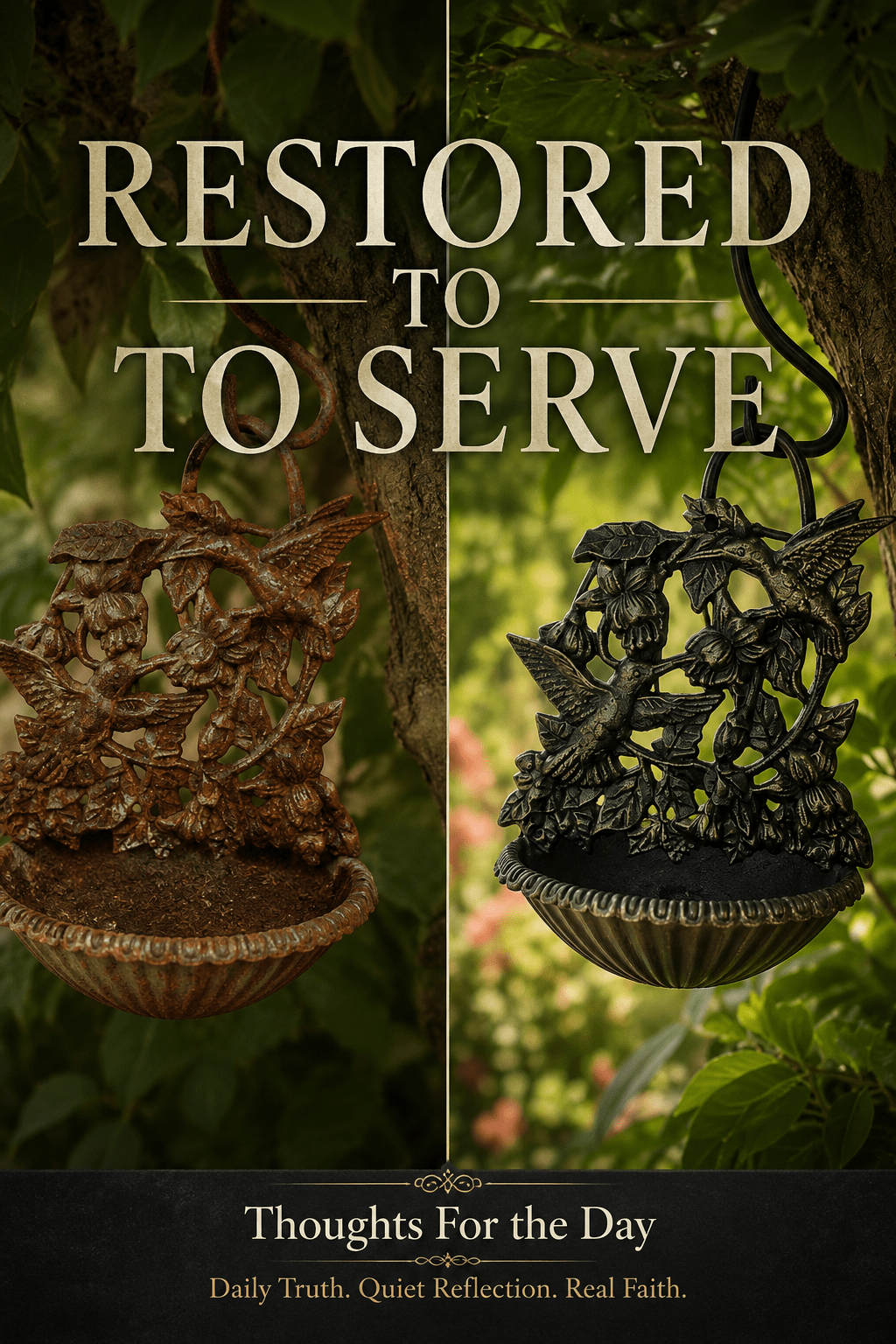
    Buried beneath years of rust, grease, carbon, and neglect was an old piece of cast iron that looked like it belonged in the scrap pile.

    Meals had been cooked in it.

    Fires had burned beneath it.

    Time had left its mark.

    Layer after layer had accumulated until the original surface was almost completely hidden.

    Most people would have seen something ruined.

    I saw the beauty of what it could be.

    That is the difference between someone who only sees the present condition and someone who understands the restoration process.

    Restoring cast iron is not quick.

    It begins with a wire brush, scraping away as much loose rust, grease, and grime as possible. It is dirty work. Dust flies. Old buildup breaks loose. What has clung to the piece for decades does not always surrender easily.

    But the wire brush can only reach so far.

    Many pieces have deep grooves, decorative patterns, tight corners, and hidden spaces that cannot be thoroughly cleaned by hand.

    Once the wire brush has removed as much as possible, the piece goes into the electrolysis tank…

    Lowered beneath the surface and left there.

    Sometimes for hours.

    Sometimes for days.

    Some pieces take longer than others.

    To someone unfamiliar with the process, it may appear that nothing is happening. The piece is simply sitting beneath the water.

    But beneath the surface, a work is taking place that the eye cannot fully see.

    The rust begins to loosen.

    The corrosion begins to release its grip.

    The buildup that once seemed permanently attached begins separating from the iron.

    When the piece is removed, it is scrubbed and inspected.

    Sometimes the work is complete.

    Sometimes rust and crust remain.

    When that happens, the piece goes back into the tank.

    The process is not repeated because it failed.

    It is repeated because the work is not finished.

    Eventually, the metal is stripped down to the bare surface.

    No paint covering the rust.

    No seasoning applied over years of grime.

    No attempt to disguise what is underneath.

    Everything that does not belong must be removed.

    Only then can the restoration continue.

    Watching that process has often reminded me of what God does in our lives.

    We accumulate things… and some of them are obvious.

    Sin.

    Shame.

    Pride.

    Bitterness.

    Compromise.

    But other things build gradually.

    Attitudes we picked up from people around us.

    Habits we never questioned.

    Influences we allowed into our minds.

    Offenses we refused to release.

    Wounds we buried instead of bringing to God.

    Excuses we repeated until we began believing them.

    One layer may not seem significant.

    Neither does one meal’s worth of grease left on a skillet.

    But over time, layer builds upon layer until what was once beautiful becomes hidden beneath what has accumulated.

    That buildup can become so familiar that we begin to believe it is simply who we are.

    “That is just the way I am.”

    “My family has always been like this.”

    “I have carried this for so long that I will never change.”

    But God never mistakes the buildup for the person beneath it.

    He sees what others may overlook.

    He sees what sin has covered.

    He sees what shame has hidden.

    He sees what years of neglect, pain, and poor choices have obscured.

    And still, He does not walk past us.

    Instead, He begins the work of restoration.

    Sometimes His work feels like the wire brush.

    Conviction can be uncomfortable.

    Correction can feel abrasive.

    God begins confronting the things we have allowed to cling to us.

    He exposes attitudes we defended.

    He challenges habits we excused.

    He reveals influences that have been shaping us in ways we did not recognize.

    That process is not always pleasant.

    But the wire brush is not destroying the iron.

    It is removing what never belonged there.

    Then there are the deeper places.

    The corners we cannot reach ourselves.

    The hidden wounds.

    The secret motives.

    The fears buried beneath years of self-protection.

    The parts of our hearts we do not fully understand.

    David prayed:

    “Search me, O God, and know my heart;
    Try me, and know my anxieties;
    And see if there is any wicked way in me,
    And lead me in the way everlasting.”

    —Psalm 139:23–24, NKJV

    David understood that there were places within him that required more than human effort.

    Some things cannot be scrubbed away through determination alone.

    They require the searching, cleansing work of God.

    Sometimes we find ourselves in a season much like that cast iron sitting beneath the water.

    Hidden.

    Waiting.

    Wondering whether anything is changing.

    We pray, but do not immediately see the answer.

    We repent, yet still feel the pull of old habits.

    We ask God to heal us, but the pain does not disappear overnight.

    From the outside, it may appear that nothing is happening.

    But beneath the surface, God is working.

    He is loosening what has held us.

    He is reaching places we could never reach on our own.

    He is separating us from things that once seemed permanently attached.

    And sometimes that work takes longer than we expected.

    Not because we are worth less.

    Not because the Restorer has forgotten us.

    But because every life has a different history.

    Different wounds.

    Different struggles.

    Different layers that have accumulated along the way.

    God knows exactly what He is working with.

    And He knows exactly what it will take to restore us.

    Sometimes God brings us out of the process, and we discover that more work remains.

    Back into His hands we go.

    More conviction.

    More surrender.

    More healing.

    More learning.

    More letting go.

    That does not mean the process failed.

    It means the work is not finished.

    Paul wrote:

    “Being confident of this very thing, that He who has begun a good work in you will complete it until the day of Jesus Christ.”
    —Philippians 1:6, NKJV

    God is not discouraged when He finds another layer.

    He knew every layer was there before He began.

    And He is committed to finishing what He started.

    There is something else every experienced restorer understands.

    You cannot season over the buildup.

    Seasoning over grease, carbon, and rust is counterproductive.

    It may temporarily cover the surface, but it does not restore the iron.

    It would be like spraying primer over a rusty fender and then covering it with paint without first removing or treating the corrosion.

    It might look better for a little while.

    But the rust is still there.

    Still spreading.

    Still weakening the metal beneath the fresh coat.

    God does not work that way.

    He does not paint over sin.

    He does not cover corruption with a religious appearance.

    He does not simply make us look better on the outside while leaving the condition of the heart untouched.

    God is not interested in cosmetic righteousness.

    Isaiah put it plainly:

    “But we are all like an unclean thing,
    And all our righteousnesses are like filthy rags…”

    —Isaiah 64:6, NKJV

    Our own righteousness cannot cleanse what sin has corrupted.

    We can polish the outside.

    We can change our appearance.

    We can learn the right words, adopt the right behaviors, and convince everyone around us that everything is fine.

    But God sees beneath the surface.

    And He loves us too much to simply paint over what needs to be removed.

    God doesn’t season over our sin.

    He cleanses us.

    He strips away what doesn’t belong and brings us back to the bare surface—not to leave us exposed, but to make all things new.

    And that brings us to the beauty of 2 Corinthians 5:17:

    “Therefore, if anyone is in Christ, he is a new creation; old things have passed away; behold, all things have become new.”
    —2 Corinthians 5:17, NKJV

    At first, restoration and new creation may sound like different ideas.

    But restoring cast iron helps us see how beautifully they work together.

    The restored piece is still the same iron.

    It has not been discarded and replaced.

    Yet after being stripped, cleansed, and renewed, it appears completely new.

    The rust is gone.

    The grime is gone.

    The old layers no longer define it.

    The craftsmanship that was hidden can finally be seen.

    On detailed cast iron pieces, the transformation can be remarkable.

    Before restoration, rust may obscure every fine feature.

    Afterward, feathers appear on birds.

    Veins emerge in leaves.

    Petals become visible on flowers.

    Details that seemed lost were not necessarily gone.

    They were hidden beneath the corrosion.

    That is what God does.

    He does not erase our history.

    He changes what defines us.

    The past may have left scars.

    Neglect may have caused pitting.

    Consequences may remain.

    But the corrosion no longer owns the piece.

    Sin no longer has the final word.

    Shame no longer determines our identity.

    The old life no longer defines who we are in Christ.

    After the metal is clean, the seasoning begins.

    A light coat of oil.

    Heat.

    Cool.

    Another coat.

    More heat.

    Again and again until the bare iron develops a strong, protective finish.

    That process also takes time.

    One coat is not enough.

    In the same way, spiritual maturity is built through repeated acts of faith and obedience.

    Prayer.

    Scripture.

    Worship.

    Faithfulness.

    Forgiveness.

    Surrender.

    Choosing what is right when nobody is watching.

    Choosing it again tomorrow.

    And again the next day.

    God forms character layer by layer.

    But restoration has another purpose.

    A beautifully restored skillet is not meant to spend the rest of its existence sitting on a shelf.

    It was made to be used.

    Again.

    And again.

    And again.

    Years of neglect did not change what the skillet was created to do.

    The rust did not change its purpose.

    The grime did not change its purpose.

    Even decades of sitting unused did not change its purpose.

    Those things only kept it from fulfilling that purpose.

    And maybe you need to hear this today:

    What has happened to you has not changed why God created you.

    Your failures did not erase His purpose.

    Your years away from Him did not erase His purpose.

    The things you allowed to accumulate did not erase His purpose.

    God does not restore us simply so we can look back and admire how far we have come.

    He restores us to usefulness.

    Paul wrote:

    “…he will be a vessel for honor, sanctified and useful for the Master, prepared for every good work.”
    —2 Timothy 2:21, NKJV

    Useful to the Master.

    That is the purpose of restoration.

    And there is something beautiful about the usefulness of cast iron.

    A skillet does not exist merely for itself.

    It feeds people.

    Meal after meal.

    Year after year.

    When properly cared for, a piece that has already served one generation can serve another.

    And another.

    Its restoration becomes a blessing to people who had nothing to do with restoring it.

    Maybe ours should too.

    God restores us so that what He has done in us can become a blessing to someone else.

    So we can love.

    Serve.

    Teach.

    Encourage.

    Disciple.

    Give.

    Forgive.

    Tell someone else where we found hope when we had none.

    Our restoration was never intended to end with us.

    The skillet’s greatest days do not have to be behind it.

    Neither do yours.

    You may feel covered in too much rust.

    You may believe too much grime has accumulated.

    You may look at your scars, your history, and your failures and conclude that you belong in the scrap pile.

    But the Restorer sees differently.

    He sees beneath the buildup.

    He sees beyond your present condition.

    He sees what His grace can uncover.

    He sees what His Spirit can cleanse.

    And He sees the purpose for which you were created.

    Most people might have walked right past.

    But the Restorer stopped.

    He saw value beneath the corrosion.

    He knew what could be restored.

    And He knew it could be useful again.

    God never mistakes the crusty exterior for the beauty of the soul beneath it.

    He sees what lies beneath.

    He knows what He created.

    And He has not forgotten why He created it.

    He is still in the business of restoration.

    And He still has a purpose for the restored.

    “And I will restore to you the years that the swarming locust has eaten…”
    —Joel 2:25, NKJV

  • The Verdict Has Already Been Rendered

    The Verdict Has Already Been Rendered

    One of the enemy’s greatest weapons isn’t temptation.

    It’s accusation.

    He reminds you who you were.

    He reminds you what you did.

    He reminds you of every failure, every regret, every moment you’d rather erase.

    Sometimes he doesn’t even have to speak.

    Our own hearts do it for him.

    We replay old chapters as though they are still being written.

    We introduce ourselves by our failures.

    We define ourselves by battles Christ has already won.

    But God tells a different story.

    When Jesus cried, “It is finished” (John 19:30), He wasn’t announcing that He had merely made forgiveness possible.

    He was declaring that the price had been paid.

    Completely.

    Fully.

    Forever.

    Three days later, the empty tomb became Heaven’s declaration that the sacrifice had been accepted.

    The resurrection wasn’t God changing His mind about Jesus.

    It was God announcing His verdict over everyone who would believe.

    Paul declares that verdict in one of the most powerful verses in all of Scripture:

    “There is therefore now no condemnation to those who are in Christ Jesus…”
    — Romans 8:1 (NKJV)

    Notice what Paul doesn’t say.

    He doesn’t say there is less condemnation.

    He doesn’t say there is future condemnation if God changes His mind.

    He says there is now no condemnation for those who are in Christ.

    That verdict changes more than your eternal destination.

    It changes your identity.

    “Therefore, if anyone is in Christ, he is a new creation; old things have passed away; behold, all things have become new.”
    — 2 Corinthians 5:17 (NKJV)

    God doesn’t simply clean up the old life.

    He creates a new one.

    That’s why Paul says:

    ”…even so we also should walk in newness of life.”
    — Romans 6:4 (NKJV)

    We don’t walk in newness of life to earn God’s acceptance.

    We walk in newness of life because, through Christ, we already have it.

    The church at Corinth understood what it meant to have a past.

    Some had lived in immorality.

    Some in idolatry.

    Some in drunkenness.

    Some in greed.

    Yet Paul reminds them:

    “And such were some of you. But you were washed, but you were sanctified, but you were justified in the name of the Lord Jesus and by the Spirit of our God.”
    — 1 Corinthians 6:11 (NKJV)

    Did you catch that?

    Such were some of you.

    Not, “Such still are you.”

    Were.

    The gospel never asks us to deny where we’ve been.

    It tells us we no longer have to live there.

    Now, does that mean Christians never struggle?

    Of course not.

    The New Testament calls us to daily repentance, continual growth, and lifelong sanctification.

    We still battle the flesh.

    But the flesh is no longer our identity.

    The enemy wants you to keep introducing yourself by your old record.

    God introduces you by His Son.

    The enemy calls you condemned.

    God says, “No condemnation.”

    The enemy calls you broken.

    God says, “A new creation.”

    The enemy calls you your past.

    God says, “Walk in newness of life.”

    The enemy says you’re still who you used to be.

    God says, “Such were some of you.”

    Whose voice are you going to believe?

    Final Word

    The enemy keeps reading from your old record.

    God has already written a new one.

    So don’t stop reading too soon.

    Don’t live like Friday has the final word.

    And don’t keep introducing yourself by a name that Christ has already buried.

    Because the empty tomb didn’t simply prove Jesus conquered death.

    It declared that everyone who is in Christ has received Heaven’s verdict.

    No condemnation.

    A new creation.

    A new life.

    A new name.

    The verdict has already been rendered.

    Now…

    Live like you believe it.

  • Part 2 – The Page That Changed Everything

    Part 2 – The Page That Changed Everything

    Part 2 – The Page That Changed Everything

    Friday looked final.

    The cross stood silent against a darkened sky. Jesus was dead. His body had been wrapped in linen and laid in a borrowed tomb. The stone was rolled into place. The disciples scattered. Hope seemed buried with Him.

    If anyone had written the story that night, they would have ended it there.

    The End.

    But God wasn’t finished writing.

    Before sunrise on the third day, a small group of women made their way to the tomb carrying spices. They weren’t expecting a miracle. They were preparing for a burial.

    Their greatest concern wasn’t whether Jesus would rise. It was much simpler.

    “Who will roll away the stone for us from the entrance of the tomb?” (Mark 16:3, NKJV)

    When they arrived, the stone had already been moved.

    The tomb was empty.

    The angel declared the words that forever changed history:

    “He is not here; for He is risen, as He said.” (Matthew 28:6, NKJV)

    The stone wasn’t rolled away so Jesus could get out.

    It was rolled away so the world could look in.

    In that moment, everything changed.

    Death no longer had the final word.

    Sin no longer had the final word.

    Failure no longer had the final word.

    Shame no longer had the final word.

    Suddenly Moses wasn’t just a murderer.

    Gideon wasn’t just afraid.

    Samson wasn’t just blind.

    Peter wasn’t just the man who denied Jesus.

    Saul wasn’t just the persecutor of the church.

    The empty tomb proved what the rest of Scripture had been pointing toward all along:

    God specializes in rewriting impossible stories.

    Maybe today you’re staring at a chapter you never wanted to read.

    Maybe all you can see is loss…

    disappointment…

    unanswered prayers…

    broken dreams.

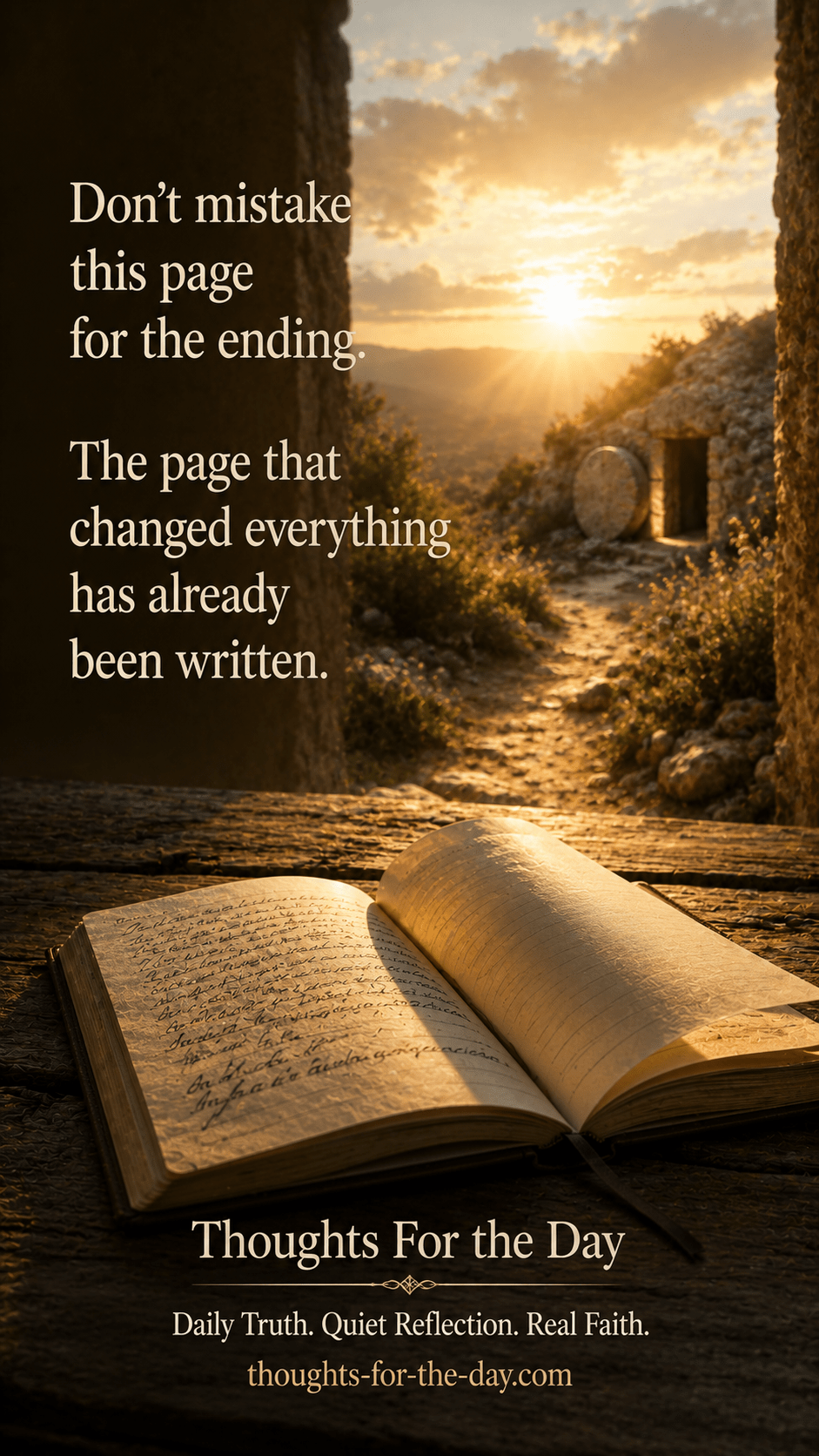
    Don’t mistake this page for the ending.

    The page that changed everything has already been written.

    Read that again.

    The page that changed everything has already been written.

    The resurrection didn’t erase Friday.

    It redeemed it.

    Think about that.

    Jesus still bore the scars.

    Friday still happened.

    The suffering was real.

    The death was real.

    But Sunday changed what Friday meant.

    That’s redemption.

    God rarely erases our Fridays.

    He redeems them.

    Because Jesus walked out of that tomb, your story is never defined by its darkest chapter. The resurrection settled forever that death doesn’t get the final word.

    Sin doesn’t get the final word.

    Failure doesn’t get the final word.

    Jesus does.

    That’s why Christians don’t merely look back to an empty tomb once a year at Easter.

    We live every day in the hope the resurrection declared.

    Every time it looks like God has reached the end…

    He turns another page.

    Scripture

    Blessed be the God and Father of our Lord Jesus Christ, who according to His abundant mercy has begotten us again to a living hope through the resurrection of Jesus Christ from the dead.”
    —1 Peter 1:3 (NKJV)

  • Part 1: I Could Only See the Page I Was Standing On

    Part 1: I Could Only See the Page I Was Standing On

    Yesterday we looked at the lives of Moses, Gideon, Samson, Peter, Saul, and Manasseh.

    Different people.

    Different failures.

    Different stories.

    Yet every one of them shared something in common.

    At some point, it looked like their story was over.

    Moses was a murderer and a fugitive.

    Gideon hid in fear.

    Samson sat blind in a Philistine prison.

    Peter denied Jesus three times.

    Saul hunted Christians.

    Manasseh filled Jerusalem with bloodshed and idolatry.

    If we had stopped reading at those chapters, we would have reached the wrong conclusion about every one of them.

    But God didn’t stop writing.

    As I reflected on that truth, I couldn’t help but think about my own story.

    I’ve lived through chapters that felt like endings.

    I’ve walked through the pain of divorce.

    I’ve stood at an altar again believing life was finally being rebuilt… only to watch another marriage come apart.

    I’ve stepped away from a Sunday School classroom that had become part of my identity.

    There were seasons when I honestly wondered whether the best chapters of my life were already behind me.

    If you had asked me then what the future held, I couldn’t have answered.

    I could only see the page I was standing on.

    But God could see the whole story.

    Looking back now, I can see that He wasn’t finished.

    He wasn’t simply restoring circumstances.

    He was restoring me.

    Patiently…

    Faithfully…

    Quietly…

    He began healing places in my heart that I didn’t even realize were still broken.

    He opened doors to a ministry I never imagined.

    Instead of speaking to one Sunday School class each week, He placed a keyboard in my hands and opened doors to encourage people I may never meet this side of eternity.

    And in His grace, He also brought a relationship that reminded me what healthy love, trust, and genuine partnership could look like again.

    Not because my past disappeared.

    Not because every scar was erased.

    But because redemption doesn’t erase yesterday.

    It gives us hope for tomorrow.

    When I look at my life today, I don’t see someone whose story avoided heartbreak.

    I see someone whose story proves that God can write beautiful chapters after painful ones.

    That’s the beauty of redemption.

    God sees beyond the chapter we’re living in.

    Joseph’s prison wasn’t the end.

    David’s cave wasn’t the end.

    Jonah’s fish wasn’t the end.

    Daniel’s lions’ den wasn’t the end.

    Peter’s denial wasn’t the end.

    Paul’s persecution wasn’t the end.

    The greatest mistake we can make is assuming today’s chapter is the final one.

    Many of us have done exactly that.

    We’ve allowed failure to become our identity.

    We’ve let regret define our future.

    We’ve convinced ourselves that because we made a terrible decision—or because life simply fell apart—God has closed the book.

    But Scripture tells another story.

    Again and again, God meets people in their darkest moments—not to excuse their sin, but to redeem what seemed beyond redemption.

    If He could rewrite Moses’ story…

    If He could restore Peter…

    If He could transform Saul…

    If He could forgive Manasseh…

    Then perhaps He isn’t finished writing yours.

    As I write these words, I know something else.

    My story isn’t finished either.

    God is still teaching me.

    Still shaping me.

    Still redeeming parts of my life I once thought were beyond repair.

    Don’t stop reading too soon.

    The Author is still holding the pen.

    Tomorrow we’ll look at the moment that proved that truth forever.

    “Being confident of this very thing, that He who has begun a good work in you will complete it until the day of Jesus Christ.” — Philippians 1:6 (NKJV)

  • Don’t Stop Reading Too Soon

    Don’t Stop Reading Too Soon

    “If you’re going to tell my story… tell it all. Don’t tell me about David and Goliath if you don’t tell me about Bathsheba. Don’t tell me about Peter walking on the water if you don’t tell me about him denying Christ. Don’t tell me about Saul becoming Paul if you don’t tell me about him persecuting the Church.”
    — Rev. Ronald LaCombe

    Those words have stayed with me since I first read them.

    Not because they excuse sin.

    Not because they diminish failure.

    But because they remind us of something we often forget.

    A single chapter is not the whole story.

    Imagine if the Bible had ended at some of its darkest moments.

    Moses standing over the body of an Egyptian.

    Gideon hiding in a winepress, fearful of the Midianites.

    Samson, blind and broken, grinding grain for the Philistines.

    David standing on a rooftop instead of a battlefield.

    Peter warming himself beside the fire as he denied even knowing Jesus.

    Saul of Tarsus breathing threats against the Church.

    Manasseh filling Jerusalem with idolatry and innocent blood.

    If the story stopped there, history would remember each of them very differently.

    But God didn’t stop writing.

    That’s one of the things I love most about Scripture.

    It doesn’t sanitize its heroes.

    If the Bible were merely a collection of inspiring legends, those chapters would have quietly disappeared. Noah’s drunkenness would have been omitted. Abraham’s fear would have been edited out. David’s adultery would have remained unmentioned. Peter’s denial would have been forgotten.

    Instead, God left every one of those stories in the pages of His Word.

    Why?

    Because the Bible has never been a book about flawless people.

    It is a book about a faithful God.

    Moses became the deliverer of Israel.

    Gideon led three hundred men against an army that couldn’t be counted.

    Samson’s greatest victory came after his greatest failure.

    David became known as a man after God’s own heart—not because he never sinned, but because he genuinely repented.

    Peter stood on the Day of Pentecost and boldly preached the very Christ he had once denied.

    Saul became Paul, carrying the gospel farther than he ever carried persecution.

    Even Manasseh—the most wicked king Judah had ever known—humbled himself before God, and God heard his prayer.

    Grace did not erase what they had done.

    Moses still never entered the Promised Land.

    David still endured painful consequences.

    Samson still died in Gaza.

    Peter never forgot that night around the fire.

    God doesn’t rewrite history.

    He redeems it.

    I wonder how many people have already decided your story is finished.

    Perhaps they know about the divorce, but not the healing.

    The addiction, but not the freedom.

    The rebellion, but not the repentance.

    The failure, but not the restoration.

    Maybe you’ve done the same thing to yourself.

    Maybe you’ve convinced yourself that one painful chapter has become the title of your entire life.

    Friend, don’t stop reading too soon.

    The same God who continued writing Moses’ story…

    continued writing David’s.

    Continued writing Peter’s.

    Continued writing Paul’s.

    Continued writing Manasseh’s.

    And if you’ve placed your life in His hands…

    He’s still writing yours.

    The world is quick to place a period where God places a comma.

    People often decide the ending while God is still turning the page.

    So if you’re going to tell my story…

    Tell it all.

    Tell them where I failed.

    Tell them where I fell.

    Tell them where I doubted.

    But don’t stop there.

    Tell them about the God whose mercy proved greater than my worst chapter.

    Because the greatest part of my story was never my failure.

    It was the grace of God that refused to let my failure become the end.

    Final Word

    The enemy wants you to believe your worst moment is your defining moment.

    God declares that, through repentance and His grace, your worst moment can become the place where His mercy shines the brightest.

    So don’t stop reading too soon.

    God isn’t finished writing.

  • If My Story Can Save Someone Else’s

    If My Story Can Save Someone Else’s

    There comes a point in life when you stop worrying about what people will remember about you…

    And you start wondering what your life will point them toward.

    I’ve made decisions I wish I could take back.

    I’ve hurt people I loved.

    I’ve failed in ways that still grieve me.

    If I could rewrite those chapters, I would.

    But I can’t.

    And maybe that’s exactly where God’s grace becomes most visible.

    Because grace isn’t proven by the lives of people who never needed it.

    Grace is proven by what God does with people who did.

    The Apostle Paul never hid the fact that he persecuted the church.

    Peter never pretended he hadn’t denied Jesus.

    David never removed Psalm 51 from the Bible.

    Their failures weren’t recorded to glorify sin.

    They were preserved to magnify God’s mercy.

    I don’t tell parts of my story because I’m proud of them.

    I’m not.

    I tell them because somewhere, someone else is standing where I once stood.

    Someone is one decision away from destroying a marriage.

    Someone is trapped in secret sin.

    Someone is convinced they’ve gone too far for God to forgive.

    If my failures can persuade one person to turn around before making the same mistake…

    If my scars can convince someone that God’s grace is still greater than their shame…

    If one person finds hope because they realized God never gave up on me…

    Then every painful chapter will have served a purpose.

    When this life is over, I don’t want people talking about my accomplishments.

    I don’t want to be remembered for clever words, popular posts, or even a ministry.

    I want them to remember a faithful God…

    Who refused to stop pursuing an unfaithful man.

    Like the song says:

    “I don’t want to leave a legacy.

    I don’t care if they remember me.

    Only Jesus.”

    Because if my life points even one person toward Him…

    Then every chapter—

    The joyful ones.

    The painful ones.

    The victories.

    The failures.

    The mountains.

    The valleys.

    Will all have been worth it.

    Final Word

    One day, every one of us will leave something behind.

    The question isn’t whether we’ll leave a legacy.

    The question is what that legacy will point to.

    May people never look at our lives and say, “What an extraordinary person.”

    May they instead say,

    “What an extraordinary Savior.”