Tag: Surrender to God

  • Until Prayer Changes Me

    Until Prayer Changes Me

    Philippians 4:6–7; Luke 22:41–42 NKJV

    How often have I worn myself out carrying something God had already invited me to bring Him?

    Sometimes I bring Him a problem I don’t understand, yet I convince myself that I know how He ought to resolve it. I’ve thought about what needs to happen, who needs to change, and how quickly everything ought to come together.

    Then I pray, asking God to help, while holding tightly to the outcome I’ve already chosen.

    The Kingdom Heirs song “Until Prayer Changes Me” has given me reason to examine that tendency in my own prayers.

    I can recognize that a situation is beyond my ability to fix and still struggle to entrust God with how it gets resolved. I want His help. I also want an answer that makes sense to me, a path I can understand, and an outcome I would have chosen.

    Trusting someone we know and can see is hard enough. They may be a close friend or family member who has proven trustworthy over the years. Even then, placing something that matters deeply to us in their hands can be difficult. We can have confidence in them and still struggle to release control.

    Trusting God, whom we cannot see, can make that struggle even more difficult. We naturally reach for something we can measure, anticipate, or influence. When circumstances become uncertain, our grip can tighten.

    Sometimes we keep carrying the weight until we reach the end of what we can figure out, arrange, or endure. Often, desperation reveals just how much we’ve still been trying to manage on our own.

    But God welcomes us long before we reach that point. We don’t have to exhaust ourselves before bringing Him the burden.

    Remembering whom we’re speaking to gives us reason to loosen our grip. The God who created us sees beyond the portion of the situation we can see. His wisdom reaches beyond our understanding. His faithfulness gives us reason to trust Him with what remains unknown.

    How much room have I left in my prayer for God to know something I don’t?

    In Gethsemane, Jesus expressed His desire openly:

    “Father, if it is Your will, take this cup away from Me; nevertheless not My will, but Yours, be done.” — Luke 22:42 NKJV

    There is room in prayer to ask honestly for relief. Jesus did. He also willingly submitted to the Father’s will in the midst of profound anguish.

    His surrender helps us understand how costly trust can be. Placing something in God’s hands may still hurt. We may surrender with tears. We may need to renew that surrender tomorrow when the fear rises again.

    In Philippians 4, Paul directs us to bring our requests to God through prayer and supplication, with thanksgiving. Then he gives this assurance:

    “and the peace of God, which surpasses all understanding, will guard your hearts and minds through Christ Jesus.” — Philippians 4:7 NKJV

    God’s peace can guard us while questions remain unanswered. We can be held by Him before we understand what He will do.

    We may still feel afraid. We may still grieve, struggle, or need help. Continued distress does not prove that our faith has failed.

    But as we keep coming to Him, we can become more willing to receive His direction. We can recognize expectations we’ve held too tightly. We can find enough steadiness to take the next faithful step.

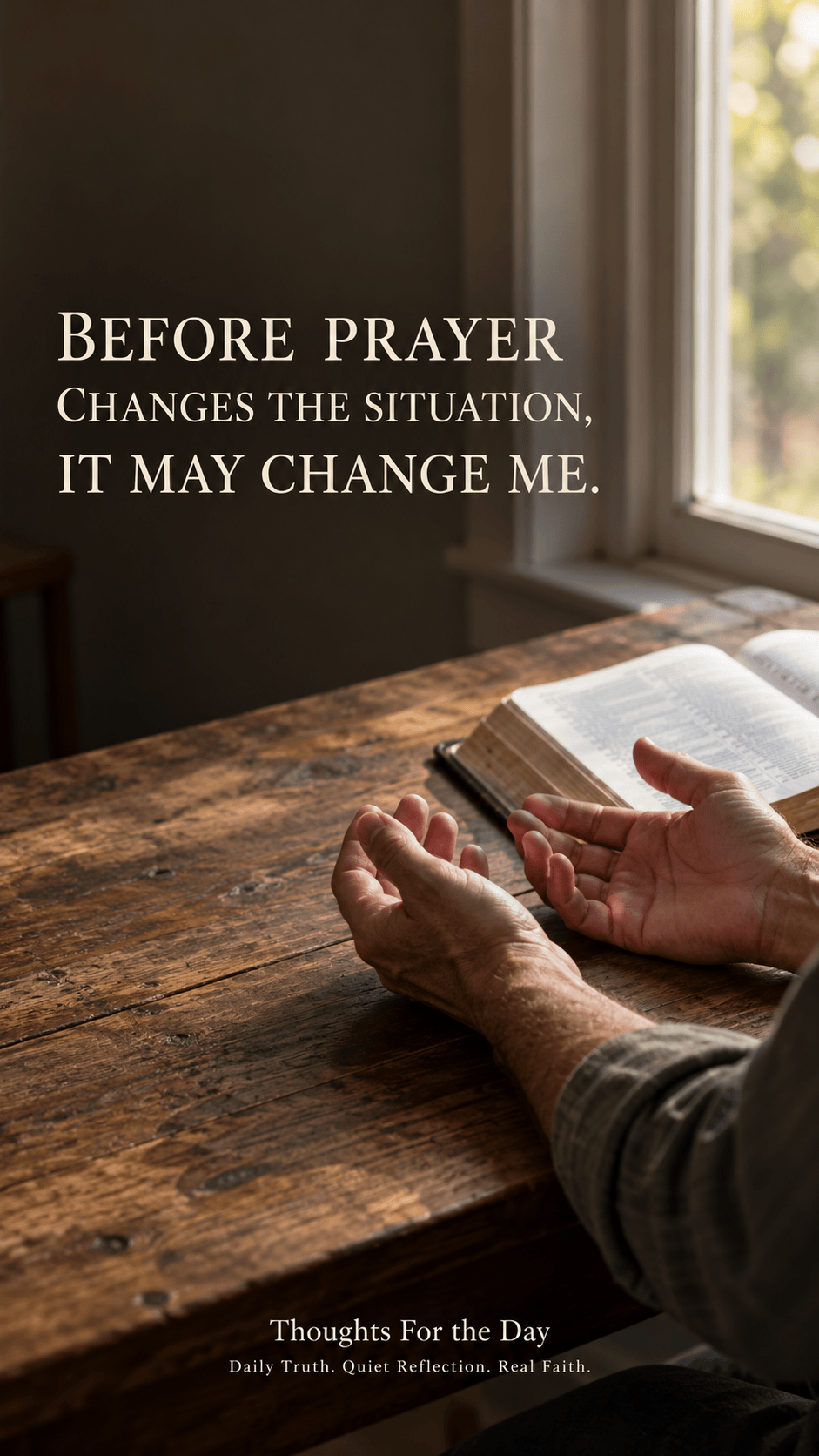
    God can change the circumstances, and we can keep asking Him to do so. As we pray, we can also open our hearts to the work He wants to do within us.

    Lord, if the situation does not change today, continue changing me within it.

  • Still Carrying the Weight

    Still Carrying the Weight

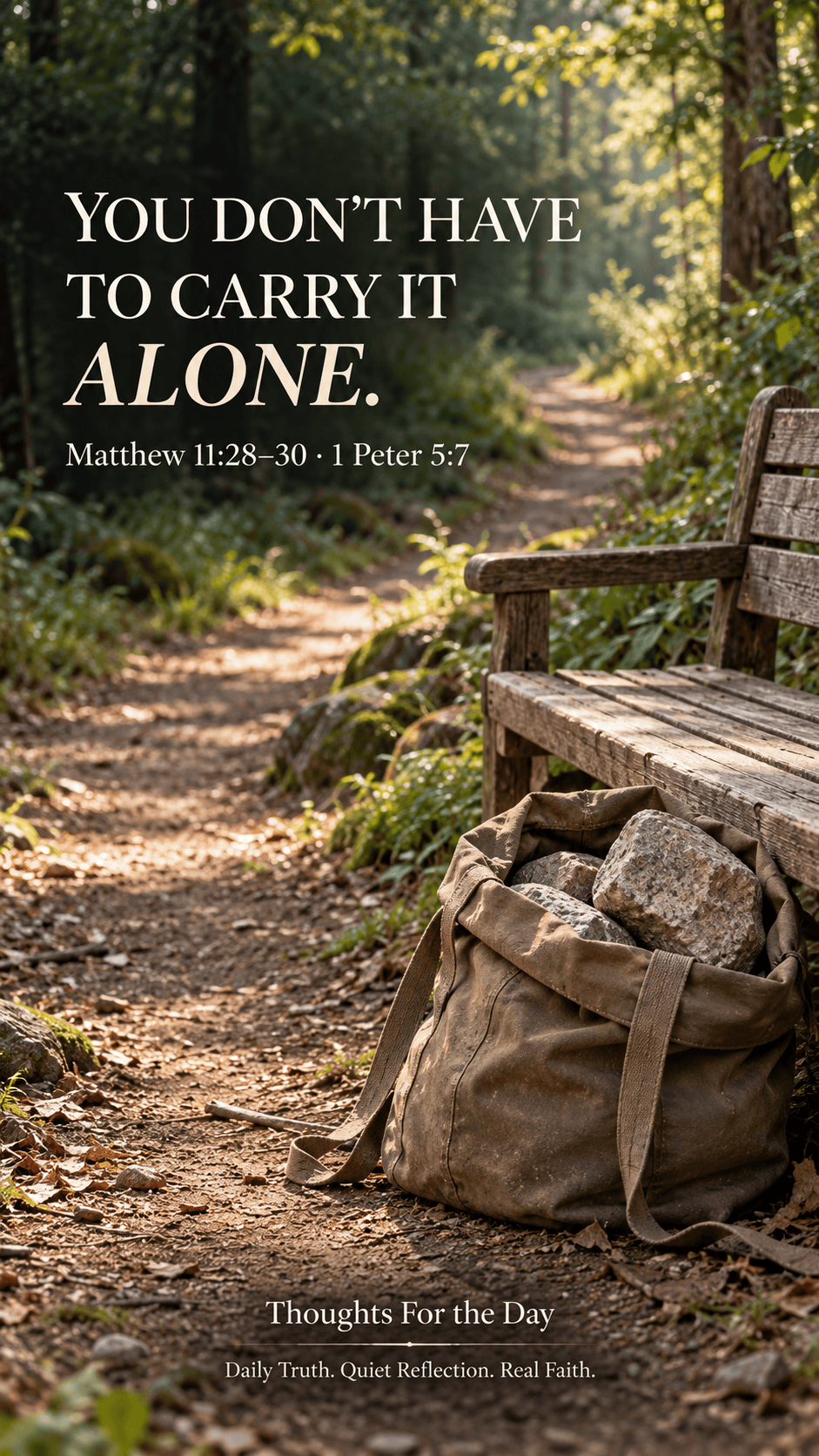
    Have you ever offered to help someone carry something, only to discover they wouldn’t let go?

    You’ve got your hands underneath it. You’re ready to take the weight. But they’re still gripping it, explaining how heavy it is.

    Sometimes, I wonder how often I’ve done that with God.

    I ask Him to help me. I tell Him I’m tired. I pray about the situation, sometimes more than once in the same conversation.

    Then I get up and go right back to carrying it as though I never asked.

    Jesus said:

    “Come to Me, all you who labor and are heavy laden, and I will give you rest.”
    — Matthew 11:28, NKJV

    He knows we’re tired. He knows what we’ve been carrying, including the things we haven’t figured out how to explain to anyone else.

    Some of that weight comes from responsibilities we can’t simply walk away from. There are bills to pay, people to care for, decisions to make, and difficult conversations we’ve put off long enough.

    But somewhere along the way, responsibility can become tangled up with the belief that everything depends upon us.

    If I don’t stay worried, something will go wrong.
    If I don’t keep checking, everything will fall apart.
    If I can just think about it a little longer, maybe I can make certain it ends the way it should.

    We can spend so much energy trying to control the outcome that we have very little left for the next thing we actually need to do.

    There’s a difference between being responsible and believing we have to hold the whole world together.

    God may ask me to make the phone call. He hasn’t given me control over how the other person responds.

    I may need to apologize, tell the truth, or make a necessary change. I can take those steps without being able to guarantee what happens afterward.

    And some of what we carry isn’t about tomorrow at all.

    It’s yesterday.

    The failure we’ve confessed but keep rehearsing. The shame that follows us into every prayer. The fear that our worst moment has permanently settled who we are.

    Yesterday, we considered the truth that sin no longer has the right to rule those who belong to Christ. But sometimes we’re still carrying the shame of serving that old master, even as we’re learning to walk in freedom.

    We can repent, make amends where we can, and accept God’s forgiveness. We don’t have to keep punishing ourselves to prove that we’re sorry.

    Peter wrote:

    “casting all your care upon Him, for He cares for you.”
    — 1 Peter 5:7, NKJV

    That last part matters.

    We’re placing our concerns into the hands of Someone who cares about us.

    And releasing them doesn’t mean pretending they don’t hurt. You can trust God and still cry. You can surrender a situation and still need treatment, counsel, practical help, or the courage to face another difficult day.

    Feeling the weight again doesn’t automatically mean your surrender wasn’t sincere. Sometimes it’s another opportunity to bring that care back to Him.

    In Matthew 11, Jesus connects His invitation to rest with taking His yoke and learning from Him. There’s still a life to live and obedience to practice, but we’re learning to live under His direction.

    We can ask Him what faithfulness requires of us today, do what He gives us to do, and entrust what we can’t control to His care.

    Maybe tonight’s prayer can be simple:

    “Lord, this matters to me. It hurts, and I don’t know how it’s going to turn out. Help me take the next right step and leave the outcome with You.”

    Then, when we notice our hands tightening around it again, we can gently ask ourselves:

    If I have placed it in His hands, why am I still gripping it as though everything depends upon mine?

  • Letting the Kingdoms Fall: A Devotion on True Surrender

    The lyrics of Clay Crosse’s ‘I Surrender All’ reach straight to the heart, don’t they? They pull us into an honest conversation about the things we quietly build in our lives — ambitions, titles, possessions, even the praises of others. The song speaks of “temporary kingdoms on foundations made of sand,” a powerful image that reminds us how easy it is to chase after things that won’t last.

    Jesus had something to say about this. In Matthew 7:24–27 (NKJV), He taught:

    “Therefore whoever hears these sayings of Mine, and does them, I will liken him to a wise man who built his house on the rock… But everyone who hears these sayings of Mine, and does not do them, will be like a foolish man who built his house on the sand.”

    It’s a simple truth, but a hard one to live by. We know the storms of life will come. And yet, too often we invest our energy and identity into structures that can’t withstand the waves. We pour ourselves into careers, reputations, or comfort, only to find they were never meant to carry the weight of our souls.

    Romans 12:1–2 (NKJV) sharpens this even further:

    “I beseech you therefore, brethren, by the mercies of God, that you present your bodies a living sacrifice, holy, acceptable to God, which is your reasonable service. And do not be conformed to this world, but be transformed by the renewing of your mind…”

    This is the heart of surrender — not an emotional moment, but a daily decision.

    A conscious offering of our lives, ambitions, and plans at the altar of God’s purpose.

    The song also draws us to one of the most powerful images of surrender in Scripture: Abraham and Isaac. In Genesis 22, Abraham was prepared to give up his promised son, fully trusting God’s will. It was not a careless decision, but an act of deep obedience and unshakable faith. Abraham believed that even if Isaac were taken, God would still keep His promises.

    What about us? Where are we still holding tight to our “temporary kingdoms”? What are we afraid to lay down before God?

    The truth is, surrender is not loss. It’s gain. When we let go of our fragile empires, we take hold of a kingdom that cannot be shaken. When we trust God with our dreams, He shapes them into something eternal.

    Let this be our prayer today:

    Heavenly Father, open our eyes to see where we’ve built on sand instead of the solid rock of Your truth. Give us the courage to let our kingdoms fall, to surrender all that we have and all that we are to You. Teach us to trust You fully, knowing that Your plans are greater than our own. In Jesus’ name, Amen.

    ‘I Surrender All’, by Clay Crosse