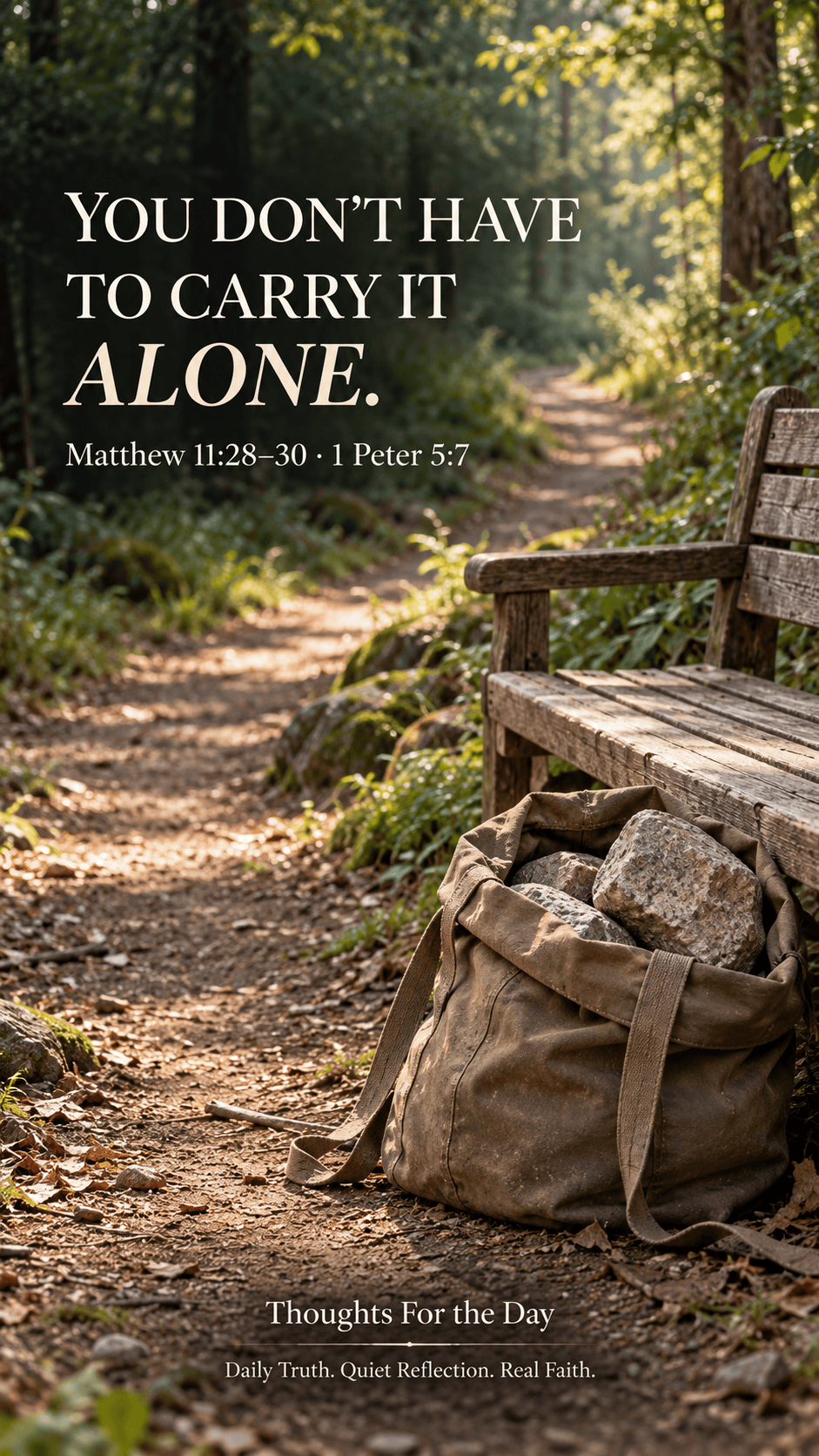
Have you ever offered to help someone carry something, only to discover they wouldn’t let go?
You’ve got your hands underneath it. You’re ready to take the weight. But they’re still gripping it, explaining how heavy it is.
Sometimes, I wonder how often I’ve done that with God.
I ask Him to help me. I tell Him I’m tired. I pray about the situation, sometimes more than once in the same conversation.
Then I get up and go right back to carrying it as though I never asked.
Jesus said:
“Come to Me, all you who labor and are heavy laden, and I will give you rest.”
— Matthew 11:28, NKJV
He knows we’re tired. He knows what we’ve been carrying, including the things we haven’t figured out how to explain to anyone else.
Some of that weight comes from responsibilities we can’t simply walk away from. There are bills to pay, people to care for, decisions to make, and difficult conversations we’ve put off long enough.
But somewhere along the way, responsibility can become tangled up with the belief that everything depends upon us.
If I don’t stay worried, something will go wrong.
If I don’t keep checking, everything will fall apart.
If I can just think about it a little longer, maybe I can make certain it ends the way it should.
We can spend so much energy trying to control the outcome that we have very little left for the next thing we actually need to do.
There’s a difference between being responsible and believing we have to hold the whole world together.
God may ask me to make the phone call. He hasn’t given me control over how the other person responds.
I may need to apologize, tell the truth, or make a necessary change. I can take those steps without being able to guarantee what happens afterward.
And some of what we carry isn’t about tomorrow at all.
It’s yesterday.
The failure we’ve confessed but keep rehearsing. The shame that follows us into every prayer. The fear that our worst moment has permanently settled who we are.
Yesterday, we considered the truth that sin no longer has the right to rule those who belong to Christ. But sometimes we’re still carrying the shame of serving that old master, even as we’re learning to walk in freedom.
We can repent, make amends where we can, and accept God’s forgiveness. We don’t have to keep punishing ourselves to prove that we’re sorry.
Peter wrote:
“casting all your care upon Him, for He cares for you.”
— 1 Peter 5:7, NKJV
That last part matters.
We’re placing our concerns into the hands of Someone who cares about us.
And releasing them doesn’t mean pretending they don’t hurt. You can trust God and still cry. You can surrender a situation and still need treatment, counsel, practical help, or the courage to face another difficult day.
Feeling the weight again doesn’t automatically mean your surrender wasn’t sincere. Sometimes it’s another opportunity to bring that care back to Him.
In Matthew 11, Jesus connects His invitation to rest with taking His yoke and learning from Him. There’s still a life to live and obedience to practice, but we’re learning to live under His direction.
We can ask Him what faithfulness requires of us today, do what He gives us to do, and entrust what we can’t control to His care.
Maybe tonight’s prayer can be simple:
“Lord, this matters to me. It hurts, and I don’t know how it’s going to turn out. Help me take the next right step and leave the outcome with You.”
Then, when we notice our hands tightening around it again, we can gently ask ourselves:
If I have placed it in His hands, why am I still gripping it as though everything depends upon mine?


Leave a Reply