Tag: Surrender

  • The Potters Wheel

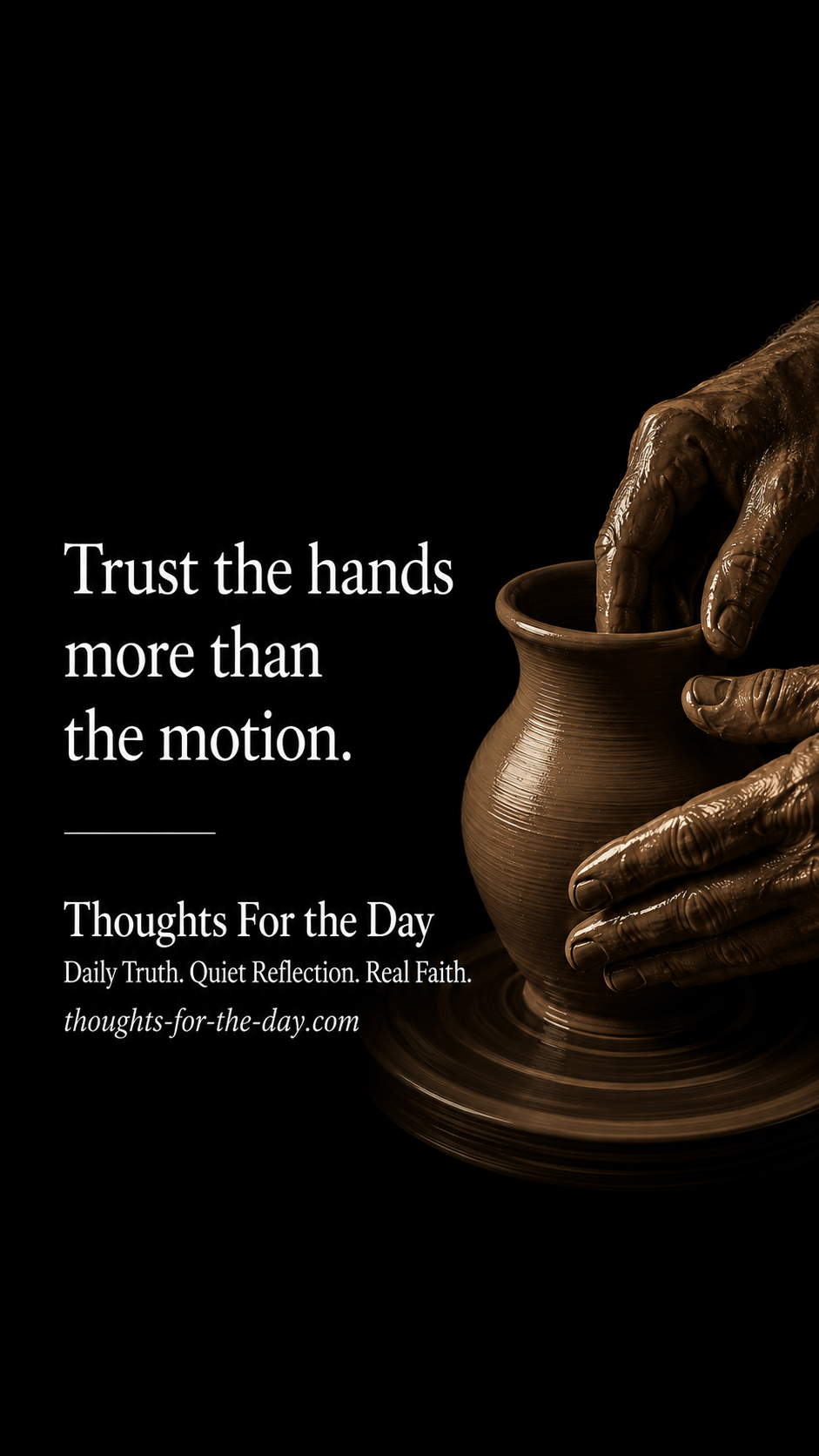
    The Potters Wheel

    Primary Text: Jeremiah 18:1–6

    “Arise, and go down to the potter’s house, and there I will cause thee to hear my words.” — Jeremiah 18:2

    When I was a kid, I had the opportunity to spend time at Philbrook Art Museum in Tulsa participating in art programs that introduced us to Native American crafts and traditions. One of the projects was pottery.

    I wasn’t very good at it.

    My attempts usually looked more like lopsided bowls than useful vessels.

    But while my own efforts left much to be desired, I never forgot watching an experienced potter at work.

    Years later, when I read Jeremiah 18, those memories came rushing back.

    God didn’t send Jeremiah to a palace or a battlefield to teach him one of Scripture’s greatest lessons. He sent him to a workshop.

    “Go to the potter’s house.”

    The lesson wouldn’t come through a sermon.

    It would come through observation.

    Sometimes God teaches us the same way.

    Instead of immediately answering our questions, He simply says, “Watch.”

    Watch how I work.

    Watch what I do.

    Watch the Potter.

    The first thing I remember about the process was how important it was to center the clay.

    Nothing else happened until that was right.

    If the clay wasn’t perfectly centered on the wheel, everything that followed would be uneven. The faster the wheel turned, the more obvious the wobble became. No amount of skill could compensate for clay that wasn’t centered.

    Life works much the same way.

    When life speeds up, whatever sits at the center of our hearts is revealed.

    Responsibilities increase.

    Schedules become full.

    Unexpected trials appear.

    Pressure mounts.

    Those seasons don’t usually create our instability. They expose it.

    Before God shapes our lives, He centers our hearts.

    Jesus said, “Seek first the kingdom of God.”

    The writer of Hebrews tells us to keep our eyes fixed on Jesus.

    Only when Christ occupies the center can everything else begin taking its proper place.

    Then came the pressure.

    Watching the potter’s hands was fascinating.

    To someone unfamiliar with pottery, the process almost looks harsh.

    The hands press firmly.

    They squeeze.

    They pull.

    They stretch.

    Yet every movement has purpose.

    Nothing is random.

    One hand supports the outside while the other shapes from within.

    Remove either hand, and the vessel collapses.

    How often is that exactly how God works in our lives?

    We notice the pressures around us—the disappointments, the delays, the hardships, the uncertainties.

    What we often fail to recognize is the quieter work taking place within us.

    While circumstances shape our character externally, the Holy Spirit is transforming our hearts internally.

    God is working from both sides at once.

    The pressure isn’t punishment.

    It’s preparation.

    I also remember the water.

    Clay without water quickly becomes stiff and brittle.

    Push too hard, and it cracks.

    Add too much water, and it loses its strength altogether.

    The potter constantly adds just enough to keep the clay workable.

    What a beautiful picture of God’s grace.

    He knows exactly when our hearts need softening.

    He comforts us without making us complacent.

    He strengthens us without making us hard.

    His grace is never excessive.

    It is always sufficient.

    Perhaps the greatest lesson, however, is this:

    The clay never shaped itself.

    Its responsibility was not to decide what kind of vessel it wanted to become.

    Its responsibility was simply to remain in the potter’s hands.

    That runs completely contrary to our culture.

    We want control.

    We want to choose the timing.

    We want to determine the outcome.

    We even try to tell God what our lives should become.

    But clay has never instructed the potter.

    It simply yields.

    Jeremiah watched as something unexpected happened.

    The vessel became marred in the potter’s hand.

    The clay resisted.

    The shape was spoiled.

    Yet the potter didn’t throw it away.

    He didn’t become frustrated.

    He didn’t walk away from the wheel.

    Scripture says, “So he made it again another vessel, as seemed good to the potter to make it.”

    Those words have always moved me.

    He made it again.

    Not repaired.

    Not patched.

    Remade.

    That is the story of redemption.

    Every one of us has been marred by sin.

    Every one of us has failed to become what we were created to be.

    Yet our failures do not surprise the Potter.

    He is able to begin again.

    He reshapes what has been broken.

    He restores what has been damaged.

    He creates something beautiful where we expected only disappointment.

    Sometimes people say they feel like life is going in circles.

    Perhaps you’ve felt that way.

    The same struggles.

    The same prayers.

    The same waiting.

    The same unanswered questions.

    May I offer another perspective?

    Perhaps you’re not going in circles.

    Perhaps you’re still on the wheel.

    The wheel keeps turning because the vessel isn’t finished.

    Every rotation places another part of our lives beneath the Potter’s hands.

    Every season brings another opportunity for Him to remove what doesn’t belong and strengthen what does.

    The clay never sees what the Potter sees.

    The clay feels the pressure.

    The Potter sees the finished vessel.

    The clay experiences the spinning.

    The Potter sees the purpose.

    The clay only knows today.

    The Potter already sees what tomorrow will require.

    That is why faith is ultimately trust.

    Not trust in the wheel.

    Not trust in the process.

    Trust in the One whose hands never leave the clay.

    If your life feels uncertain today…

    if the pressure seems greater than you expected…

    if the wheel seems to keep turning without end…

    don’t mistake movement for abandonment.

    The Potter is still at work.

    And the fact that His hands are still shaping you is evidence that He is not finished yet.

  • When Was the Last Time Discipleship Cost You Something?

    “…To be a disciple of Jesus is going to cost you something…”

    That quote hit me square between the eyes. Because when I held it up to my own life, I had to admit something uncomfortable: I don’t know that I’ve ever truly lived that kind of discipleship. Not consistently. Not fully.

    Jesus didn’t mince words. The call to follow Him was direct, costly, and repeated.

    Matthew 16:24. Mark 8:34. Mark 10:21. Luke 9:23

    That phrase—“take up your cross and follow Me”—isn’t some poetic metaphor for mild inconvenience. It was a death sentence. A surrender of will. And the fact that all three Synoptic Gospels include it—Mark more than once—tells us just how central it is to the Christian life.

    Discipleship isn’t a suggestion. It’s a command.

    And we’ve spent far too much time reshaping that command into something manageable.

    Comfortable.

    Instagrammable.

    We’ve turned “take up your cross” into a cozy quote rather than a call to daily death to self.

    Let’s be brutally honest: when was the last time following Jesus actually cost you something?

    Not just time.

    Not just a tithe.

    But real, personal sacrifice.

    Something that forced you to change your plans, stretch your faith, or confront your pride?

    We love the verses about being blessed. We highlight the promises of peace and provision. But we skip over the ones about obedience, sacrifice, and suffering. We love the idea of being “called,” but wrestle when that calling demands discomfort.

    That’s not legalism. That’s lordship.

    And Jesus made it crystal clear:

    “If anyone desires to come after Me, let him deny himself, and take up his cross daily, and follow Me.” (Luke 9:23)

    He didn’t say, “Take up your dreams.”

    He said, “Take up your cross.”

    That cross is not a religious accessory.

    It’s a declaration of surrender. It means laying down your rights.

    It means serving people you don’t like, giving when it hurts, forgiving when it’s undeserved, and going where you’d rather not go.

    Jesus said in Matthew 25:35–40 that whatever we do for “the least of these,” we do for Him. That means giving a sandwich to the hungry, a drink to the thirsty, a warm welcome to the outcast, and our time to those who can’t repay it.

    Discipleship means getting out of our comfort zones.

    Rolling up our sleeves.

    Doing the hard, often thankless work of loving people well in Jesus’ name.

    It’s not flashy. It’s not always fun. But it’s faithful.

    So here’s the challenge:

    What has your faith cost you lately?

    What have you surrendered—not just out of guilt, but out of obedience?

    May we be found faithful—not just in belief, but in obedience.

    Not just in words, but in sacrifice.

    Not just on Sunday—but every single day.

  • Lord, Use Me — Even in the Humble Things

    “Jesus, use me. O Lord, don’t refuse me. Surely there’s a work that I can do. Even though it’s humble, Lord help my will to crumble. For though the cost be great, I’ll work for you.”

    These lyrics from a song my mother used to hum while folding laundry or picking tomatoes have echoed in my heart lately. Back then, I thought it was just a sweet old tune. Now I know better. It’s a prayer of surrender. A plea for purpose. A cry of commitment.

    We often associate “working for God” with grand gestures—preaching, missions, miracles. But more often, the work is humble.

    It’s obedience when no one sees.

    Faithfulness in the mundane.

    Forgiveness when it hurts.

    Jesus said,

    “He who is faithful in what is least is faithful also in much.” (Luke 16:10, NKJV)

    And again,

    “Take up your cross daily, and follow Me.” (Luke 9:23, NKJV)

    The cross doesn’t always look like suffering on a public stage. Sometimes it looks like dying to your pride in a private moment.

    Think of William Tyndale—burned at the stake for translating the Bible. His work was humble, slow, unseen for years. Yet because of him, we hold the Word of God in our hands today.

    Today, ask yourself:

    What work has God called you to that you’ve been resisting because it’s “too small”?

    Have you asked God to use you but ignored His invitations to humble service?

    Is your will still on the throne, or have you let it crumble at the foot of the cross?

    There is a work you can do. But you’ll never do it if you wait for applause, comfort, or control.

    Today, make the same choice that old song proclaims:

    Even though it’s humble, Lord, I’ll work for You.

  • The Bargain and the Broken Box

    On Holy Wednesday, two people made two very different decisions—one sold the Savior, and the other poured everything out at His feet.

    It began with a cold exchange. Judas Iscariot went to the chief priests—not the other way around.

    “What are you willing to give me if I deliver Him to you?” (Matthew 26:15).

    There’s no emotion in the text.

    Just calculation.

    He didn’t plead or wrestle.

    He named the price of betrayal and took the deal.

    Thirty pieces of silver.

    The cost of a slave.

    That’s what they believed Jesus was worth.

    That’s what Judas accepted.

    We can almost picture the smirk on Caiaphas’ face, the scribes nodding in approval, the money counted out and dropped into Judas’ hand with a metallic clink.

    Done deal.

    The Son of God sold for pocket change.

    No prayer.

    No hesitation.

    Just a transaction.

    A soul for sale.

    But while Judas was closing his bargain, a broken woman was stepping into a Pharisee’s house to pour out her heart.

    The setting couldn’t have been more different. Jesus was dining at the home of Simon the Pharisee when a woman walked in carrying an alabaster flask of fragrant oil. Luke 7 describes her only as “a sinner.” Her name isn’t mentioned here, but many believe this was Mary Magdalene—a woman who knew what it meant to be shunned, whispered about, and cast aside.

    She didn’t ask to speak.

    She didn’t make a scene.

    She just knelt behind Jesus and wept.

    Tears poured from her soul before any oil left the jar.

    She wiped His feet with her hair.

    She kissed them.

    Then she broke open the alabaster box and anointed Him with perfume that would’ve cost nearly a year’s wages.

    CeCe Winans captures the moment in the song “Alabaster Box”:

    “I can’t forget the way life used to be, I was a prisoner to the sin that had me bound…But I’ve come to pour My praise on Him like oil, From my alabaster box.”

    While Simon judged her silently, Jesus told a parable: two debtors, one owing much and the other little. Both were forgiven. “Tell Me, therefore, which of them will love him more?” (Luke 7:42). Simon answered, “I suppose the one whom he forgave more.”

    And Jesus said, “You have rightly judged.” Then turning to the woman, He said, “Her sins, which are many, are forgiven, for she loved much. But to whom little is forgiven, the same loves little.” (v. 47)

    Both Judas and Mary encountered Jesus face to face.

    Both had the chance to respond to who He truly was.

    One chose betrayal.

    One chose brokenness.

    One calculated what Jesus was worth.

    The other couldn’t put a price on what He had done for her.

    And today, we stand in that same tension.

    Will we grow so familiar with Jesus that we start measuring His worth in silver? Or will we fall at His feet in worship, tears, and surrender?

    Holy Wednesday reminds us: It’s not how far you’ve fallen—it’s how deeply you realize you’ve been forgiven.

    Let’s not hold back. Let’s break the box.

    Prayer: Lord, don’t let my love grow cold. Break through my pride and self-reliance. Remind me of the mercy that found me. Teach me to pour out my worship freely and to never withhold what You deserve. In Jesus’ name, amen.

  • Palm Sunday: The King Comes in Humility and Victory

    Palm Sunday launches us into the sacred rhythm of Holy Week. It’s a day filled with anticipation and paradox — celebration that hints at sacrifice, triumph that leads to the cross.

    The scene is alive with movement and meaning. Jesus, fully aware of what awaits Him in Jerusalem, chooses to enter not as a conquering warrior but as a humble King.

    “So they brought the colt to Jesus and threw their clothes on it, and He sat on it. And many spread their clothes on the road, and others cut down leafy branches from the trees and spread them on the road. Then those who went before and those who followed cried out, saying: ‘Hosanna! “Blessed is He who comes in the name of the LORD!”‘” (Mark 11:7–9, NKJV)

    The colt, the cloaks, the palm branches — all signs of honor. The crowd erupts in praise, quoting Psalm 118, recognizing Jesus as the One sent from God. But their understanding is incomplete. They hoped for immediate deliverance from Roman rule. Jesus came instead to deliver their souls from eternal bondage.

    In fact many of those crying, “Hosanna!” on Sunday, would be shouting, “Crucify Him!” just a few days later.

    It’s a tension we still feel today. We cry out “Hosanna!” in our struggles, praying for immediate relief, quick fixes, visible victories. Yet Jesus, in His wisdom, rides at His own pace and purpose. He doesn’t always give us the triumph we expect — He gives us the salvation we desperately need.

    This Palm Sunday, as we look at the waving branches and hear the echoes of ancient praise, we must ask ourselves: Are we welcoming Jesus for who He is, or for who we want Him to be?

    The invitation of Palm Sunday is to surrender not just our praises, but our expectations. To lay down not just palm branches, but our very lives. To trust that His path, though it leads to the cross, will also lead to resurrection.

    Reflection: What expectations do you need to lay at the feet of Jesus today?

  • Letting the Kingdoms Fall: A Devotion on True Surrender

    The lyrics of Clay Crosse’s ‘I Surrender All’ reach straight to the heart, don’t they? They pull us into an honest conversation about the things we quietly build in our lives — ambitions, titles, possessions, even the praises of others. The song speaks of “temporary kingdoms on foundations made of sand,” a powerful image that reminds us how easy it is to chase after things that won’t last.

    Jesus had something to say about this. In Matthew 7:24–27 (NKJV), He taught:

    “Therefore whoever hears these sayings of Mine, and does them, I will liken him to a wise man who built his house on the rock… But everyone who hears these sayings of Mine, and does not do them, will be like a foolish man who built his house on the sand.”

    It’s a simple truth, but a hard one to live by. We know the storms of life will come. And yet, too often we invest our energy and identity into structures that can’t withstand the waves. We pour ourselves into careers, reputations, or comfort, only to find they were never meant to carry the weight of our souls.

    Romans 12:1–2 (NKJV) sharpens this even further:

    “I beseech you therefore, brethren, by the mercies of God, that you present your bodies a living sacrifice, holy, acceptable to God, which is your reasonable service. And do not be conformed to this world, but be transformed by the renewing of your mind…”

    This is the heart of surrender — not an emotional moment, but a daily decision.

    A conscious offering of our lives, ambitions, and plans at the altar of God’s purpose.

    The song also draws us to one of the most powerful images of surrender in Scripture: Abraham and Isaac. In Genesis 22, Abraham was prepared to give up his promised son, fully trusting God’s will. It was not a careless decision, but an act of deep obedience and unshakable faith. Abraham believed that even if Isaac were taken, God would still keep His promises.

    What about us? Where are we still holding tight to our “temporary kingdoms”? What are we afraid to lay down before God?

    The truth is, surrender is not loss. It’s gain. When we let go of our fragile empires, we take hold of a kingdom that cannot be shaken. When we trust God with our dreams, He shapes them into something eternal.

    Let this be our prayer today:

    Heavenly Father, open our eyes to see where we’ve built on sand instead of the solid rock of Your truth. Give us the courage to let our kingdoms fall, to surrender all that we have and all that we are to You. Teach us to trust You fully, knowing that Your plans are greater than our own. In Jesus’ name, Amen.

    ‘I Surrender All’, by Clay Crosse

  • When Trust Has No Borders: Following God Into Deeper Waters

    Yesterday morning, I found myself meditating on the powerful invitation found in the song “Oceans” by Hillsong: “Spirit lead me where my trust is without borders…”

    Such words challenge us, not to cling to safe ground, but to step bravely into the unknown, confident that God’s hand will guide us every step of the way. This reflective practice has led me to ponder what real, unreserved trust in God looks like in the midst of our daily lives.

    Consider the story of Peter, who stepped out of the boat to walk on water (Matthew 14:29 NKJV). Peter’s journey wasn’t one of immediate or unerring faith; it was marked by moments of courage amid fear, breakthrough amidst stumbling. In much the same way, our lives are a series of small, courageous acts—moments when we allow ourselves to be led by the Spirit even when the path is obscured by uncertainty. The call to “walk upon the waters” is a vivid metaphor for stepping out of our comfort zones and into an arena where God’s power is made perfect in our weakness.

    Proverbs 3:5–6 (NKJV) reminds us, “Trust in the LORD with all your heart, And lean not on your own understanding…” This is not simply an instruction for idealistic times, but a daily reminder for when our feet falter and our hearts quaver. The reality of living out such a trust is not without struggles. There are days when the shadows of doubt linger, when our human instincts compel us to retreat to safety. Yet, it is precisely in those moments that faith is refined and our spirits are strengthened.

    Reflecting on my own journey, I see that trusting God fully involves acknowledging the real challenges we face—financial struggles, relational tensions, personal failings—and choosing to rely on the assurances of God’s word despite these difficulties. It means letting the Holy Spirit lead us into spaces where vulnerability meets divine strength.

    This kind of trust is countercultural; it asks us to believe in a promise that goes beyond what is visible and tangible. It’s an invitation to surrender, and in that surrender, discover a deeper intimacy with our Savior.

    Today, I invite you to reflect on what “trust without borders” means in your personal walk.

    Where has God called you out of your comfort zone?

    What waters are you willing to step into, trusting that His presence will make you steady?

    Share your thoughts and struggles in the comments below, and let’s build each other up as we journey toward a more authentic, fearless faith. May every step you take, no matter how uncertain, lead you closer to the heart of our Lord.

  • Only Jesus

    Legacy.

    Influence.

    Recognition.

    The world tells us these are the markers of success, the things that define a life well-lived. But what if we’re chasing the wrong thing?

    The Bible reminds us of the fleeting nature of life. “For what is your life? It is even a vapor that appears for a little time and then vanishes away” (James 4:14, NKJV). If life is so short, shouldn’t we spend it on what truly matters?

    Jesus posed the ultimate question: “For what profit is it to a man if he gains the whole world, and loses his own soul?” (Matthew 16:26). You could have wealth, power, and influence, but without Christ, it’s meaningless. And if that’s true, then shouldn’t our focus be on making His name great instead of our own?

    Paul grasped this truth when he declared, “For to me, to live is Christ, and to die is gain” (Philippians 1:21). His life wasn’t about accolades or reputation—it was about Jesus. Every breath, every step, every moment was lived for the glory of God.

    This should be our mindset. Our jobs aren’t just careers—they’re opportunities to reflect Christ. Our families, friendships, and even chance encounters are moments to point others to Him. When we stop trying to build our own legacy and start living to make Jesus known, we step into the real purpose we were created for.

    At the end of my life, I don’t care if people remember my name. I just want them to have known Jesus because of the way I lived. So today, I surrender my ambitions, my plans, my legacy. My life belongs to Him.

    Only Jesus.

  • The Hound of Heaven vs. The Hounds of Hell

    I first heard a sermon over 45 years ago titled “The Hounds of Hell.” Bro. Bass, a hunter, described how his trained dogs would track their prey relentlessly—up mountains, through valleys, across rivers—never stopping until their target was cornered, exhausted, and alone. He compared it to how Satan and his demons track us, waiting for us to stumble.

    1 Peter 5:8 (NKJV) warns us: “Be sober, be vigilant; because your adversary the devil walks about like a roaring lion, seeking whom he may devour.” The enemy is relentless. He will chase us through every twist and turn, pressing in until we feel trapped with no escape.

    But yesterday morning, I was reminded of a different pursuit—one not of destruction, but of love.

    I pulled a book from my shelf titled A Gentle Thunder and saw the title of chapter two: “The Hound of Heaven: The God Who Pursues.”

    Francis Thompson’s poem describes God as “that tremendous Lover, pursuing me with His love.” Unlike the enemy, who seeks to destroy, Jesus pursues with grace, patience, and mercy.

    Revelation 3:20 (NKJV) says, “Behold, I stand at the door and knock. If anyone hears My voice and opens the door, I will come in to him and dine with him, and he with Me.”

    Satan’s hounds chase to wear you down.
    But Jesus stands at the door, waiting for you to open it.

    He doesn’t force His way in. He doesn’t demand entry. He simply knocks.

    Maybe today, you feel exhausted—like you’re running from something you can’t escape. The enemy has been on your trail, whispering lies, making you feel trapped.

    But hear this: Jesus is pursuing you, too. Not with pressure, but with love. Not with force, but with grace.

    He stands at the door.
    He knocks.
    He waits.

    The question is—will you let Him in?

  • The Tightrope of Life

    Thoughts for the day…….

    The Tightrope of Life

    I been keepin’ Jesus at a distance
    So afraid to let Him get too close
    To the two lives I’ve been livin’
    As if He couldn’t see them both
    Close enough to feel the warmth of the fire
    Far enough away for me to hide
    But I’m tired of walkin’ the wire
    Between the darkness and the light

    “I know your works, that you are neither cold nor hot. I would wish you were cold or hot.” Revelation 3:15 (NKJV)

    You ever feel like you’re living two lives? I know I have. It’s a strange and weary thing, keeping Jesus at arm’s length while trying to maintain this illusion of control. It’s safer that way, isn’t it? We feel the warmth of His fire, but we’re terrified to let it consume us fully. We desire what He offers, yet cling to the shadows of who we think we should be, balancing precariously between light and dark.

    As a teenager, I was at church in McAlester when Bro. Heard took the pulpit to preach. How he introduced his message is something I will never forget. “I know you’ve heard it preached before, ‘How Close Can I Live to the World and Still be Saved?’, but tonight I’m approaching that topic from a different angle; ‘How Close Can I Live to God and Still be Lost?’” Those words struck a chord within me, highlighting the danger of superficial faith—the feigned closeness to God while still holding onto the remnants of the world.

    The truth is, straddling that fence isn’t just uncomfortable—it’s dangerous. We think we can manage it, that we can keep one foot in the world and the other in faith, all while sitting pretty on that top rail. But that’s an illusion. That fence doesn’t belong to us; it’s a part of Satan’s domain, a subtle trap that whispers lies of compromise. And if we aren’t careful, we can be led down a path we never intended to walk.

    Jesus doesn’t want us teetering between two opposing forces. He invites us to surrender, to lay down the struggle, and to embrace the truth of who He is. In Matthew 16:24, He tells us, “If anyone desires to come after Me, let him deny himself, and take up his cross, and follow Me.” He’s asking for more than just a half-hearted commitment; He desires our whole hearts, our full surrender.

    Here’s the kicker: we can’t walk the line indefinitely without consequences. This balancing act creates inner turmoil, leaving us exhausted and seeking clarity. We hold on to our stubbornness, thinking we can do it our way, but in reality, we are prolonging our own pain. It’s time we stop bargaining with God, thinking we can negotiate our faith on our own terms.

    Let’s be honest: can we really thrive on that tightrope? God’s invitation is clear—step off that fence and draw nearer to Him. In the safety of His embrace, we’ll find rest, purpose, and the courage to follow the path He has laid out for us. No more hiding. No more walking the wire. Only the freedom that comes from surrendering to the One who knows us best, the One who wants us to flourish in His light. Are you ready to take that step?