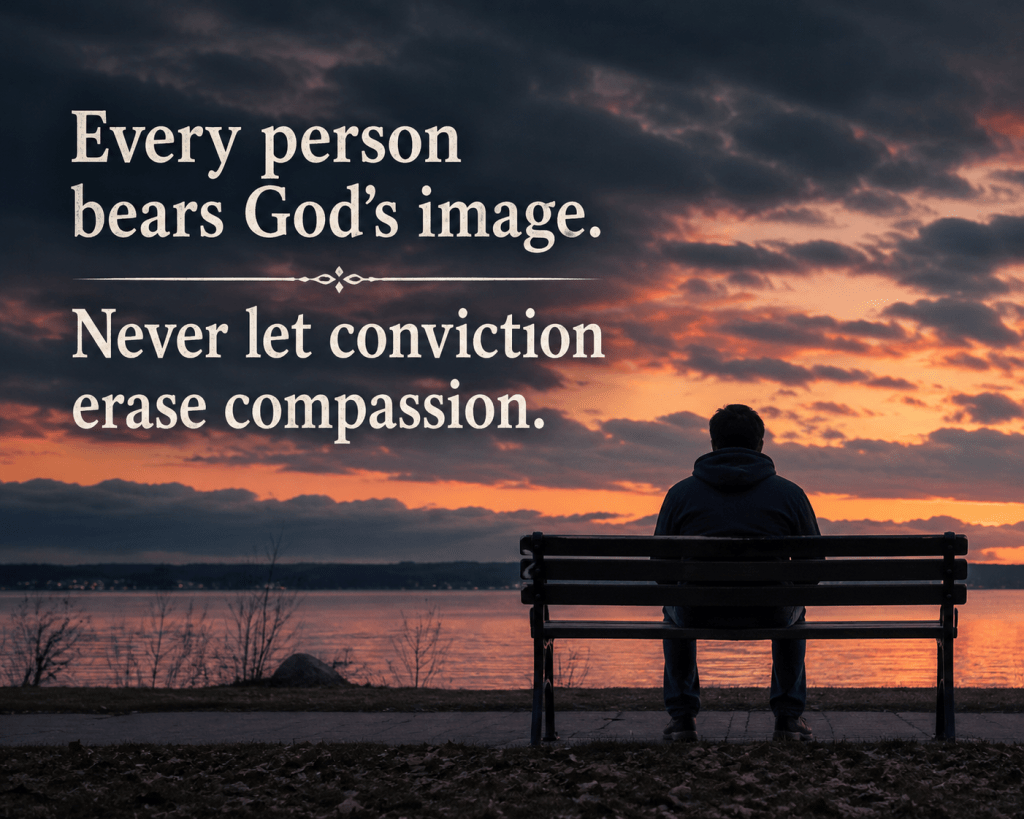
One of the saddest realities of our culture is that we have become convinced we must choose between truth and compassion.
We’re told that if we stand for biblical truth, we cannot truly love people.
Or, if we genuinely love people, we must eventually surrender biblical truth.
Jesus accepted neither option.
He never compromised truth.
He never withheld compassion.
And somehow, two thousand years later, many of us have managed to separate what He perfectly united.
Before we go any further, let me be equally clear about where I stand. I believe God’s design for marriage and sexuality is revealed in Scripture, and I do not have the authority to redefine what God has already spoken. At the same time, I believe every person—regardless of their beliefs, identity, choices, or lifestyle—is created in the image of God and is therefore worthy of dignity, compassion, and respect. These convictions are not in conflict. In fact, they belong together.
⸻
I recently came across a simple quote that has lingered in my mind:
“When you hold a belief so tightly you cannot see another’s humanity, it will eventually obscure your own.”
Whether the author intended it or not, I immediately thought of Jesus.
Not because He abandoned truth…
But because He never allowed truth to become an excuse for forgetting the value of the person standing in front of Him.
Think about His ministry.
The woman caught in adultery.
The Samaritan woman at the well.
Matthew, the tax collector.
Zacchaeus.
The lepers everyone else avoided.
The demoniac living among the tombs.
People whom society had already categorized, condemned, dismissed, or avoided.
Jesus never ignored their sin.
But neither did He ignore their humanity.
He saw people before He addressed their problems.
⸻
Genesis tells us something remarkable.
Every human being is created in the image of God.
Not just Christians.
Not just people who agree with us.
Not just those living according to Scripture.
Every person.
Sin has marred that image, but it has not erased it.
That truth should forever change the way followers of Christ see people.
The person addicted to drugs.
The man sitting in prison.
The woman who has had multiple abortions.
The atheist.
The Muslim.
The political activist.
The LGBTQ+ individual.
The person who hurt you.
The family member who rejected your values.
The coworker who mocks your faith.
Every one of them still bears the imprint of the Creator.
If God saw enough value in them to create them…
And enough value in them to send His Son to die for them…
Who am I to pretend they are beneath my compassion?
⸻
James writes something that should stop every Christian in their tracks.
With our mouths we bless God…
And with those same mouths we curse people who have been made in the likeness of God.
James says these things should not be.
Think about that.
When I insult, mock, dehumanize, or rejoice in another person’s humiliation, I am doing so against someone who still carries the fingerprints of God.
That doesn’t excuse sin.
It simply reminds me that sinners are still people.
Sometimes I wonder if we’ve become so busy defending biblical positions that we’ve forgotten why God gave us those truths in the first place.
The purpose of truth is not to win arguments.
The purpose of truth is to lead people to Christ.
⸻
Jesus never confused acceptance with approval.
He welcomed people without affirming everything they did.
He loved them enough to meet them where they were.
He also loved them too much to leave them there.
To the woman caught in adultery He extended mercy…
Then He called her to leave her sin.
Those are not contradictory actions.
They are the very definition of biblical love.
Love without truth leaves people lost.
Truth without love leaves people hopeless.
The Gospel has always been both.
⸻
During the past month, as conversations surrounding Pride once again filled social media, I noticed something that deeply grieved me.
Not the disagreements.
Disagreement is inevitable.
Christians and our culture have very different understandings of sexuality, marriage, and identity.
Those conversations matter.
But what disturbed me wasn’t disagreement.
It was the hatred.
The mocking.
The cruel jokes.
The celebration of another person’s pain.
The comments that seemed to delight in making someone feel less than human.
I couldn’t help but wonder…
When did we decide that cruelty became a fruit of the Spirit?
There is nothing Christlike about humiliating someone.
There is nothing holy about ridicule.
There is nothing righteous about treating another image-bearer of God as though they have no value.
If we believe someone is living apart from God’s design, shouldn’t that move us toward compassion instead of contempt?
After all…
That’s exactly how Jesus treated us.
⸻
The Apostle Paul wrote words that every believer should remember:
“Such were some of you.”
Those words level the ground beneath the cross.
Every Christian has a past.
Every Christian has needed grace.
Every Christian has stood in desperate need of mercy.
The only difference between us and anyone still trapped in sin is not our goodness.
It’s God’s grace.
That realization should produce humility instead of arrogance.
Compassion instead of contempt.
Tears instead of insults.
⸻
Perhaps the greatest danger isn’t abandoning biblical convictions.
It’s allowing those convictions to harden our hearts.
The Pharisees knew Scripture better than almost anyone.
Yet they looked into the eyes of the Son of God and could not recognize Him because their hearts had become so consumed with being right that they no longer loved the people they were supposed to shepherd.
Knowledge had replaced mercy.
Religion had replaced relationship.
Truth had lost compassion.
May that never be true of us.
⸻
As followers of Christ, we should never apologize for what Scripture teaches.
But neither should we apologize for loving the people Christ died to save.
Those are not opposing commitments.
They are inseparable.
If my convictions cause me to look down on people…
Something is wrong with my heart.
If my theology allows me to despise those Christ willingly died for…
Something is wrong with my theology.
Because every person I meet is someone Jesus considered worth stretching out His hands for.
And if He could love them enough to die for them…
Surely I can love them enough to treat them with dignity.
Final Word
The world often tells us we must choose between conviction and compassion.
Jesus chose neither.
He embodied both.
He never compromised truth.
He never forgot a person’s worth.
As His followers, neither should we.
Because biblical conviction should never make us less compassionate.
It should remind us just how much compassion God first showed us.