Those of you who have followed me for any length of time know that I rarely—almost never—use this space to address doctrinal controversies.
I’d much rather point people toward Christ than spend my time arguing about the things Christians disagree over.
But every once in a while, something happens.
A conversation.
A social media post.
A sermon that doesn’t quite sit right in my spirit.
And something begins to burn.
Not because I want an argument. Not because I believe everyone has to agree with me. And certainly not because I have everything figured out.
But because sometimes something needs to be said.
This is one of those times.
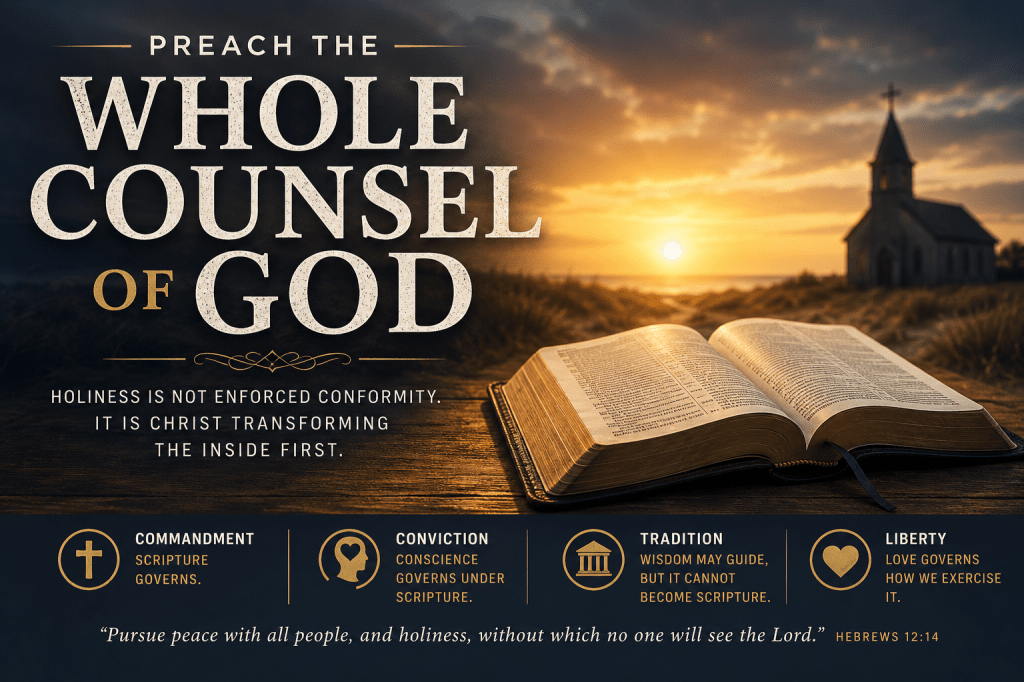
I recently encountered a meme criticizing churches that do not enforce certain “holiness standards.” It accused them of cherry-picking the Bible, called their worship “strange fire,” compared them to the Laodicean church, and ended with an admonition:
“Repent. Return to holiness. Preach the whole counsel of God.”
On that last point, I couldn’t agree more.
So let’s do exactly that.
I believe in holiness.
I believe Scripture when it says, “Pursue peace with all people, and holiness, without which no one will see the Lord” (Hebrews 12:14 NKJV).
Biblical holiness is a life set apart unto God—belonging wholly to Him and increasingly reflecting His character in the way we think, speak, behave, and live. It begins with what God does within us and produces visible change in how we live before Him and before others. Holiness is therefore neither merely inward nor merely outward; genuine holiness transforms the whole person.
I believe Christians are called to be different from the world. I believe our relationship with Christ should affect our conduct, our speech, our relationships, our entertainment, our priorities, our appearance, and ultimately every area of our lives.
This is not an argument against holiness.
It is an argument that holiness and enforced conformity are not the same thing.
A church can enforce a dress code.
A church can establish grooming requirements.
A church can make rules concerning jewelry, makeup, clothing, entertainment, or any number of other things.
Those rules may even have been established with sincere intentions and based upon someone’s earnest application of biblical principles.
But rules can only produce compliance.
They cannot produce holiness.
A person can look exactly right on Sunday morning while being filled with bitterness, pride, lust, dishonesty, hatred, unforgiveness, or self-righteousness.
Jesus addressed precisely that danger when He confronted the Pharisees:
“First cleanse the inside of the cup and dish, that the outside of them may be clean also.”
— Matthew 23:26 NKJV
Notice the order.
Inside first. Then outside.
Jesus wasn’t teaching that the outside doesn’t matter. He was teaching us where genuine transformation begins.
And that distinction matters.
Commandment, Conviction, and Tradition
I believe much of the confusion surrounding holiness disappears when we recognize three different categories that Christians sometimes unintentionally combine.
First, there are biblical commands.
Where Scripture clearly speaks, we obey.
Adultery isn’t a personal-conviction issue. Neither are dishonesty, drunkenness, hatred, sexual immorality, or the many other things Scripture plainly addresses.
We don’t get to dismiss God’s commandments by saying, “I don’t personally feel convicted about that.”
God has already spoken.
Second, there are personal convictions.
This is an area where I believe we desperately need to recover Paul’s teaching in Romans 14.
There may be things you cannot do with a clear conscience before God that another sincere Christian can.
If a woman sincerely believes cutting her hair would violate her conscience before God, she shouldn’t cut it.
If a man sincerely believes wearing facial hair would violate his conscience before God, he shouldn’t grow it.
If someone believes wearing shorts would violate his conviction before God, he shouldn’t wear them.
Paul writes:
“Happy is he who does not condemn himself in what he approves.”
— Romans 14:22 NKJV
And then:
“For whatever is not from faith is sin.”
— Romans 14:23 NKJV
We should never encourage someone to violate a sincere conviction simply because we don’t share it.
But Romans 14 goes both directions.
Paul also says:
“Let not him who eats despise him who does not eat, and let not him who does not eat judge him who eats; for God has received him.”
— Romans 14:3 NKJV
That’s a remarkable balance.
Don’t despise.
Don’t judge.
The Christian who possesses liberty shouldn’t mock someone whose conscience is more restrictive.
But the Christian with the restrictive conviction shouldn’t turn his personal conviction into God’s universal commandment.
“God convicted me” and “God commanded everyone” are not necessarily the same statement.
We need enough humility to recognize the difference.
Liberty Is Governed by Love
There’s another side of this that matters deeply to me.
Having Christian liberty doesn’t mean I have to exercise it everywhere simply because I can.
Paul writes:
“But beware lest somehow this liberty of yours become a stumbling block to those who are weak.”
— 1 Corinthians 8:9 NKJV
I wear shorts.
I have no personal conviction against them.
But if I’m going somewhere with a brother whom I know sincerely believes he shouldn’t wear shorts, I’m perfectly capable of putting on a pair of long pants.
Why?
Not because his conviction suddenly became mine.
Not because I’ve decided shorts are sinful.
And not because another Christian gets to dictate my convictions.
I do it because loving my brother matters more than proving my liberty.
Christian maturity isn’t demonstrated by seeing how much liberty we can exercise.
Sometimes it’s demonstrated by having liberty and voluntarily laying it aside for someone else’s sake.
But neither should the phrase “stumbling block” be used as a weapon to control other believers.
Being offended by another person’s liberty isn’t necessarily the same thing as stumbling.
Paul’s concern was that my exercise of liberty could encourage another believer to violate his own conscience.
There’s a difference between:
“I wouldn’t do that.”
and:
“Watching you do that is leading me to do something I believe is sin.”
Love requires us to understand the difference.
Then There Is Tradition
This is where the conversation becomes uncomfortable.
Tradition isn’t inherently evil.
Some traditions are beautiful.
Some church standards are wise.
Some applications of biblical principles have been passed down because generations before us learned lessons worth remembering.
There’s nothing inherently wrong with saying:
“This is how our church practices this principle.”
The danger begins when:
“This is how we practice it”
becomes:
“This is what holiness requires,”
and eventually:
“Anyone who doesn’t practice it exactly as we do is disobedient to God.”
Jesus confronted this problem directly.
Speaking to religious people who had elevated their traditions, He said:
“All too well you reject the commandment of God, that you may keep your tradition.”
— Mark 7:9 NKJV
Then, after discussing their tradition concerning Corban, Jesus said they were:
“making the word of God of no effect through your tradition which you have handed down.”
— Mark 7:13 NKJV
The problem wasn’t simply that they possessed traditions.
The problem was that human tradition had acquired an authority that belonged to God’s Word.
And that should make every one of us examine ourselves.
Not just Apostolics.
Not just Baptists.
Not just Catholics.
Not just Pentecostals.
Every one of us.
Because every Christian tradition is capable of confusing:
“This is how we’ve always done it”
with:
“Thus says the Lord.”
Those statements are not interchangeable.
Tradition becomes dangerous not when we practice it, but when we can no longer distinguish between what we have always taught and what God actually said.
Where Does Scripture Say It?
Scripture teaches modesty.
Absolutely.
Scripture teaches separation from sin.
Absolutely.
Scripture teaches holiness in our conduct and how we present ourselves.
Absolutely.
But once we begin creating specific applications of those principles, intellectual and spiritual honesty require us to distinguish the biblical principle from our application of it.
How long must a sleeve be?
Exactly where must a hemline fall?
May a man wear shorts?
May he have facial hair?
What constitutes jewelry?
What about a wedding band?
What constitutes makeup?
What exactly constitutes cutting one’s hair?
Christians have developed answers to questions like these.
Sometimes those answers represent deeply held and sincere convictions.
Respect them.
If that is your conviction before God, live it faithfully.
I have no desire whatsoever to talk you out of something you sincerely believe God has asked of you.
But before we tell another Christian that our particular application is required for holiness, we have an obligation to ask:
Where does Scripture say it?
Not merely:
Where is the biblical principle from which I derived it?
But:
Where does Scripture establish my particular application of that principle as the universal requirement for every believer?
If we cannot demonstrate that, perhaps the more humble statement is:
“This is how I believe God has called me to apply that biblical principle.”
There’s no shame in saying that.
There is wisdom in it.
You Can Look the Part and Still Miss the Point
For years, I told the young people in my Sunday School classes something I still believe today.
You can wear all the right clothes.
Girls, you can keep your hair long. You can wear sleeves to your fingertips and skirts to the floor.
Boys, you can keep your hair short. You can wear long sleeves and long pants.
You can look exactly like everyone expects an Apostolic young person to look.
And then one word can reveal your heart.
One action can reveal your heart.
One moment of anger.
One cruel comment.
One lie.
One piece of gossip.
One arrogant response.
One act of dishonesty when telling the truth would cost you something.
The world already sees how you’re dressed.
They already recognize what you profess to believe.
Now they’re watching to see whether you live what you say you believe.
Jesus said:
“For out of the abundance of the heart the mouth speaks.”
— Matthew 12:34 NKJV
That’s why I never wanted my students merely to learn how to look Apostolic.
I wanted them to become like Christ.
The clothing matters when it reflects a sincere conviction.
Modesty matters because Scripture teaches it.
Obedience matters.
Separation from sin matters.
But none of those things can substitute for a transformed heart.
You can dress modestly and treat the waitress terribly because your order is wrong.
You can never cut your hair and destroy someone’s reputation with gossip.
You can wear long sleeves and lie when telling the truth would cost you something.
You can remove every piece of jewelry and still adorn yourself with pride.
You can look unmistakably Christian and treat someone who doesn’t look like you as though they’re beneath you.
A holiness standard may tell the world something about our convictions. Our character tells the world something about our Christ.
And if our outward holiness announces that we belong to Jesus while our character tells the people around us something entirely different, the problem isn’t that our outward standard was too high.
The problem is that our transformation didn’t go deep enough.
The Pharisee Problem
This is precisely why Jesus’ confrontations with the Pharisees should make religious people uncomfortable.
His strongest confrontations were often not with people who cared nothing about righteousness.
They were with people who cared tremendously about religious observance.
He told the scribes and Pharisees:
“For you pay tithe of mint and anise and cummin, and have neglected the weightier matters of the law: justice and mercy and faith.”
— Matthew 23:23 NKJV
But don’t miss what Jesus said next:
“These you ought to have done, without leaving the others undone.”
Jesus wasn’t advocating lawlessness.
The problem wasn’t that they were too obedient.
The problem was that they had become meticulous about things they could measure while neglecting things that revealed the condition of their hearts.
And religious people are still vulnerable to that.
It’s relatively easy to measure a hemline.
It’s considerably harder to measure humility.
It’s easy to see whether someone is wearing jewelry.
It’s harder to see bitterness.
It’s easy to enforce grooming standards.
It’s harder to confront pride.
It’s easy to determine whether somebody looks like us.
It’s considerably harder to ask whether we look like Christ.
That is why outward conformity can never become our primary measurement of holiness.
Paul gives us another measurement of what is happening inside a Spirit-led person:
“The fruit of the Spirit is love, joy, peace, longsuffering, kindness, goodness, faithfulness, gentleness, self-control.”
— Galatians 5:22–23 NKJV
Those aren’t alternatives to holiness.
They are evidence of it.
So perhaps we should occasionally ask ourselves a harder question:
If everyone around us can see our standards, but they cannot see our love, joy, peace, patience, kindness, goodness, faithfulness, gentleness, and self-control…
What exactly are we showing them?
And Yes—Preach the Whole Counsel of God
Preach modesty.
Preach purity.
Preach separation from sin.
Preach sobriety.
Preach obedience.
Preach repentance.
But if we’re going to preach the whole counsel of God, then let’s preach all of it.
Preach mercy.
Preach humility.
Preach compassion.
Preach patience.
Preach forgiveness.
Preach generosity.
Preach controlling the tongue.
Preach caring for the poor.
Preach loving our enemies.
Preach bearing with weaker believers.
Preach refusing to judge another man’s servant.
Preach the fruit of the Spirit.
Preach that knowledge without love makes us nothing.
Preach that the greatest among us is the servant.
Preach that God resists the proud but gives grace to the humble.
That’s holiness too.
And perhaps this is where we have sometimes failed people.
When Christianity becomes primarily a list of visible behaviors, people can learn how to look holy without ever learning how to be holy.
Worse, when our traditions are presented with the same authority as Scripture, someone who eventually discovers that a particular tradition cannot be established from the biblical text may begin questioning everything else we taught them.
And I believe this has contributed to some people walking away from churches—and, tragically, sometimes walking away from God altogether.
Not every person who leaves does so because of legalism. Not remotely. People leave churches and abandon faith for many reasons, and we shouldn’t rewrite every story to excuse individual choices.
But neither should we refuse to examine ourselves.
Because some people haven’t rejected Christ nearly as much as they’ve rejected a religious culture they were taught was indistinguishable from Christ.
That should concern us.
It should especially concern those of us entrusted with teaching the next generation.
We should want their faith anchored so deeply in Jesus Christ and the Word of God that when they encounter traditions, disagreements, failures in leadership, or Christians who practice their faith differently, their foundation remains secure.
So yes.
Preach the whole counsel of God.
Teach what Scripture commands.
Preach the principles Scripture establishes.
Allow the Holy Spirit room to develop personal convictions.
Respect the conscience of your brother or sister.
Never encourage someone to violate a sincere conviction.
When love requires it, willingly limit your own liberty.
Honor traditions that are beneficial without pretending they are Scripture.
And never confuse:
“God convicted me”
with:
“God commanded everyone.”
You can enforce rules.
You can enforce dress codes.
You can enforce institutional standards.
You can even enforce conformity.
But you cannot enforce holiness.
Only God can produce holiness.
And when He truly changes the inside, it will eventually show on the outside.
Maybe instead of spending so much time making sure everyone else looks like us, we should spend a little more time asking whether we look like Him.
Because holiness was never supposed to make us feel superior to our neighbor.
Holiness is supposed to make us more like Christ.